USAID DEC
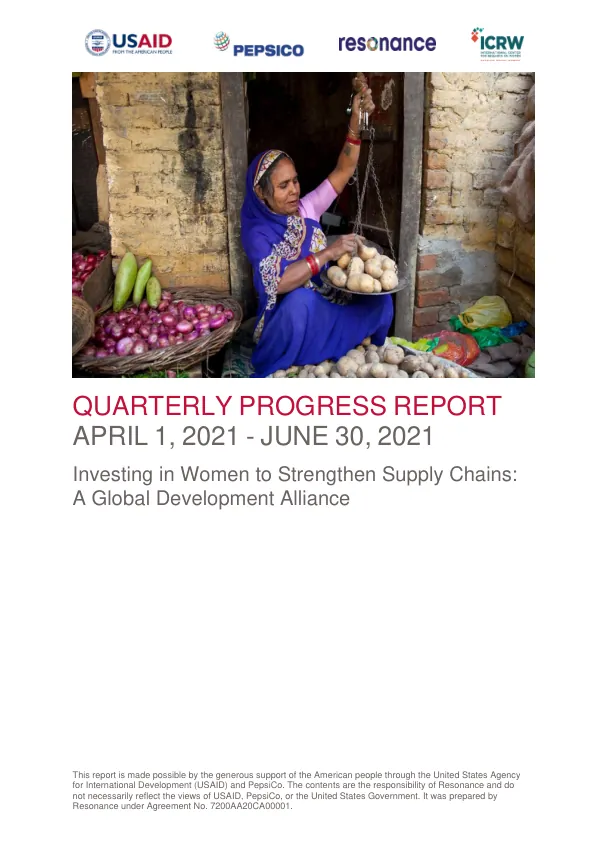
Investing in Women to Strengthen Supply Chains: Quarterly Progress Report (April-June 2021)
Sign inRESONANCE
Investing in Women to Strengthen Supply Chains: Quarterly Progress Report (April-June 2021)
Investing in Women to Strengthen Supply Chains is a global partnership between USAID and PepsiCo to make the business case for women's economic empowerment (WEE) in agricultural supply chains.
2021 · 31 pages
Sign in to readA free account is required to download.
Abstract
The partnership aims to ensure that women – as farmers or workers – benefit from being directly or indirectly involved within PepsiCo's supply chains while also being empowered within their households and communities. Focus countries for the partnership include Colombia, India, Pakistan, and Vietnam. The partnership will work together across four programmatic pillars. Pillar 1 focuses on capitalizing on PepsiCo's Demonstration Farms to Showcase Innovative Ways to Empower and Support Women in Agricultural Supply Chains. Pillar 2 invests in Women's Empowerment Solutions in Agriculture, providing grants to bolster the work women-led farmer groups, women-led businesses, and other supply chain actors are pursuing to strengthen women's economic opportunities. Pillar 3 influences the industry by using evidence and lessons learned from the activity to make the case for scaling investments in women to PepsiCo peer companies sourcing from or working in rural communities. Pillar 4 scales WEE within PepsiCo Business Units, leveraging the evidence-based business case for WEE to inform and reinforce PepsiCo's commitment and investments. Supply Chain and Gender Assessments (SCGAs) are being conducted in each of the partnership countries. In Colombia, Resonance is partnering with the local consulting firm, Fedesarrollo, to complete the SCGA. Fedesarrollo completed field interviews with PepsiCo farmers, agricultural experts, USAID Mission staff, agricultural input suppliers, and gender experts. The assessment team in Colombia has interviewed 7 key informants, 6 in-depth interviewees, and conducted 3 focus group discussions with women lead farmers, women on-farm workers, and women household members. Women's roles on PepsiCo potato and plantain farms in Colombia are being assessed. Due to the high volume of plantain and potatoes required by PepsiCo, the company sources mostly from large farms. Few lead farmers in PepsiCo's supply chain are individual women, with women lead farmers making up only 10.26% of large potato farms and 14.28% of large plantain farms. Those women who do own large farms are typically less involved in day-to-day management than men lead farmers. The partnership will need to design activities differently from the West Bengal pilot project, which focused on women smallholder lead farmers, given the low number of women who are lead farmers in Colombia. In India, the SCGA is being conducted by Resonance in partnership with the International Center for Research on Women (ICRW). The assessment team has started to mobilize or completed interviews. In Pakistan, the SCGA is being conducted by Resonance in partnership with the International Center for Tropical Agriculture (CIAT). The assessment team has started to mobilize or completed interviews. In Vietnam, the SCGA is being conducted by Resonance in partnership with the International Center for Research on Women (ICRW). The assessment team has started to mobilize or completed interviews. The partnership will use evidence and lessons learned from the activity to make the case for scaling investments in women to PepsiCo peer companies sourcing from or working in rural communities. The partnership will also leverage the evidence-based business case for WEE to inform and reinforce PepsiCo's commitment and investments.