MERCY CORPS INTERNATIONAL
Quarterly Progress Report: Food Security for Flood-affected Populations in Odisha
The "Food Security for Flood-affected Populations in Odisha" program, implemented by Mercy Corps in partnership with Adhikar, aims to provide cash assistance to 3,500 poor and vulnerable households in Odisha, India.
2015 · 20 pages
Sign in to readA free account is required to download.
Abstract
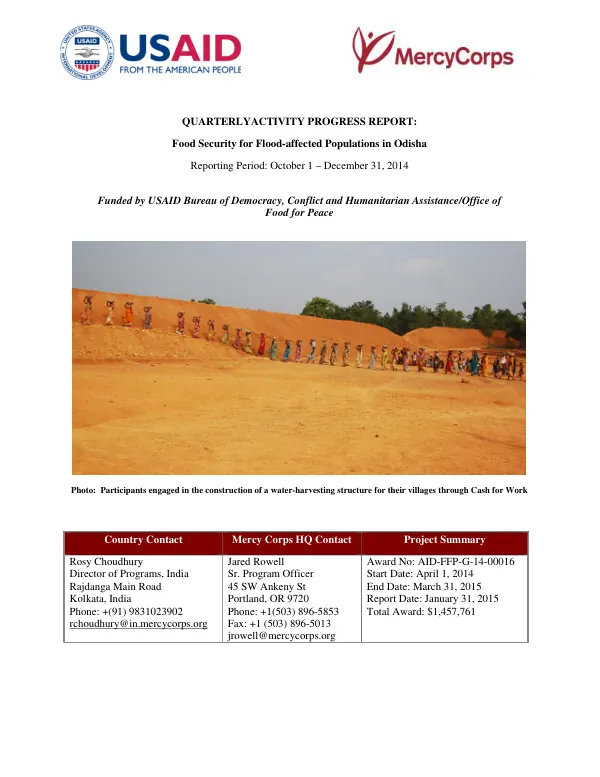
The program is funded by USAID's Bureau of Democracy, Conflict and Humanitarian Assistance/Office of Food for Peace. The goal is to improve food security for 17,500 people in flood-affected villages of Mayurbhanj and Balasore districts. The program employs two strategies for cash transfers: Cash for Work (CfW) and unconditional cash transfers (UCT). During the reporting period of October 1 – December 31, 2014, 3,330 households participated in CfW, receiving cash payments for their labor. An additional 300 most vulnerable households received unconditional cash to purchase food items. The Food Consumption Score (FCS) survey was completed in November 2014 to understand the communities' utilization of cash and food intake. Implementation of the program continued during the quarter, with a focus on providing CfW opportunities to participating beneficiaries to improve their household food security. Community consultations were conducted to identify and agree on CfW sites and community infrastructures to be built or rehabilitated. Structural plans for community assets were prepared with the help of technical consultants, and household members engaged in CfW activities. Support services were provided at work sites to create a welcoming atmosphere for beneficiaries, especially women. The program's cash transfer strategy has shown significant improvements in household food consumption. The Food Consumption Survey and Nutrition Survey Reports found that cereals are still a staple, but there was an increase in the diversity of food groups consumed. The average consumption of pulses increased by 45%, and vegetable consumption increased by 42.82%. Animal protein consumption increased by 41%, and edible fats and oil consumption increased by 44%. Sugar consumption increased by 25%. The program's implementation has been successful in providing cash assistance to flood-affected households, improving their food security and livelihood opportunities. The staggered approach to CfW activities has helped spread the support over a longer period of time, enabling communities to build resilience and recover from flood damages. The program's goal of improving food security for 17,500 people in flood-affected villages of Mayurbhanj and Balasore districts is on track to be achieved. The program's progress against objectives is as follows: 3,330 households participated in CfW, exceeding the initial target of 3,200 households. The program also exceeded the target of 60 projects for ER 1.1.2, with 94 smaller infrastructure plans prepared. The average household participation in CfW activities was approximately 20 days, with each household receiving INR 3,300 (USD55) per month. This amount covers a large percentage of the food demands for a typical household during the month. The program's monitoring and evaluation activities have shown positive results, with significant improvements in household food consumption and diversity. The Food Consumption Survey and Nutrition Survey Reports provide valuable insights into the impact of cash transfers on household food consumption and food diversity. The program's success in improving food security for flood-affected households is a testament to the effectiveness of the cash transfer strategy and the importance of community-led initiatives in disaster response and recovery.