USAID DEC
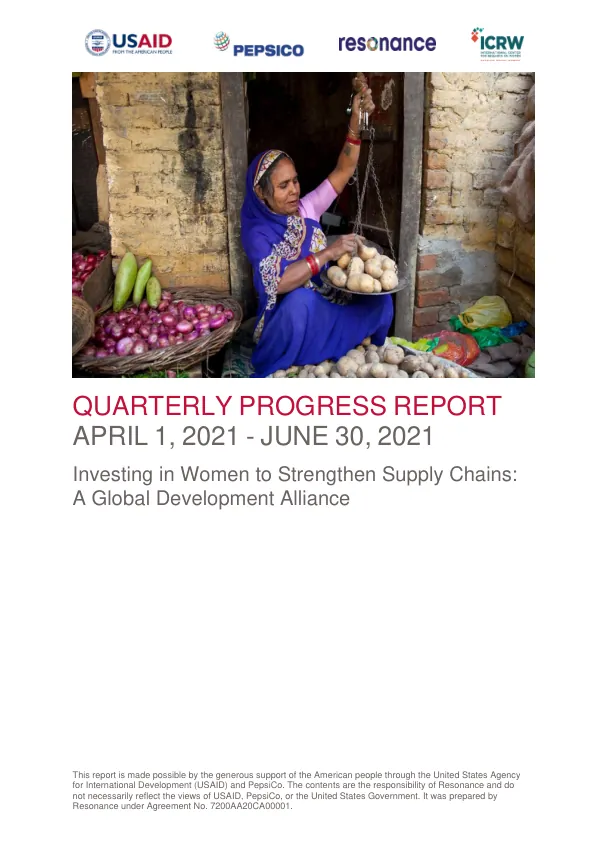
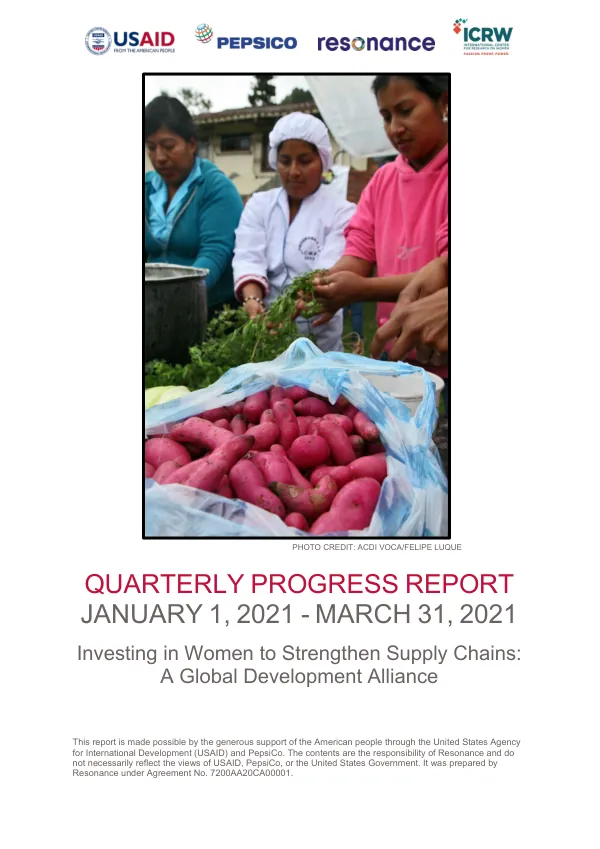
Quarterly Progress Report (January 1- March 31, 2021) Investing in Women to Strengthen Supply Chains
Sign inRESONANCE
Quarterly Progress Report (January 1- March 31, 2021) Investing in Women to Strengthen Supply Chains
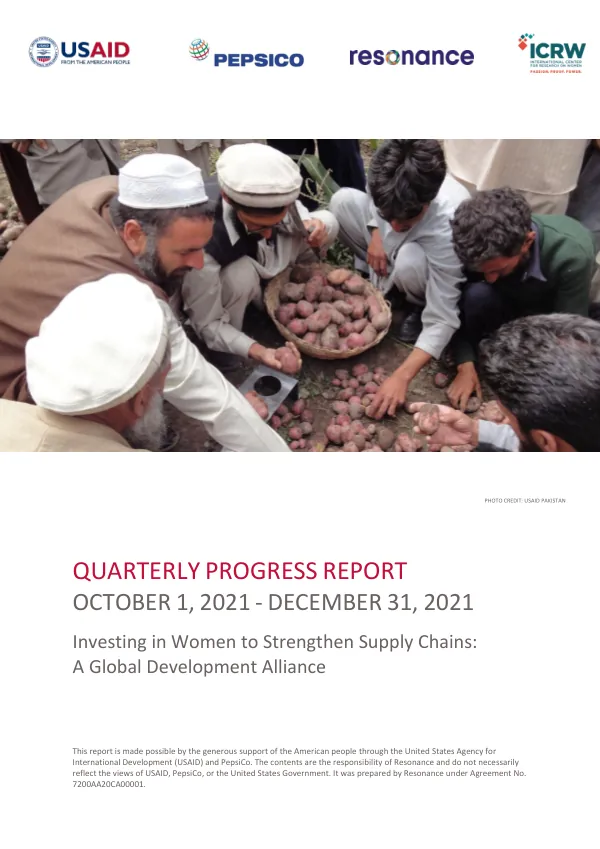
Investing in Women to Strengthen Supply Chains is a global partnership between USAID and PepsiCo to make the business case for women's economic empowerment (WEE) in agricultural supply chains.
2021 · 21 pages
Sign in to readA free account is required to download.
Abstract
The partnership aims to strengthen women's agricultural skills and access to resources within PepsiCo's supply chains to demonstrate the value of women's contributions to core business and impact goals. The partnership will work together across four programmatic pillars: Capitalize on PepsiCo's Demonstration Farms to Showcase Innovative Ways to Empower and Support Women in Agricultural Supply Chains, Invest in Women's Empowerment Solutions in Agriculture, Influence the Industry, and Scale WEE within PepsiCo Business Units. The partnership is conducting four Supply Chain and Gender Assessments (SCGAs) in each of the partnership countries, including Colombia, India, Pakistan, and Vietnam. The SCGAs aim to paint an accurate picture of supply chain actors and activities, including the contributions, recognition, and rewards for women and men participating in the supply chain. An interim SCGA deliverable will be a gender-sensitive supply chain map, which will be developed for the Pakistan context in the upcoming quarter. Initial findings from the SCGAs have highlighted the complexities and nuances within PepsiCo's potato procurement models in each country. The current datasets have gaps, and PepsiCo manages different supply chain schemes across countries. For example, some markets rely on large aggregators, while others rely on farmer associations. The SCGAs have also found that PepsiCo supply chain characteristics vary significantly from market to market, along with farmer needs, and best-suited strategies to address them. One area of potential opportunity involves more active engagement of temporary contract farm workers, both female and male, to ensure access to trainings in Sustainable Farming Program (SFP) practices. However, farm owners may not know or interact with the women and men who cultivate their land, and there may be few incentives for management to invest in the skills upgrading necessary for temporary workers to access advancement and/or permanent jobs. The effectiveness of PepsiCo training uptake and adherence varies among farms and farm workers, and it may be difficult to measure the effects of training and farm-level outcomes. The partnership will leverage the evidence-based business case for WEE to inform and reinforce PepsiCo's commitment and investments. PepsiCo will apply lessons learned from the partnership to focus its investments on the highest impact approaches for empowering women. The partnership will also use evidence and lessons learned from the activity to make the case for scaling investments in women to PepsiCo peer companies sourcing from or working in rural communities. Country updates for the quarter include: * Colombia: The SCGA progress to date in Colombia is included in the Country Updates section below. * India: The SCGA progress to date in India is included in the Country Updates section below. * Pakistan: The SCGA progress to date in Pakistan is included in the Country Updates section below. * Vietnam: The SCGA progress to date in Vietnam is included in the Country Updates section below. The partnership will continue to work together to strengthen women's agricultural skills and access to resources within PepsiCo's supply chains, and to make the business case for women's economic empowerment in agricultural supply chains.