JHPIEGO
Quarterly Progress Report for MCSP in Zambia
The MCSP project in Zambia began its implementation in 2017 with a focus on improving maternal and child health.
2017 · 3 pages
Sign in to readA free account is required to download.
Abstract
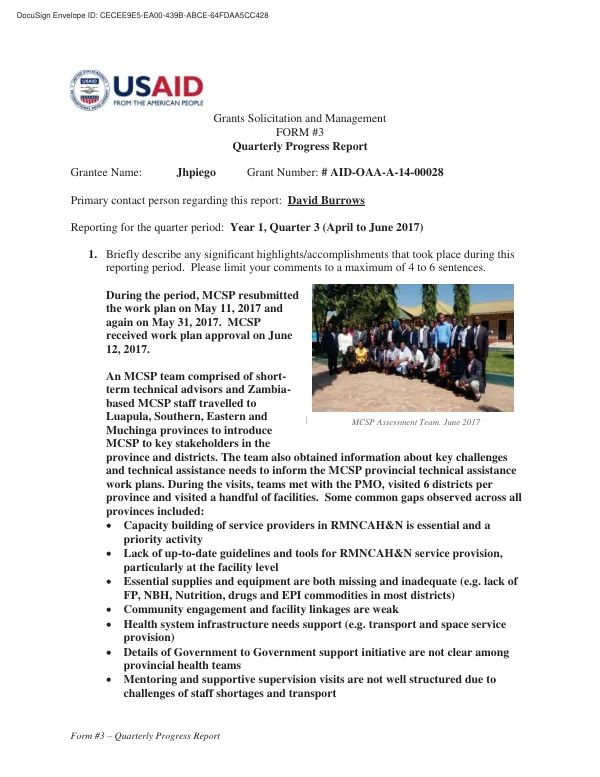
Initial assessments conducted in Luapula, Southern, Eastern, and Muchinga provinces identified key challenges and technical assistance needs to inform the project's provincial technical assistance work plans. Capacity building of service providers in reproductive, maternal, newborn, child, and adolescent health and nutrition (RMNCAH&N) was identified as a priority activity. Implementation of the project involved introducing MCSP to key stakeholders in the provinces and districts, as well as conducting gap identifications to inform activity planning. A team of technical advisors and Zambia-based MCSP staff traveled to the provinces to meet with the Provincial Medical Office, visit districts, and facilities. Common gaps observed across all provinces included capacity building of service providers, lack of up-to-date guidelines and tools for RMNCAH&N service provision, and inadequate essential supplies and equipment. The project team also identified challenges related to community engagement and facility linkages, health system infrastructure, and mentoring and supportive supervision visits. To address these gaps, the project will develop a monitoring plan for family planning regulations, a comprehensive activity plan, and a project management plan. The project is currently consistent with the agreed-to work plan, with a focus on resubmission of the annual work plan, recruitment, and introduction of MCSP to key stakeholders. The project team has not observed any concerns related to USAID family planning and commodity regulations. However, the project is anticipating the printing of guidelines for RMNCAH, which will require the application of the USAID logo/brandmark. The project's indicators will be developed during the workplan development workshop in August 2017. As of the end of the quarter, the project's actual cumulative expenditures were $525,714, which is below the expected estimated budgeted cumulative expenditures of $2,781,250. The project expects to increase spending in the next quarter as staff are hired, procurements are completed, and partner invoicing is stabilized.