USAID DEC
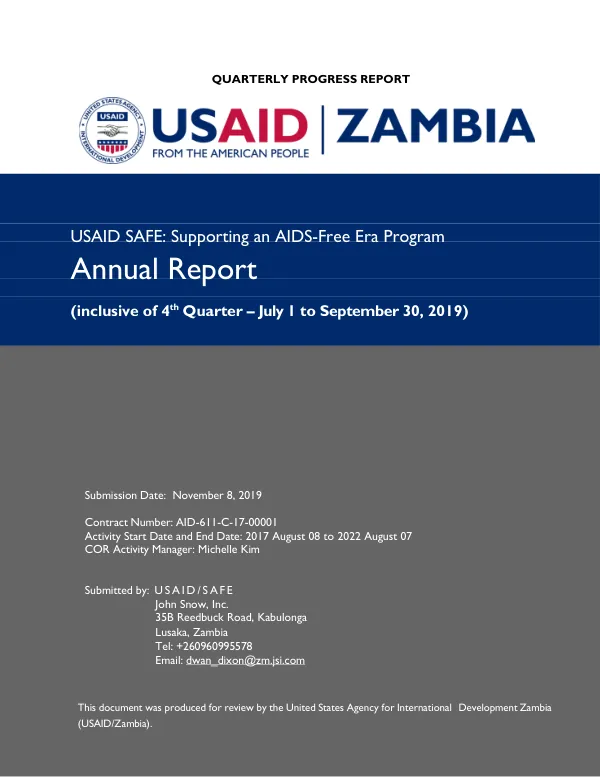
Quarterly Progress Report: USAID SAFE Supporting an AIDS-Free Era Program Annual Report (inclusive of 4th Quarter – July 1 to September 30, 2019)
Sign inABT ASSOCIATES
Quarterly Progress Report: USAID SAFE Supporting an AIDS-Free Era Program Annual Report (inclusive of 4th Quarter – July 1 to September 30, 2019)
The USAID SAFE program is a five-year initiative aimed at reducing HIV mortality, morbidity, and transmission in Zambia.
2019 · 69 pages
Sign in to readA free account is required to download.
Abstract
The program operates in three provinces: Central, Copperbelt, and North-Western, and is implemented by John Snow, Inc. (JSI) in partnership with Abt Associates, Inc., mothers2mothers (m2m), and the Catholic Medical Mission Board. The program works with the Government of the Republic of Zambia (GRZ), private-sector actors, and civil society institutions at various levels to increase access to antiretroviral therapy (ART) for HIV-positive adults and children, reduce new infections, and improve nutritional assessment, counseling, and support (NACS) and family planning services. The program is organized around nine clearly defined objectives, each of which must be fully completed to contribute to the program's overall success. These objectives include ensuring that 95 percent of HIV-positive individuals know their HIV status, initiating 95 percent of those who tested positive on ART, and ensuring that 95 percent of those on ART are virally suppressed. The program also aims to strengthen the health system to support the 95/95/95 objectives, provide voluntary medical male circumcision (VMMC) to priority populations to avert new infections, and integrate voluntary family planning (FP) services into 95 percent of HIV service delivery locations. As of the end of the reporting period, the program has achieved significant results in various areas. In public facilities, 244, private facilities 28, and labs 87, the program has tested 1,029,070 individuals for HIV, with a positivity yield of 6.7 percent. The program has also achieved a cumulative achievement of 68,646 individuals who were tested and received their positive results. Additionally, the program has reached 97 percent of pregnant women who know their HIV status, and 97 percent of those who test positive are put on treatment. The program has also made progress in strengthening the health system to support the 95/95/95 objectives. The program has strengthened monitoring and evaluation (M&E) systems for improved program management, and has built the capacity of local health institutions to serve HIV-affected populations. Furthermore, the program has strengthened public financial management systems of the Ministry of Health (MOH) and Ministry of Finance (MOF) to enable efficient use of direct government-to-government (G2G) funds from USAID. The program has also implemented various strategies to meet the annual targets, including specific achievement strategies for each indicator. The program has also conducted quality assurance and quality improvement activities to ensure that the services provided are of high quality. Overall, the program has made significant progress in reducing HIV mortality, morbidity, and transmission in Zambia, and is on track to meet its annual targets. The program has also implemented various interventions to improve the health outcomes of HIV-positive individuals. These interventions include providing antiretroviral therapy (ART) to HIV-positive individuals, providing nutritional assessment, counseling, and support (NACS) to HIV-positive individuals, and providing family planning services to HIV-positive individuals. The program has also implemented various strategies to improve the health outcomes of HIV-positive individuals, including providing technical assistance to health facilities, providing training to healthcare workers, and providing support to community-based organizations. The program has also made significant progress in reducing new infections among HIV-negative individuals. The program has implemented various interventions to reduce new infections, including providing voluntary medical male circumcision (VMMC) to priority populations, providing HIV testing and counseling services to HIV-negative individuals, and providing family planning services to HIV-negative individuals. The program has also implemented various strategies to reduce new infections, including providing technical assistance to health facilities, providing training to healthcare workers, and providing support to community-based organizations. Overall, the USAID SAFE program has made significant progress in reducing HIV mortality, morbidity, and transmission in Zambia, and is on track to meet its annual targets. The program has implemented various interventions to improve the health outcomes of HIV-positive individuals, reduce new infections among HIV-negative individuals, and strengthen the health system to support the 95/95/95 objectives.