TETRA TECH ARD, INC.
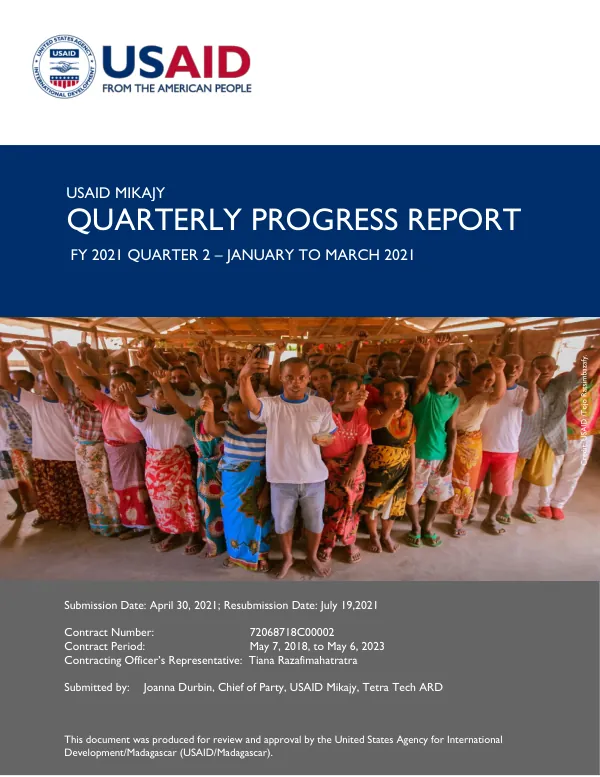
Quarterly Progress Report FY 2021 Quarter 2 – January to March 2021
The USAID Mikajy project in Madagascar aims to improve protected area and natural resource management.
2021 · 70 pages
Sign in to readA free account is required to download.
Abstract
The project's target actors have improved capacity for natural resource management and protected area management to support conservation. This is evident in the implementation of the Management Effectiveness Tracking Tool, update of protected areas management and business plans, and evaluation and update of management transfer contracts. The project also focuses on improving coordination and engagement among target actors. Coordination mechanisms for co-management, ecological monitoring systems, active and passive restoration, community patrols, and joint patrols are some of the key initiatives. These efforts aim to enhance the effectiveness of protected area management and natural resource conservation. Furthermore, the project seeks to provide information for decision-making and better use of natural resource management. Meetings of protected area managers and other actors, mobile platforms, and other initiatives aim to facilitate the sharing of information and best practices among stakeholders. The project also supports community-based, conservation-friendly enterprises and livelihoods. Private sector engagement, sustainable value chains, and community skills and resources are some of the key areas of focus. The project aims to increase conservation-friendly private sector investment in target landscapes and improve income for target communities. In addition, the project synergizes with other development programs to enhance conservation efforts. Stakeholders adopt an integrated approach to conservation, and synergies between USAID Mikajy and USAID Health Programs are established. The project also disseminates climate change information and supports natural disaster management committees. The project operationalizes decentralized natural resource management in target lands. Target actors have improved capacity for natural resource management and protected area management to support conservation. Missions and roles of territorial defense of natural heritage (DTPN) structures, capacity building plans for DTPN structures, and access rights to land and resources are some of the key initiatives. Finally, the project strengthens community, CSO, private sector, and government capacity in targeted landscapes to defend and engage in better management of community lands and natural resources. Awareness campaigns on rights and responsibilities, knowledge, attitudes, and practices (KAP) studies, and trainings on land and resource rights are some of the key initiatives. Improved accountability of the judicial system and community structures is also a key area of focus.