CENTER FOR EDUCATIONAL DEVELOPMENT
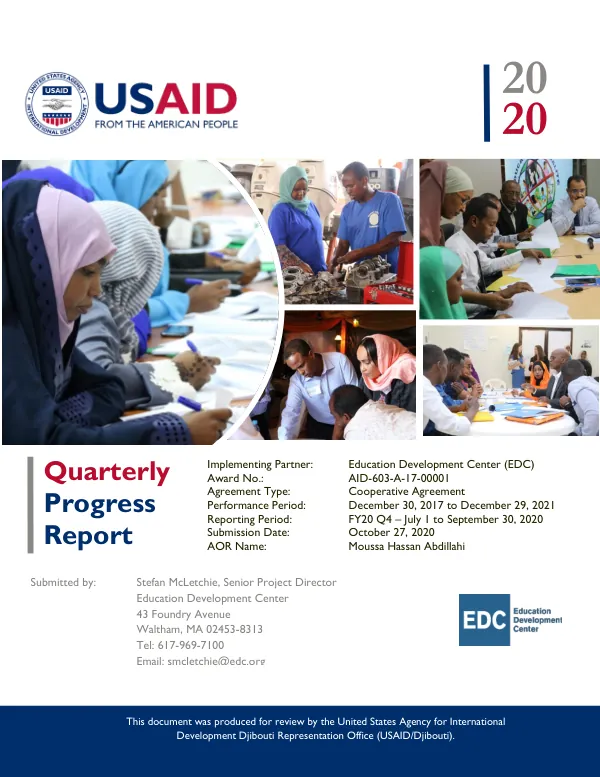
Quarterly Progress Report – FY20 Q4
The Djibouti Workforce Development Program (WFD) aims to improve workforce readiness and competitiveness in Djibouti based on market needs.
2020 · 44 pages
Sign in to readA free account is required to download.
Abstract
With an unemployment rate hovering between 45-50 percent, and a youth unemployment rate close to 60 percent, Djibouti faces a daunting challenge in its economic and social development. The program is a five-year project, executed by the Education Development Center, a U.S.-based, global nonprofit that promotes lasting solutions to improve education, health, and economic opportunity. The program works with the Ministry of National Education and Technical Training (MENFOP) to improve teacher technical skills and align technical curricula with sector needs. It also collaborates with the National Employment Agency (ANEFIP) to enhance job intermediary services for job-seekers and employers, as well as collect and analyze employment statistics. Additionally, the program supports port logistics and technical trainings and entrepreneurship for small and medium-sized enterprises. This quarter, the program continued to face restrictions related to the COVID-19 pandemic. However, it relaunched in-person activities at a 50% capacity to ensure physical distancing and respect COVID measures. Highlights of the quarter include: 15 teachers were trained for the roll-out of the new Employability and Entrepreneurship Program in the Commercial Bac Pro. 11 teachers were trained on the Sage Saari software. The program received confirmation from MENFOP Secretary General for a six-month contract with an expert on international norms in support of TVET revision. 49 participants completed employability and port technical trainings through the Centre de Competence et Ressources des Metiers Portuaires. 95 participants completed English training groups. 26 ANEFIP personnel participated in a Training on the Work Now training program. 203 participants completed WRN/Work-Based Learning training, co-facilitated by ANEFIP and WFD trainers. The program also updated the Financial Sector Djibouti Job Opportunities and Labor Turnover Survey with 21 sector businesses. It supported the improvement of ANEFIP's Annuaire Statistique. The program negotiated public-private partnerships between ANEFIP and 16 sector businesses. 198 participants conducted Work-Based Learning activities. 22 participants completed entrepreneurship training. 5 finalists continued entrepreneurship coaching and mentoring. The program also strengthened job placement, advancement, and placement services. It held working sessions to elaborate ANEFIP's Service Pathways for job-seekers and employers. 99 job-seekers and 7 employers participated in the testing of the ANEFIP Job-Matching Platform. The program procured equipment and furniture for ANEFOUTI's new building in support of the Job-Matching Platform. The program's quarterly progress report highlights the challenges and constraints faced by the program. It also outlines the management structure, including project staffing, sub-contracts, and monitoring and evaluation activities. The report also includes annexes, including the Performance Indicator Tracking (PITT) and success stories.
Related documents