ACDI/VOCA
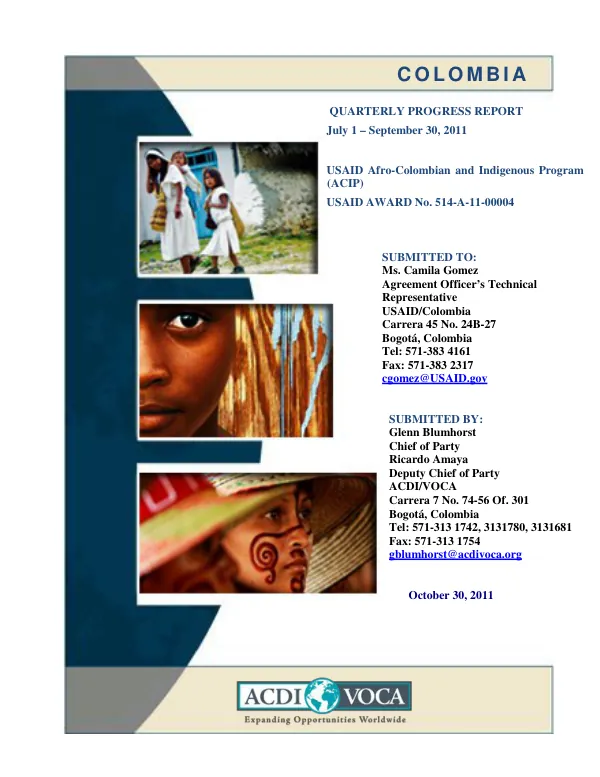
Quarterly Progress Report: July 1 – September 30, 2011
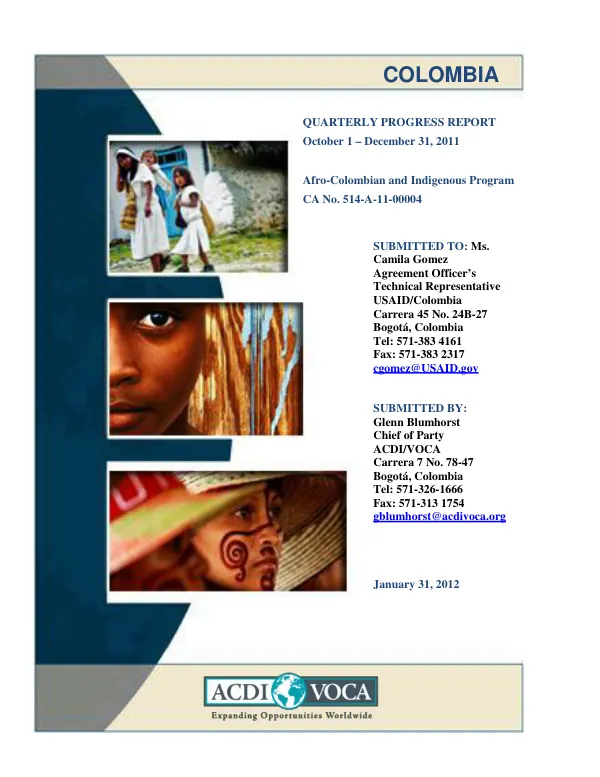
The USAID Afro-Colombian and Indigenous Program (ACIP) is a five-year initiative aimed at improving the socio-economic status of Afro-Colombians and indigenous persons in target areas of Colombia.
2011 · 8 pages
Sign in to readA free account is required to download.
Abstract
The program, valued at $61 million, is designed to achieve several objectives, including the implementation of existing and supportive policies related to ethnic minorities, increased formal sector employment of ethnic minorities, improved governance in indigenous communities, and increased respect for cultural diversity and identity. The program's quarterly progress report for July-September 2011 highlights several key activities and milestones achieved during this period. One of the notable events was the post-award conference held at the US Embassy in Bogota on September 12, where USAID and ACDI/VOCA reviewed the award and discussed program implementation. Following the conference, ACIP's management team focused on elaborating the Year One Annual Work Plan, which was submitted to USAID on October 12, 2011. The report also highlights the establishment of a series of technical review and planning sessions with relevant USAID/Colombia Assistance Objective (AO) teams, as well as orientation and planning sessions with key ACIP stakeholders, including government of Colombia and Afro-Colombian and indigenous organization representatives. Additionally, ACDI/VOCA commenced development of the ACIP Performance Monitoring and Evaluation Plan (PMEP), which was to be presented to USAID on November 12, 2011. The report also discusses the formulation and design of the work plan and project activities, focusing on three key areas: USAID technical areas, Government of Colombia institutional technical areas, and the formulation of the Year One Annual Work Plan. In the USAID technical areas, the report highlights the main aspects of the new mission-funded environmental program, BIO-REDD+, and potential areas of program interfacing with ACIP's rural target areas. In the Government of Colombia institutional technical areas, the report identifies several priorities, including support for the legislative agenda, follow-up of the Plan de Desarrollo, and assistance in the purging of indicators of GOC institutions. The report also highlights the importance of coordination and collaboration with other programs and stakeholders, including the Ministry of the Interior, the Dirección para Afrocolombianos e Indígenas, and the Programa Presidencial para Comunidades Indígenas. The report concludes by noting that the ACIP team is committed to working closely with these stakeholders to achieve the program's objectives and improve the lives of Afro-Colombians and indigenous persons in Colombia. The program's geographic focus is on target areas of Colombia, including Bogota, Medellin, Cali, Quibdó, the San Andres archipelago, and a Caribbean Coast cluster composed of Barranquilla, Santa Marta, and Cartagena. The program's timeframes are from August 30, 2011, to August 28, 2016, with quarterly progress reports submitted to USAID. Overall, the USAID Afro-Colombian and Indigenous Program is a significant initiative aimed at improving the socio-economic status of Afro-Colombians and indigenous persons in Colombia. The program's quarterly progress report highlights several key activities and milestones achieved during the July-September 2011 period, and demonstrates the program's commitment to coordination and collaboration with other stakeholders to achieve its objectives.
Related documents