ACDI/VOCA
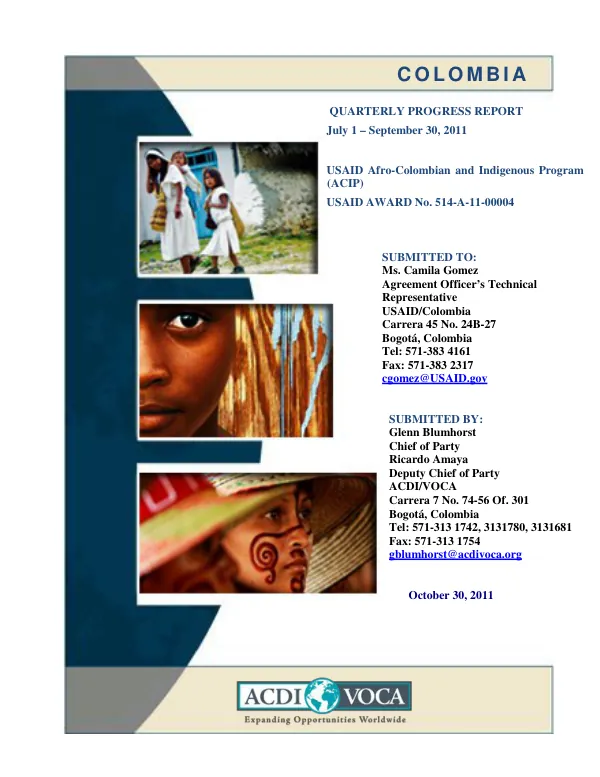
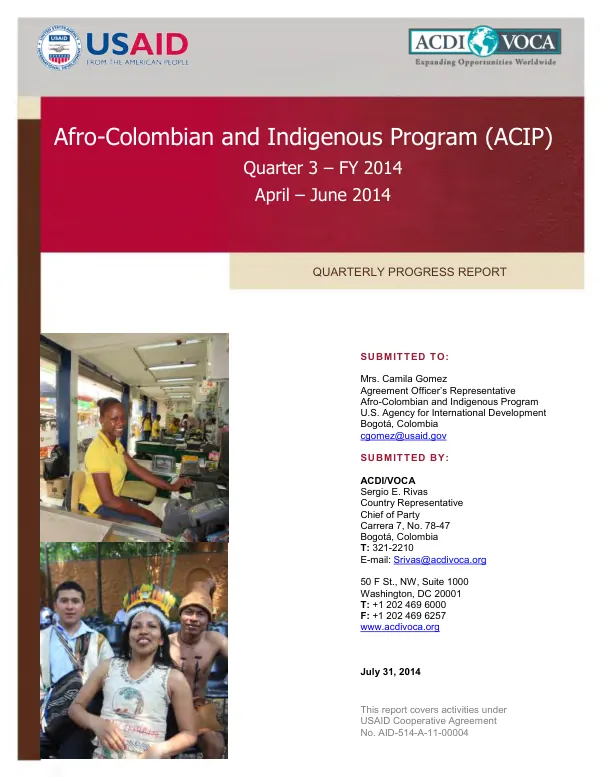
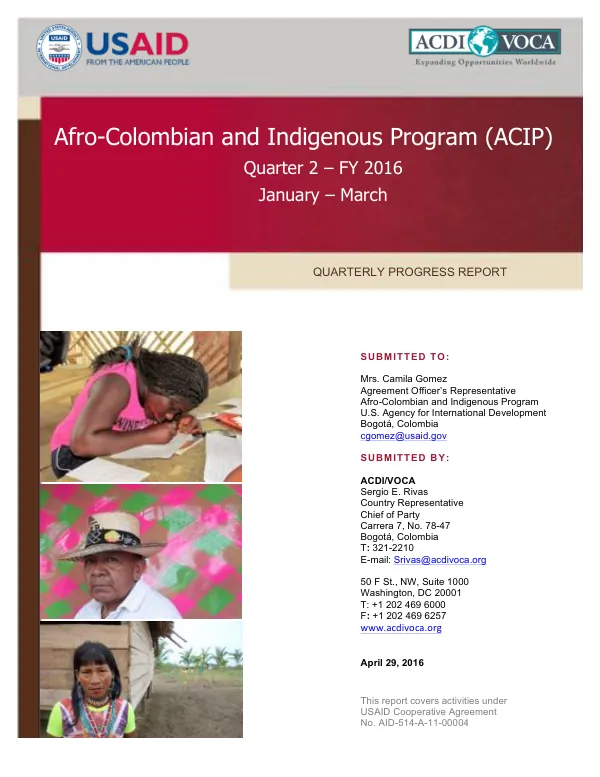
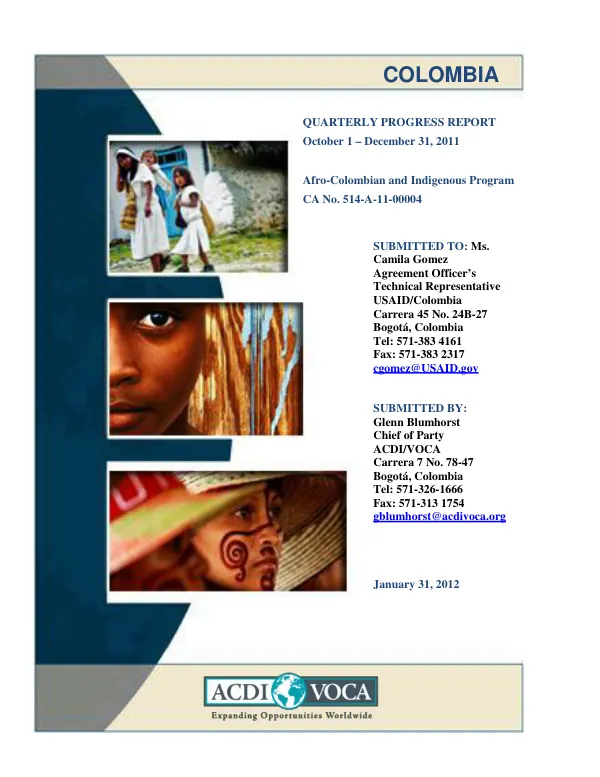
Quarterly Progress Report: Afro-Colombian and Indigenous Program
The Afro-Colombian and Indigenous Program in Colombia began on August 30, 2011, with a five-year life of project (LOP) from August 30, 2011, through August 28, 2016.
2011 · 11 pages
Sign in to readA free account is required to download.
Abstract
The program, funded by the United States Agency for International Development (USAID) with a budget of $61.4 million, aims to improve the socioeconomic status of Afro-Colombian and indigenous persons in target areas of Colombia. The program's purpose is to implement existing and supportive policies related to ethnic minorities, increase formal sector employment of ethnic minorities, improve governance in indigenous communities, and increase respect for cultural diversity and identity. The program's geographic focus includes Bogota, Medellin, Cali, Quibdó, the San Andres archipelago, and a Caribbean Coast cluster composed of Barranquilla, Santa Marta, and Cartagena. During the first quarter of the 2012 fiscal year, encompassing activities carried out from October 1 to December 31, 2011, the program's management team completed the Year One Annual Work Plan through a consultative process with key program stakeholders. The Work Plan was submitted to USAID for approval on October 15 and a second iteration on November 15. The program's Performance Monitoring and Evaluation Plan (PMEP) was also submitted to USAID on November 15. The program's start-up action plan, staffing plan, and procurement plan were completed, and program offices were established in Bogota, Quibdo, and Cali. ACDI/VOCA issued a special Request for Proposals (RFP) and a subaward was made to Maximizar Grupo Consultor to provide technical assistance in strategic planning to four directorates in the Viceministerio de la Participación e Igualdad de Derechos and one directorate in the Viceministerio de Relaciones Políticas of the Ministry of the Interior. The program's Component One Manager, Martha Chaverra, participated in the World Summit of Mayors Leadership Conference held in Dakar, Senegal, from December 16-19, to support Colombia's hosting of the conference in 2013. A two-month extension to the existing Letter of Authorization was negotiated and executed by ACDI/VOCA with Tetra Tech ARD, and a sub-agreement for the LOP is currently being negotiated. Through a Letter of Authorization, CONSUCOL initiated advisory activities and technical assistance to 23 new municipal governments of Cauca and Chocó to include the needs of Afro-Colombian and indigenous communities. The program's Component One team held several meetings with various organizations and provided guidance and support in helping the organizations to improve dialogues among each other and with governmental institutions. The program's technical team continued to coordinate with national Afro-Colombian and indigenous organizations to further define and plan the areas that ACIP will support. Potential initiatives were formulated and are currently under review by Program management, including support to improve operational capacities in order to enhance political participation for Asociación Nacional de Afrocolombianos Desplazados (AFRODES) and provide organizational strengthening for Proceso de Comunidades Negras de Colombia (PCN). The program's Component Two focused on increasing employment of Afro-Colombians and indigenous persons in targeted sectors in select urban areas. The Component Three aimed to improve governance in ethnic territories, while the Component Four sought to increase respect for cultural diversity and identity. The program's geographic focus included Bogota, Medellin, Cali, Quibdó, the San Andres archipelago, and a Caribbean Coast cluster composed of Barranquilla, Santa Marta, and Cartagena. The program's management team conducted a consultative exercise to specify the geographic focus for Year One, with priority given to working with local municipal and departmental governments elected on October 30, 2011. The program's Component One Manager, Martha Chaverra, participated in the World Summit of Mayors Leadership Conference held in Dakar, Senegal, from December 16-19, to support Colombia's hosting of the conference in 2013. The program's Component Two Manager, Maria Rodriguez, worked with local organizations to develop a strategy for increasing employment of Afro-Colombians and indigenous persons in targeted sectors. The Component Three Manager, Juan Sanchez, coordinated with national and local governments to improve governance in ethnic territories. The Component Four Manager, Ana Gomez, worked with local organizations to increase respect for cultural diversity and identity. The program's management team conducted a series of awareness and planning sessions with key stakeholders, including GOC and Afro-Colombian and indigenous organization representatives. The program's Component One team held several meetings with various organizations and provided guidance and support in helping the organizations to improve dialogues among each other and with governmental institutions. The program's technical team continued to coordinate with national Afro-Colombian and indigenous organizations to further define and plan the areas that ACIP will support. Potential initiatives were formulated and are currently under review