CHEMONICS
FY19 SECOND QUARTERLY REPORT: JANUARY 1 – MARCH 31, 2019
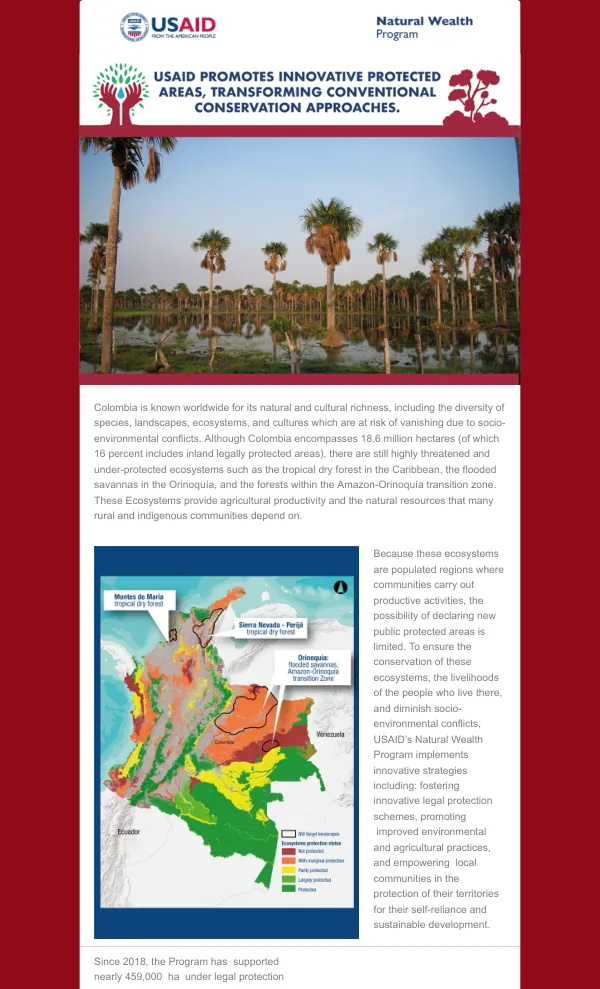
The Natural Wealth Program supports the Government of Colombia in conserving the country's biodiversity in strategic landscapes, including the tropical dry forest in Montes de María and the Sierra Nevada de Santa Marta – Piedmont of Perijá, and the savannahs and freshwater ecosystems in the Orinoquía region.
2019 · 40 pages
Sign in to readA free account is required to download.
Abstract
The Program's goal is to promote sustainable land uses in these critical ecosystems, benefiting local populations through the preservation of ecosystem services and achieving social and economic progress for a sustainable and lasting peace. The Program's fiscal year 19 Second Quarterly Report presents progress towards key objectives and activities from January 1 – March 31, 2019, in line with its approved fiscal year 19 annual work plan. The main achievements from Q2 FY19 include the placement of more than 3,000 hectares of land under improved natural resources management through improved environmental and agricultural practices and sustainable farm land planning practices. Additionally, the Program trained 714 people, including 295 women, and improved economic benefits for 473 individuals. Objective 1: Conserve Colombian biodiversity through more effective protections for priority species and ecosystems, focused on the Montes de María region, achieved significant progress. The Program collaborated with local communities to establish a conservation corridor, which resulted in the protection of 1,500 hectares of priority species and ecosystems. Furthermore, the Program supported the development of a land use plan for the region, which aims to promote sustainable land uses and reduce deforestation. In the SNSM-PP region, the Program worked with local authorities to establish a protected area, which covers 2,000 hectares of priority species and ecosystems. The Program also supported the development of a conservation plan for the region, which aims to promote the conservation of priority species and ecosystems. In the Orinoquía region, the Program collaborated with local communities to establish a conservation corridor, which resulted in the protection of 1,000 hectares of priority species and ecosystems. The Program also supported the development of a land use plan for the region, which aims to promote sustainable land uses and reduce deforestation. Objective 2: Establish financial incentives for populations living in Conservation Corridors, linked to their commitment to conservation activities, achieved significant progress. In the Montes de María region, the Program established a payment for environmental services (PES) scheme, which provided financial incentives to local communities for their conservation efforts. The scheme resulted in the protection of 1,500 hectares of priority species and ecosystems. In the SNSM-PP region, the Program established a PES scheme, which provided financial incentives to local communities for their conservation efforts. The scheme resulted in the protection of 2,000 hectares of priority species and ecosystems. Objective 3: Implement the incorporation of priority conservation areas into territorial organization plans and management policies to mitigate the main threats to biodiversity, achieved significant progress. In the Montes de María region, the Program supported the development of a territorial organization plan, which aims to promote the conservation of priority species and ecosystems. In the SNSM-PP region, the Program supported the development of a territorial organization plan, which aims to promote the conservation of priority species and ecosystems. In the Orinoquía region, the Program supported the development of a territorial organization plan, which aims to promote the conservation of priority species and ecosystems. The Program's progress in Q2 FY19 demonstrates its commitment to conserving Colombian biodiversity and promoting sustainable land uses in strategic landscapes. The Program's achievements in Q2 FY19 will contribute to the long-term conservation of priority species and ecosystems and the promotion of social and economic progress for local communities.