THE AMREF HEALTH AFRICA
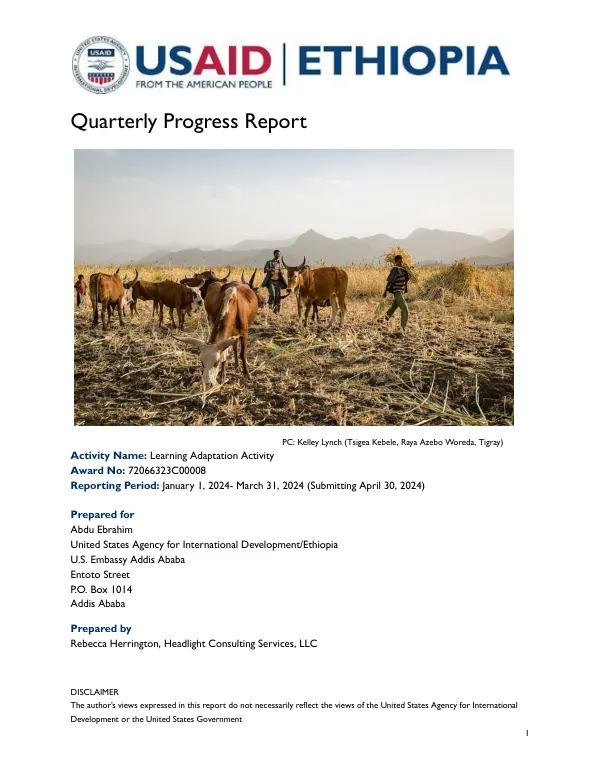
Quarterly Progress Report: Learning Adaptation Activity FY24 Q2 (Jan-March)
The Learning Adaptation Activity, implemented and managed by Headlight Consulting Services, LLC, is a five-year contract from April 3, 2023, to April 2, 2028.
2024 · 12 pages
Sign in to readA free account is required to download.
Abstract
The activity provides systematic collaboration, learning, and adaptation (CLA) services, Developmental Evaluation (DE) supports, and systems-based design services to the USAID/Ethiopia and USAID/Djibouti missions. The Learning Adaptation Activity is part of the USAID Learning Project, which aims to drive program results through innovative approaches to CLA. During the reporting period of January 1, 2024, to March 31, 2024, the Learning Adaptation Activity made significant progress in supporting the Country Development Coordination Strategy (CDCS) development process. The CDCS Catalyst Working Group Retreat was held from January 23 to January 26, 2024, where Catalysts selected by the Mission's Office Directors came together to brainstorm, identify long-term aspirations for Ethiopia, and prioritize problems. Learning Adaptation supported the development and facilitation of presentations and group exercises to ground the CDCS development process in evidence, innovation, and diverse perspectives. The CDCS Mission-Wide Retreat was held from March 26 to March 28, 2024, where Learning Adaptation supported the development of problem trees that visualized the root causes and effects of the five key challenges Ethiopia faces. The retreat participants used the problem trees as a launching point to discuss potential entry points to address the challenges. Key takeaways from both sessions were summarized in a post-retreat report. In addition to CDCS support, Learning Adaptation also drafted a set of documents to fill information gaps identified during the January CDCS Catalyst Working Group retreat. These briefers will be used in Phase 2 of the CDCS development process, and some will be further developed by their respective Technical Offices. Learning Adaptation also developed a detailed proposal for CDCS Stakeholder Consultations and supported the development of the DVC Phase 1 presentation. The Learning Adaptation Activity also supported the re-launch of the Mission's CLA Advisory Group on February 29, 2024. During the re-launch meeting, participants reviewed and provided feedback on the terms of reference and brainstormed ideas for a group name. Going forward, the Learning Adaptation POC will co-chair the group and provide coordination support as requested. Furthermore, Learning Adaptation conducted an interactive Enimar! session on Scenario Planning on March 3, 2024, which was attended by 28 online and in-person participants. The session participants indicated in post-event survey responses that they found the opportunity to practice scenario planning helpful and that they were eager to explore the topic further in future applied sessions. The Developmental Evaluations (DEs) have established points of contact (POCs) within their respective offices, conducted introductory meetings with all Technical Offices, and are working to establish and finalize six-month workplans in consultation with and approved by their POC counterparts. Each of those Office-specific workplans is available for review. The DE Tracking Engagement Analysis Report 3 summarizes DE engagements for the December 2023 to February 2024 period, enabling the DEs to learn about the trajectory of their stakeholder engagement, adapt strategic planning, and help support strengthening the communication among actors and collaborators. In the Education and Youth Office, Learning Adaptation worked to incorporate and synthesize additional evidence provided by the EYO team to help understand the State of Education and Youth regarding trends in enrollment, gender parity, financial barriers, budget availability, youth unemployment, and the effects of conflict. This seeks to build on previous work done to support CDCS development objectives preparation and other support being provided to EYO for improved data-driven decision-making. In the Office of Economic Growth and Resilience, the Learning Adaptation DE Lead facilitated the Private Sector Engagement Learning Event with the Banking and MFI sectors on March 25, 2024. The session outlined major constraints for the financial sector and recommendations, with a fuller report being finalized with stakeholder inputs and feedback. The Learning Adaptation Project Director and the EGR DE Lead worked together to provide technical inputs and copy-editing support on the GFSS Country Plan, as well as supported refining the GFSS Results Framework and Theory of Change. The team is still awaiting confirmation from EGR colleagues regarding approvals from the Front Office and Inter-Agency colleagues before a final design of this deliverable is completed. The Learning Adaptation team mapped the MEL Plans from the Global Food Security Strategy (GFSS)-aligned activities to proactively identify any gaps so that the EGR office can take those into consideration for upcoming activity design and their operationalization planning. In the Office of Democracy, Governance, and Conflict, Learning Adaptation's DE Lead became more familiar with Technical Office staff and portfolios through formal introductions and responding to initial support requests, including attending a Learning Event for the CEPPS Activity and other internal team meetings. In the Health Office, Learning Adaptation has continued to support the Digital Health Activity (DHA) design process through
Related documents