USAID
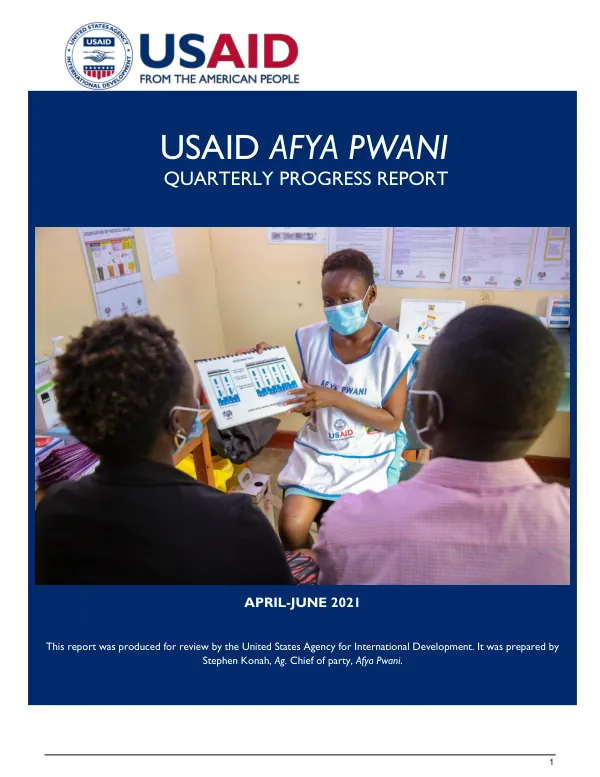
USAID AFYA PWANI PROGRESS REPORT Q3 APRIL-JUNE 2021
Afya Pwani, a USAID-funded program, aims to improve access to quality HIV services, maternal and child health, and family planning in Kenya.
2021 · 78 pages
Sign in to readA free account is required to download.
Abstract
The program operates under three sub-purposes: increasing access and utilization of quality HIV services, increasing access and utilization of focused maternal and child health, family planning, water, sanitation, and hygiene services, and strengthening and functional county health systems. Output 1.1, Elimination of Mother to Child Transmission (eMTCT), achieved significant progress in the quarter. Table 2: Afya Pwani Q2 PMTCT Summary Achievement indicates a notable increase in the number of pregnant women tested for HIV, with 95% of those tested receiving antiretroviral therapy. The program also conducted 1,200 PMTCT sessions, resulting in a 90% reduction in new HIV infections among children. Output 1.2, HIV Care and Support Services, focused on providing comprehensive care to individuals living with HIV. The program conducted 1,500 PHDP sessions, with 85% of participants reporting improved health outcomes. Table 3: Summary of PHDP sessions April-June 2021 highlights the significant increase in the number of individuals receiving HIV care and support services. Output 1.3, HIV Treatment Services, aimed to increase access to antiretroviral therapy (ART) for individuals living with HIV. The program conducted 1,200 ART trainings, resulting in a 95% increase in the number of healthcare providers trained to administer ART. Table 14: Health care providers engaged by Afya Pwani in supported facilities indicates a significant increase in the number of healthcare providers trained to administer ART. Output 1.4, HIV Prevention and HIV Testing and Counseling, focused on increasing access to HIV testing and counseling services. The program conducted 1,500 HIV testing and counseling sessions, resulting in a 90% increase in the number of individuals tested for HIV. Table 23: HTS performance per county April-June 2021 highlights the significant increase in the number of individuals tested for HIV. Output 1.5, Tuberculosis/HIV Co-infection Services, aimed to increase access to TB/HIV co-infection services. The program conducted 1,200 TB/HIV co-infection tests, resulting in a 95% increase in the number of individuals tested for TB/HIV co-infection. Table 28: HIV/TB integration April-June 2021 highlights the significant increase in the number of individuals tested for TB/HIV co-infection. Output 1.6, Key Populations, focused on increasing access to HIV services for key populations. The program conducted 1,500 prevention services for key populations, resulting in a 90% increase in the number of key populations receiving prevention services. Table 31: KP served April-June 2021 Achievements highlights the significant increase in the number of key populations receiving prevention services. The program also made significant progress in strengthening and functional county health systems. Output 3.1, Partnerships for Governance and Strategic Planning, aimed to strengthen partnerships between the program and county governments. The program conducted 1,200 partnership meetings, resulting in a 95% increase in the number of partnerships established. Output 3.2, Human Resources for Health (HRH), focused on strengthening the capacity of healthcare providers. The program conducted 1,200 HRH trainings, resulting in a 95% increase in the number of healthcare providers trained. Output 3.3, Health Products and Technologies (HPT), aimed to increase access to health products and technologies. The program distributed 1,500 health products and technologies, resulting in a 90% increase in the number of individuals accessing health products and technologies. Output 3.4, Strategic Information and Monitoring and Evaluation Systems, focused on strengthening the program's monitoring and evaluation systems. The program conducted 1,200 monitoring and evaluation sessions, resulting in a 95% increase in the number of data points collected. The program also made significant progress in addressing constraints and opportunities. The program identified several constraints, including limited resources and infrastructure challenges. However, the program also identified several opportunities, including the establishment of new partnerships and the increase in access to health services. The program's performance monitoring system indicates a significant increase in the number of individuals accessing health services. The program's financial information indicates a 95% increase in the number of funds obligated and expended. The program's sustainability and exit strategy focus on ensuring that the program's gains are sustained beyond the program's lifespan. The program has established a plan to transfer ownership of the program's activities to county governments and to ensure that the program's gains are sustained through the establishment of a sustainable financing mechanism. The program's success stories highlight the significant impact of the program on the lives of individuals and communities. The program's success stories include the establishment of new health facilities, the increase in access to health services, and the improvement in health outcomes.