USAID DEC
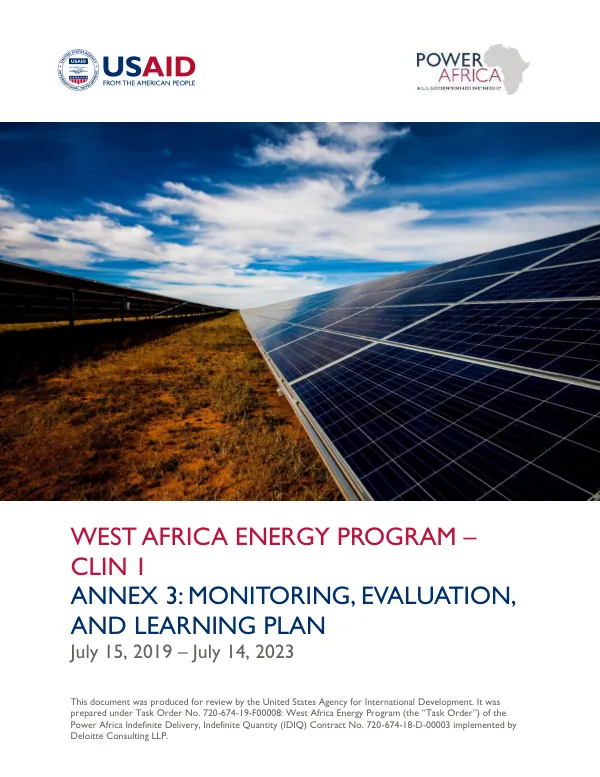
West Africa Energy Program – CLIN 1 Annex 3: Monitoring, Evaluation, and Learning Plan
Sign inDELOITTE CONSULTING, LLP
West Africa Energy Program – CLIN 1 Annex 3: Monitoring, Evaluation, and Learning Plan
The West Africa Energy Program (WAEP) is a comprehensive initiative aimed at improving energy access and promoting sustainable energy development in West Africa.
2019 · 97 pages
Sign in to readA free account is required to download.
Abstract
The program is implemented by Deloitte Consulting LLP under the Power Africa Indefinite Delivery, Indefinite Quantity (IDIQ) Contract No. 720-674-18-D-00003. The WAEP is focused on achieving several key objectives, including increasing generation capacity, improving wholesale cost of generation, and enhancing electricity access. The program also aims to promote regional power utility trade relationships, operationalize control area centers, and support policy reforms to enhance energy sector governance. To achieve these objectives, the WAEP has established a robust monitoring and evaluation framework, which includes 30 performance indicators. These indicators are categorized into several areas, including generation capacity, wholesale cost of generation, electricity access, regional power utility trade relationships, and policy reforms. The WAEP performance indicators are designed to track progress towards the program's objectives and provide a basis for learning and adaptation. The indicators are also used to identify areas where the program can improve its performance and make adjustments to its implementation strategy. The WAEP has established a detailed performance indicator tracking chart, which provides a comprehensive overview of the program's progress towards its objectives. The chart includes data on the number of megawatts of generation capacity reached financial close, the number of kilometers of transmission and distribution lines reached financial close, and the amount of investment mobilized for energy projects. The WAEP also has a robust stakeholder engagement strategy, which involves working closely with regional power utilities, governments, and other stakeholders to promote energy sector development. The program has established a number of targets and baselines, which are used to track progress towards its objectives. The WAEP's monitoring and evaluation approach is based on a lifecycle framework, which includes data analysis and reporting, learning and adapting, and risk monitoring. The program uses a range of data sources, including annual progress reports, data quality assessments, and financial mobilization memos, to track its progress and identify areas for improvement. The WAEP's learning and adapting approach is designed to promote continuous improvement and learning throughout the program. The program uses a range of tools and techniques, including training and capacity building activities, to build the capacity of regional power utilities and other stakeholders. The WAEP's risk monitoring approach is designed to identify and mitigate potential risks to the program's objectives. The program uses a range of risk mitigation tools, including financial guarantees and insurance, to manage risk and ensure the program's success. Overall, the WAEP is a comprehensive initiative aimed at improving energy access and promoting sustainable energy development in West Africa. The program's robust monitoring and evaluation framework, stakeholder engagement strategy, and learning and adapting approach make it well-positioned to achieve its objectives and promote energy sector development in the region.
Related documents