FOOD AND AGRICULTURE ORGANIZATION OF THE UNITED NATIONS IN GEORGIA
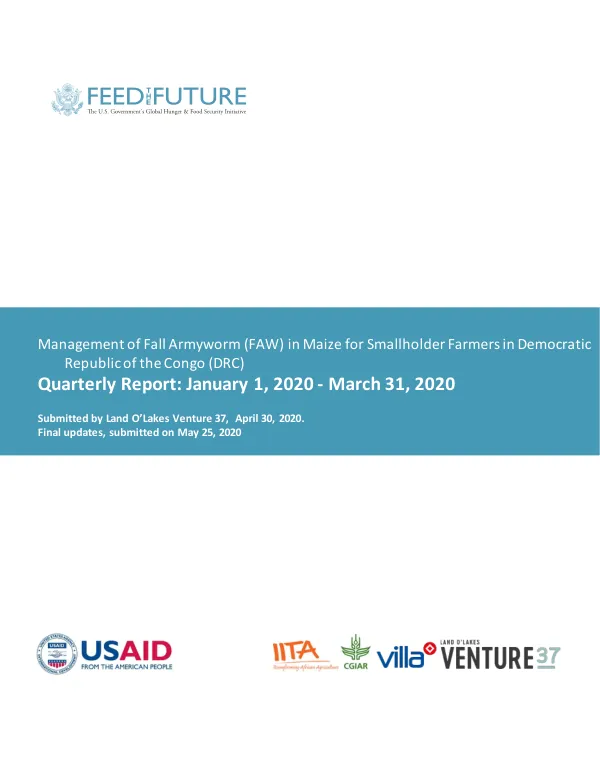
DRC-M-FAW- First Quarter Year 2-Progress Report
The Management of Fall Armyworm in Maize for Smallholder Farmers in the Republic of the Democratic of the Congo project began on October 18, 2019, and is set to conclude on October 17, 2024.
2020 · 31 pages
Sign in to readA free account is required to download.
Abstract
The project is implemented by Land O'Lakes Venture37 Cooperative and has several major collaborating organizations, including the International Institute of Tropical Agriculture (IITA), Villa Crop Protection, and the United Nations Food and Agriculture Organization (FAO). The project's geographic coverage includes the former provincial areas in DO2 (Corridor 1: southern Katanga and Corridor 2: Kasai Occidental and Kasai Oriental/Lomami) and the majority of TO3 (South Kivu and Tanganyika, formerly northern Katanga). The project aims to develop and implement sustainable and cost-effective Integrated Pest Management (IPM) technologies for smallholder farmers in the Democratic Republic of the Congo. The project is divided into three components: Component 1 focuses on identifying and validating sustainable and cost-effective IPM technologies; Component 2 aims to increase the adoption of Good Agricultural Practices (GAP) IPM practices among smallholder farmers; and Component 3 seeks to improve policies and systems for GAP IPM deployment. During the first quarter of Year 2, the project team conducted several key events, including the Year 2 Work Plan Validation Workshop in Kinshasa and presentations of the project and key findings in the five target provinces. The team also continued to adjust activities in response to the COVID-19 pandemic, demonstrating resilience in working at the office in Kinshasa and during in-country assignments. The project's technical activities during this quarter included the development of key technical documents, such as the Gender Analysis Report, Baseline Report, and Year 2 Work Plan and Gantt Chart. The team also finalized the Safe Use Action Plan (SUAP) and conducted short-term technical assistance reports. In terms of Component 1, the project team identified and validated 13 technologies for tests and validation trials, conducted baseline and progress surveys on pest status and smallholder farmer practices, and surveyed for Fall Armyworm indigenous natural enemies. The team also adapted and validated a monitoring and early warning system operational in local conditions and inventoried and validated the best and environmentally friendly pesticides. For Component 2, the project team conducted project launch events at the national and provincial levels, presented the project and key findings in Kinshasa and the provinces, and developed and tested Fall Armyworm-related messages. The team also identified project participants and selected community facilitators. The project's management overview during this quarter included global security and security planning, registration, procurement, recruitment, and human resources management. The team also conducted a Year 2 Work Plan Validation Workshop in Kinshasa and promoted project launch materials. Looking ahead to the next quarter, the project team plans to continue with Component 1, Component 2, and Component 3 activities, as well as priority administrative, legal, and financial activities. The team will also conduct monitoring and evaluation activities, including data entry into USAID's Development Information Solution (DIS) and progress on the project performance plan.
Related documents
Documents in this collection
 2020
2020USAID DEC
Management of Fall Armyworm (FAW) in Maize for Smallholder Farmers in Democratic Republic of the Congo (DRC) Quarterly Report: April 1, 2020 - June 30, 2020
Open record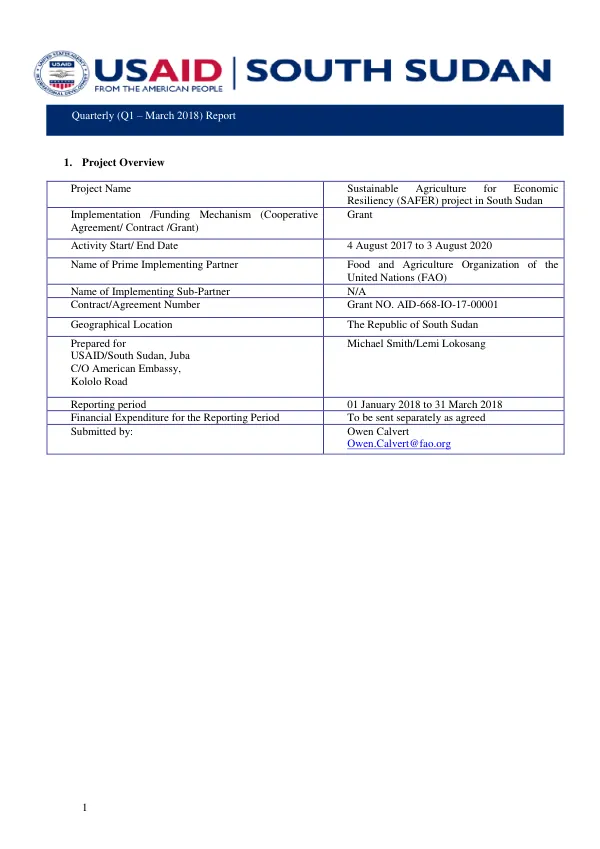 2018
2018USAID DEC
Quarterly (Q1 – March 2018) Report: Sustainable Agriculture for Economic Resiliency (SAFER) project in South Sudan
Open record