USAID DEC
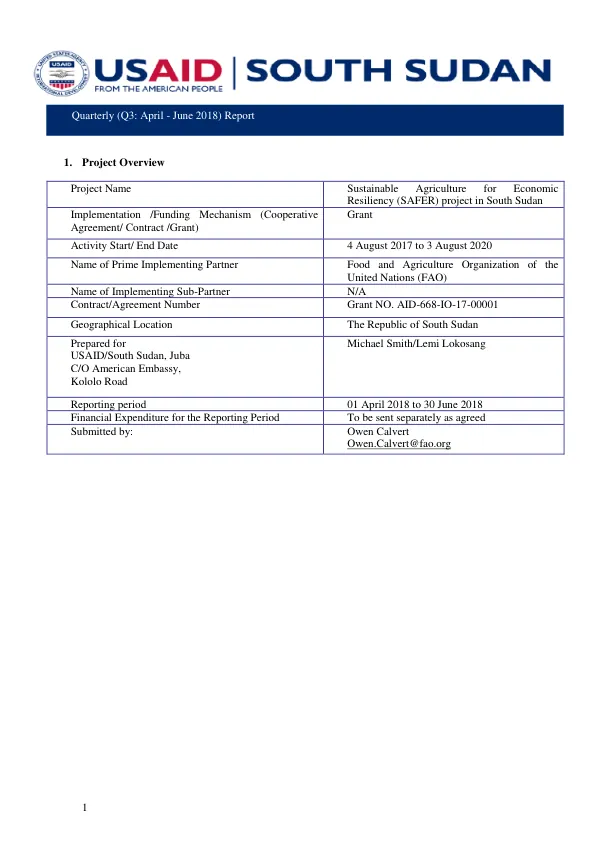
Quarterly (Q3: April - June 2018) Report: Sustainable Agriculture for Economic Resiliency (SAFER) project in South Sudan
Sign inFOOD AND AGRICULTURE ORGANIZATION OF THE UNITED NATIONS IN GEORGIA
Quarterly (Q3: April - June 2018) Report: Sustainable Agriculture for Economic Resiliency (SAFER) project in South Sudan
The Sustainable Agriculture for Economic Resiliency (SAFER) project in South Sudan was implemented from August 2017 to August 2020, with funding from the United States Agency for International Development (USAID).
2018 · 19 pages
Sign in to readA free account is required to download.
Abstract
The project aimed to improve agricultural productivity and economic resilience in South Sudan, particularly in the areas of crop and livestock production. The Food and Agriculture Organization of the United Nations (FAO) served as the prime implementing partner, with no sub-partners listed. The project's geographical focus was on four locations in South Sudan: Yambio, Aweil, Bor, and Rumbek. The project's reporting period for this quarter was from April to June 2018. Key achievements during this quarter included the completion of a Community-Based Participatory Planning (CBPP) exercise, which identified potential groups and individuals for involvement in commercial enterprises. The project also delivered training to service providers on Value Chain Development and natural resource management. Training was conducted for 34 participants, representing all five project service providers, on the Value Chain Development Approach, basic principles of business development, marketing, and dynamics. Additionally, a three-day training on natural resource management was conducted for field project management teams from all four locations. Training material for community and intercommunal resource sharing and management practices development was also completed. Assessments were conducted to determine livestock production-specific challenges and natural resource management constraints. Livestock and natural resource management assessments were carried out in the intervention areas, including Rumbek Centre, Rumbek East, Wulu, Yirol East, Yirol West, and Awerial counties. Crop seeds were dispatched to service providers for distribution to beneficiaries, and distribution was ongoing in different locations. The project also initiated collaboration with UNICEF for resettlement and reintegration of demobilized youths into the community through agricultural activities. However, challenges were encountered during this quarter, including insecurity, targeting challenges related to the Joint Recovery and Stabilization Programming, and delayed rains, which were likely to impact agricultural production. Key lessons learned during this quarter included the need to provide training to farmer communities on basic business skills, record keeping, marketing, and cost and income calculations. Recommendations included supporting existing initiatives for livestock feed production, improving animal health provision, strengthening existing production groups and cooperative societies, and encouraging cattle fattening pens for local slaughter.