USAID DEC
Quarterly Report #1: Helping Address Rural Vulnerabilities and Ecosystem Stability (HARVEST) Program
Sign inAUBURN UNIVERSITY
Quarterly Report #1: Helping Address Rural Vulnerabilities and Ecosystem Stability (HARVEST) Program
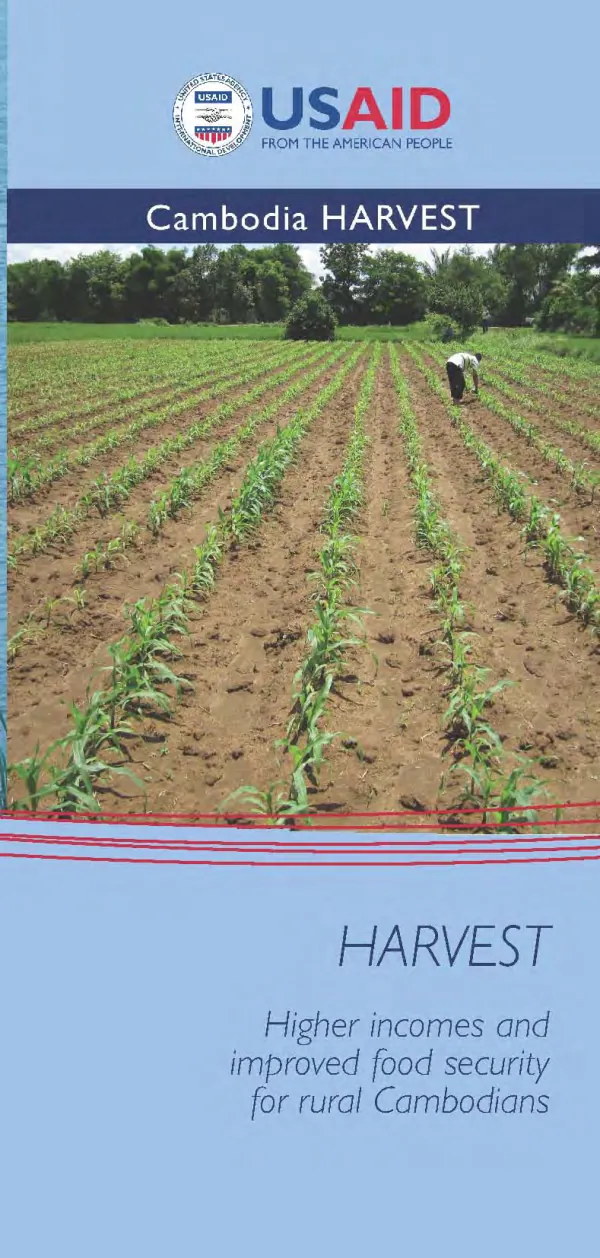
The USAID-HARVEST program is a five-year food security initiative focused on increasing incomes for 70,000 rural Cambodian households.
2011 · 44 pages
Sign in to readA free account is required to download.
Abstract
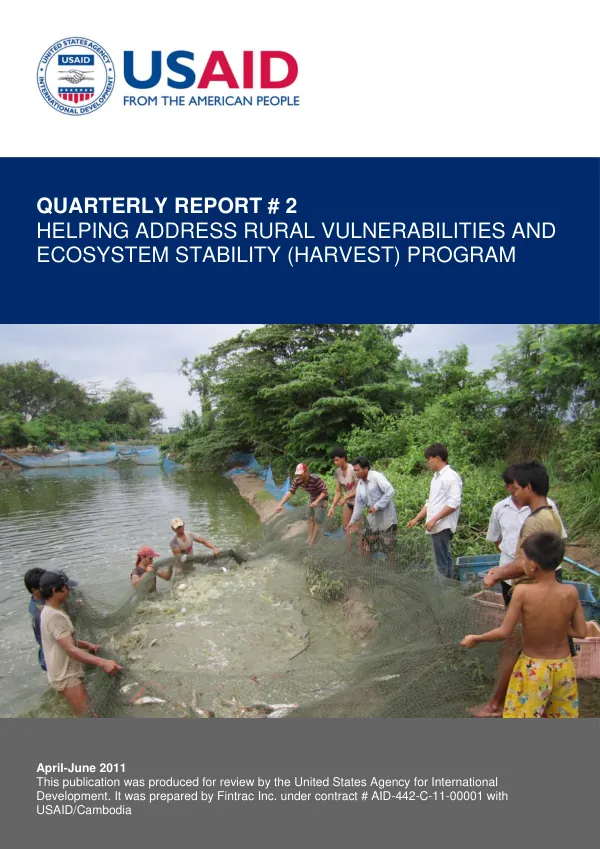
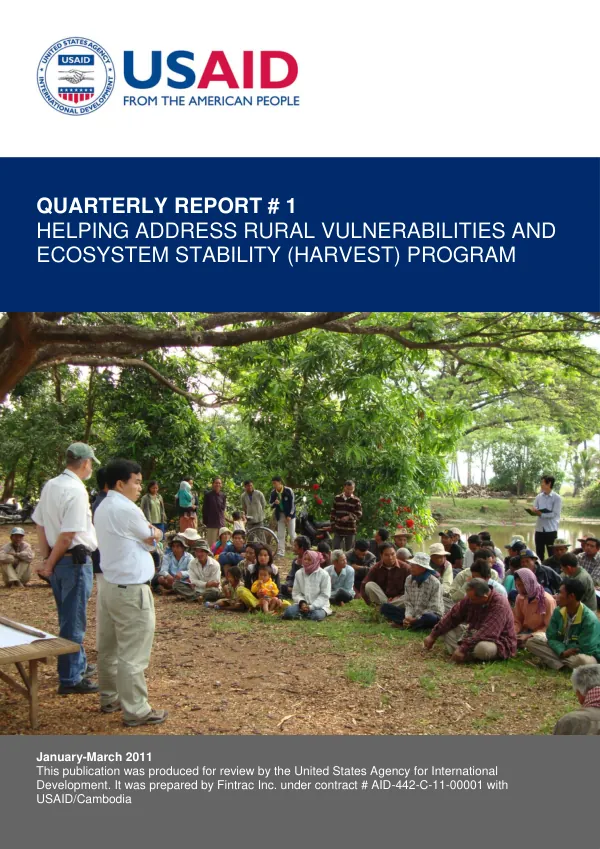
The program aims to improve food security through increased food availability, increase food access through rural income diversification, strengthen natural resource management and resilience to climate change, and increase the capacity of public, private, and civil society to support agricultural competitiveness. The program's geographic focus is on four provinces surrounding the Tonle Sap Lake, which were identified as having the greatest percentage of poor and food insecure households in Cambodia. These provinces are Kampong Thom, Siem Reap, Battambang, and Pursat. In the first year, HARVEST is concentrating its agriculture, fisheries/aquaculture, and NRM activities in Battambang (districts Bovil, Thmor Korl, and Moung Reusi) and Pursat (districts Bakan, Krar Kor). During the first quarter of implementation, Phase I analytical, design, and stakeholder consultation activities were completed. Achievements included consultations with dozens of public and private sector stakeholders, identification of participating farmer groups, demonstration sites, commercial partners, and twenty-five fruit and vegetable crops for market-led production in five districts in the Battambang and Pursat provinces. Design work was completed for the rehabilitation of a 13-kilometer irrigation canal that will benefit rice farmers participating in certified seed demonstrations. Implementation of the program's components began during the first quarter. The Agribusiness Value Chain component focused on developing agricultural solutions to address poor productivity, postharvest losses, food safety issues, lack of market access, environmental degradation, and the effects of climate change on food vulnerable populations. The Rice Sector component involved the rehabilitation of a 13-kilometer irrigation canal and the introduction of certified seed varieties, plant nutrition, and good agricultural practices. The Natural Resource Management and Biodiversity component included the inventory and valuation of key natural resources, using mapping and survey technologies through satellite imagery. The Social Inclusion and Capacity Development component focused on social inclusion assessment, household roles, and livelihood opportunities, with an emphasis on women and youth. The Business Development Services and Small and Medium Enterprises component involved the design of smallholder technical assistance and training interventions, including three hundred demonstration sites to introduce certified seed varieties, plant nutrition, and good agricultural practices. The Policy and Enabling Environment component included the completion of a cost-benefit analysis for smallholder participation in the warehouse receipts system. The program's headquarters and two provincial offices were established, and staff were trained in financial and administrative systems. Critical plans and waivers were submitted and approved, including the work plan, subcontract manual, procurement plan, and others. The Monitoring and Evaluation (M&E) Plan/Framework was finalized, and the M&E System was installed for baseline data collection across all sectors. The program's goals and objectives include increasing incomes for 70,000 rural households, accruing economic benefits for 330,000 individuals, developing income-generating activities for 7,000 "extreme poor" households, diversifying cropping systems for 32,000 households, and generating $45 million in incremental new agricultural sales. The program's planned activities for the next quarter include the implementation of Phase II actions, including the rehabilitation of the 13-kilometer irrigation canal, the introduction of certified seed varieties, plant nutrition, and good agricultural practices, and the completion of the warehouse receipts system.