USAID DEC
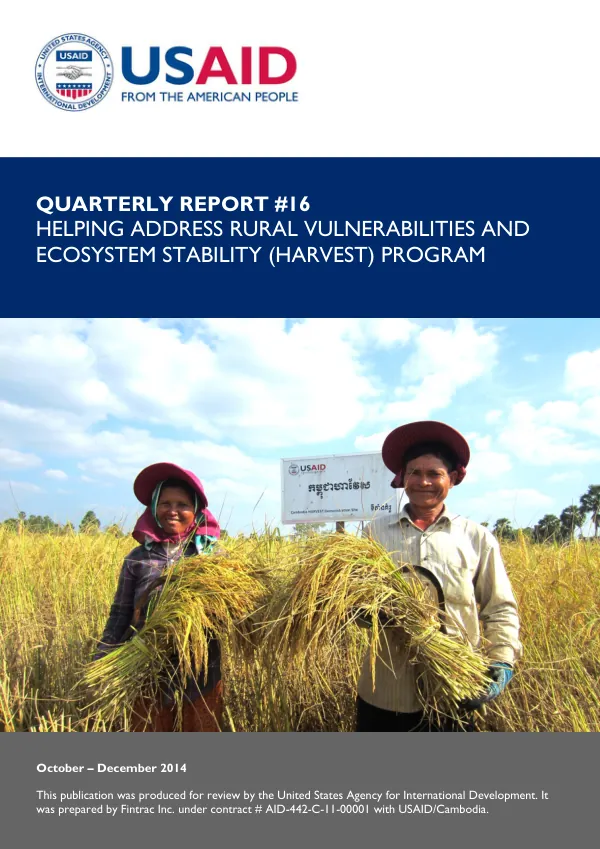
Quarterly Report #16: Helping Address Rural Vulnerabilities and Ecosystem Stability (HARVEST) Program
Sign inFINTRAC
Quarterly Report #16: Helping Address Rural Vulnerabilities and Ecosystem Stability (HARVEST) Program
Cambodia HARVEST is a five-year food security program focused on increasing incomes for 70,000 rural Cambodian households as part of the United States Feed the Future and Global Climate Change initiatives.
2014 · 87 pages
Sign in to readA free account is required to download.
Abstract
The program has trained more than a quarter of a million people in agriculture, natural resource management, and food security concepts. This quarter, the program's wet-season rice farmers had their largest and most successful harvest yet, despite serious floods affecting large parts of the four target provinces. Agribusinesses receiving Public Private Alliance funds began installing equipment and undergoing training that will strengthen their respective value chains and benefit thousands of farmers. Under the nutrition component, community-based savings funds dispensed hundreds of loans to poor households to help them start microenterprises that will strengthen food security and increase incomes. A carbon assessment found that Cambodia has avoided emissions equivalent to 1.5 million tons of carbon dioxide as a result of the program's work in the Central Cardamoms Protected Forest, an amount equal to the emissions produced by 300,000 cars in one year. The program is working to increase the availability of food to meet the everyday dietary needs of Cambodians. A total of 106,862 farmers have applied new technologies or management practices, exceeding the total program target of 44,100. The dietary diversity of women of reproductive age improved to 5.7 food groups consumed from six of Feed the Future's nine foods essential to dietary diversity, a 24 percent increase over the baseline number of 4.6. Cambodia HARVEST is also strengthening the ability of Cambodians to generate income through economic activities to increase their capacity to purchase food. The program linked 46 horticulture producer groups with two district- and provincial-level vegetable buyers this quarter, resulting in 436 metric tons of new sales worth $133,458. Incremental sales from farm-level rice, horticulture, and aquaculture totaled $3.2 million this quarter, bringing the total to $17.2 million, 164 percent of the total program target of $10.5 million. The program is working to protect the country's globally significant natural resources, which are an essential source of economic activity and food security for Cambodians. A total of 30,484 people received training in natural resource management or biodiversity conservation, exceeding the total program target of 27,000. The program has reduced or sequestered 1.5 million tCO2 of greenhouse gas emissions, 68 percent of the total life of the program target of 2.2 million tCO2. Cambodia HARVEST is strengthening the capacity of Cambodians to manage and resolve challenges related to food security and global climate change. A total of 3,280 stakeholders have increased their capacity to adapt to the effects of climate variability and change this quarter, bringing the total to 39,548, 117 percent of the cumulative target of 33,875 and 87 percent of the total program target of 45,500. The program has also provided small-scale loans totaling $1.9 million to 1,444 agribusinesses and households, bringing the total to $8 million worth of loans for 8,470 agribusinesses and households, 242 percent of the total program target of 3,500. The program has provided technical assistance to 87,404 rural households to date, 125 percent of the total program target of 70,000. Among these, 8,129 (9.3 percent) were extreme poor, 116 percent of the total program target of 7,000. A total of 267,093 people have received agriculture and food security training through demonstration sites, interactive field days, mobile kitchens, and one-on-one technical assistance, 191 percent of the 140,000 people targeted over the life of the program.