ADRA
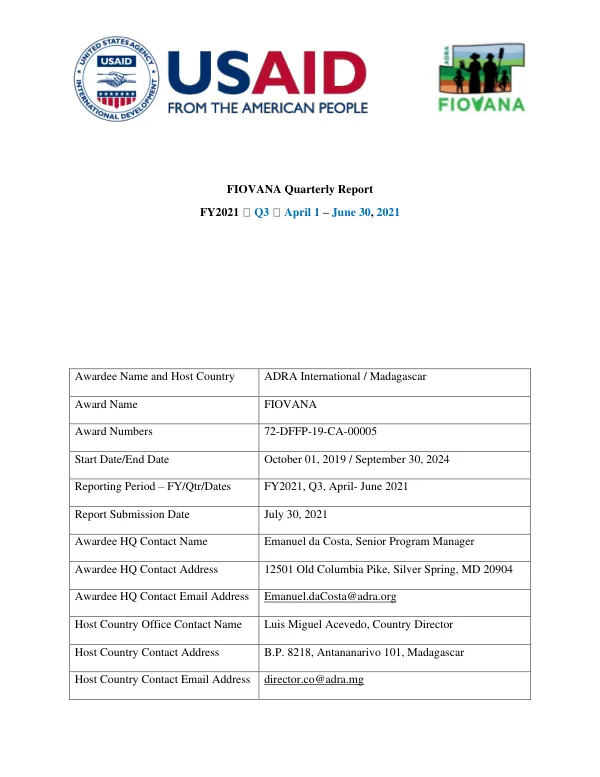
Quarterly Report 3 – FY2021: FIOVANA Project in Madagascar
The FIOVANA project is implemented in the Atsimo Atsinanana and Vatovavy-Fitovinany regions of southeastern Madagascar.
2021 · 10 pages
Sign in to readA free account is required to download.
Abstract
The program goal is to achieve sustainable improvement of food and nutrition security and resilience among vulnerable populations in these regions. The geographic focus is on 10 districts, including Atsimo Atsinanana, Vatovavy-Fitovinany, Farafangana, Vatovavy, Voldrozo, Manakara, Mananjary, and Vatovavy. The project has three main purposes: sustained improvement in health and nutritional status of women of reproductive age, adolescent girls, and children under five; households' incomes and production are sufficient to access food and non-food essentials and build savings; and enhanced social and ecological risk management. The project targets 428,800 participants, including 71,197 households. The project is implemented by a consortium composed of the Adventist Development and Relief Agency (ADRA) as prime and sub-awardee, and Agronomes et Vétérinaires Sans Frontières (AVSF) as sub-awardee. The project is funded by the United States Agency for International Development (USAID) through the Food for Peace (FF) program. The project's implementation is guided by a Detailed Implementation Plan (DIP) and a Disaster Preparedness and Mitigation Plan (DPMP). The project's monitoring and evaluation activities are conducted through a Performance Indicator Reference Sheet (PIRS) and a Poverty Probability Index (PI). The project's progress is reported quarterly to USAID through a Program Performance Report (PPR). The project's activities are focused on improving the health and nutritional status of women of reproductive age, adolescent girls, and children under five. This is achieved through the implementation of activities under Sub-Purpose 1.1, which includes sustained consumption of optimal diets by women of reproductive age, adolescent girls, and children under five. The project also aims to reduce exposure to pathogens in households and community environments through activities under Sub-Purpose 1.3. In addition to improving health and nutrition, the project also aims to increase households' incomes and production to access food and non-food essentials and build savings. This is achieved through activities under Sub-Purpose 2.1, which includes increased agricultural production by women, youth, and men. The project also aims to enhance social and ecological risk management through activities under Sub-Purpose 3.2, which includes improved management of shocks and risks by households and communities. The project's implementation is supported by a range of stakeholders, including local government officials, community leaders, and other partners. The project's progress is monitored and evaluated through a range of indicators, including indicators of health and nutrition, income and production, and social and ecological risk management. The project's implementation is guided by a range of policies and guidelines, including the USAID Food for Peace (FF) program's policies and guidelines. The project's activities are also guided by a range of international and national policies and guidelines, including the United Nations' Sustainable Development Goals (SDGs) and the Government of Madagascar's policies and guidelines. The project's progress is reported quarterly to USAID through a Program Performance Report (PPR). The report provides an update on the project's progress, including its achievements, challenges, and challenges. The report also provides an update on the project's budget and financial situation, including its income and expenses. The project's budget is funded by USAID through the Food for Peace (FF) program. The project's budget is allocated to a range of activities, including personnel, equipment, and other expenses. The project's budget is also allocated to a range of stakeholders, including local government officials, community leaders, and other partners. The project's progress is reported quarterly
Related documents