UNITED NATIONS
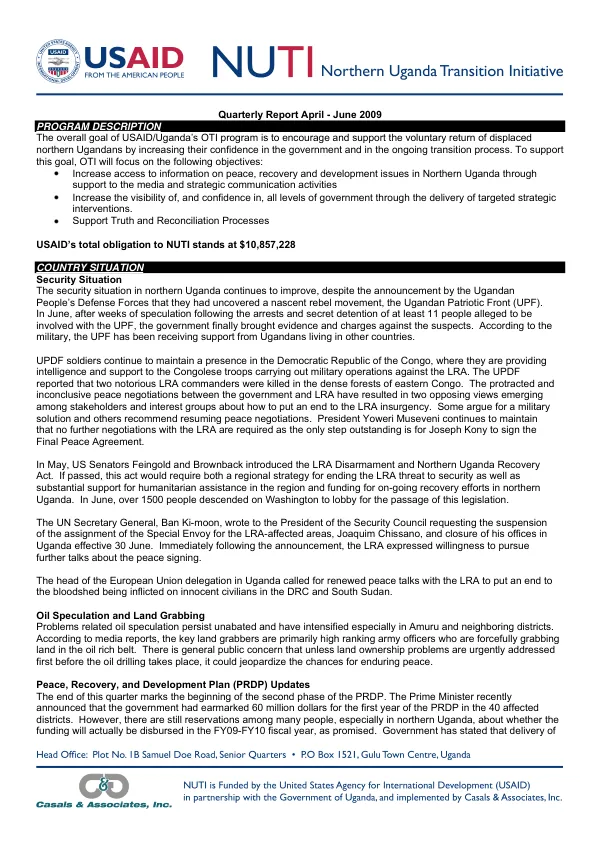
Quarterly Report April - June 2009
The overall goal of USAID/Uganda's OTI program is to encourage and support the voluntary return of displaced northern Ugandans by increasing their confidence in the government and in the ongoing transition process.
2009 · 7 pages
Sign in to readA free account is required to download.
Abstract
To support this goal, OTI focuses on increasing access to information on peace, recovery, and development issues in Northern Uganda through support to the media and strategic communication activities, increasing the visibility of, and confidence in, all levels of government through the delivery of targeted strategic interventions, and supporting Truth and Reconciliation Processes. The security situation in northern Uganda continues to improve, despite the announcement by the Ugandan People's Defense Forces that they had uncovered a nascent rebel movement, the Ugandan Patriotic Front (UPF). In June, the government finally brought evidence and charges against the suspects, and the UPDF reported that two notorious LRA commanders were killed in the dense forests of eastern Congo. The protracted and inconclusive peace negotiations between the government and LRA have resulted in two opposing views emerging among stakeholders and interest groups about how to put an end to the LRA insurgency. The LRA Disarmament and Northern Uganda Recovery Act was introduced in May by US Senators Feingold and Brownback, which would require both a regional strategy for ending the LRA threat to security as well as substantial support for humanitarian assistance in the region and funding for on-going recovery efforts in northern Uganda. In June, over 1500 people descended on Washington to lobby for the passage of this legislation. The UN Secretary General, Ban Ki-moon, wrote to the President of the Security Council requesting the suspension of the assignment of the Special Envoy for the LRA-affected areas, Joaquim Chissano, and closure of his offices in Uganda effective 30 June. Oil speculation and land grabbing persist in Amuru and neighboring districts, with high-ranking army officers forcefully grabbing land in the oil-rich belt. There is general public concern that unless land ownership problems are urgently addressed first before the oil drilling takes place, it could jeopardize the chances for enduring peace. The Peace, Recovery, and Development Plan (PRDP) has entered its second phase, with the government earmarking 60 million dollars for the first year of the PRDP in the 40 affected districts. The Northern Uganda Transition Initiative (NUTI) achieved a rapid acceleration of grant development and implementation, clearing 39 grants from April to June and increasing the monthly average to 13 grants. Two high-level delegation visits by USAID/OTI Washington staff took place in April and June, including a tour by Rob Jenkins, OTI's Director, who met with the Paramount Chief of the Acholi People and senior local government officials in Gulu and Amuru Districts. NUTI also piloted its first successful bidders conference, which attracted over 80 participants, and convened its first public opening of bids for new infrastructure projects. NUTI supported several high-profile activities in Gulu, Amuru, and Kitgum districts, including the inauguration of two water boreholes, kick-off of a training for staff from the Engineering and Public Works Offices in Gulu and Amuru districts, inauguration of Langol Health center staff houses, celebration of Kitgum's winning the national primary athletics competition, and the launch of Wang Oo, a traditional ceremony where elders pass on Acholi traditions to the youth. NUTI also completed "three-months-after" evaluations of CAS032, the grant supporting traditional cleansing ceremonies, and a comparative analysis of CAS04 and CAS059, which supported the rehabilitation of the sub-county administration offices in Odek and Purongo. The findings showed that although the cleansing ceremonies did not necessarily accelerate IDP return rates, they were fundamental in allaying fears and anxieties among returnees.
Related documents