USAID
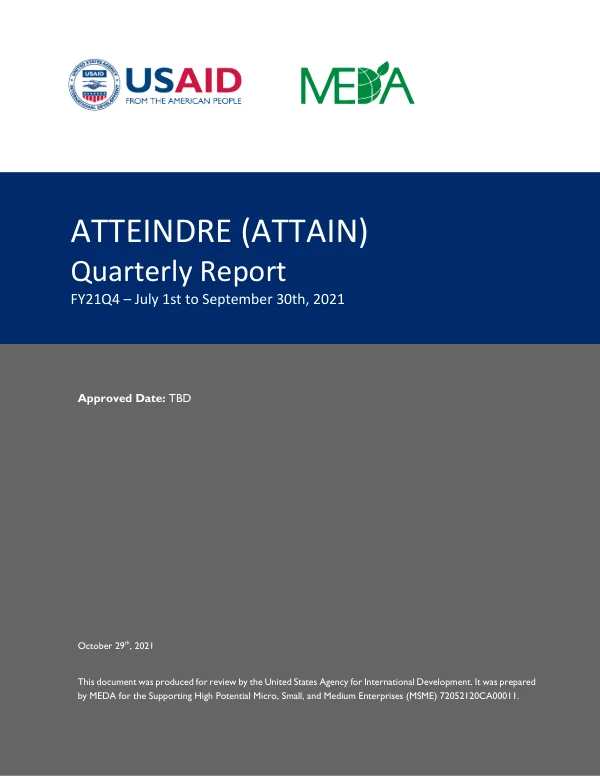
Quarterly Report: ATTEINDRE (ATTAIN) FY21Q4 – July 1st to September 30th, 2021
The ATTEINDRE project, implemented by Mennonite Economic Development Associates (MEDA) in Haiti, aims to provide targeted support for Micro, Small, and Medium Enterprises (MSMEs) to become bankable enterprises.
2021 · 22 pages
Sign in to readA free account is required to download.
Abstract
The project's goal is to enable MSMEs to grow, become more competitive, and generate jobs, ultimately contributing to household income, business expansion, and job creation. The project is supported by three intervention objectives and corresponding components, which provide direct support through competitive pay-for-performance contracts with selected sub-contractors to deliver business advisory support and workforce development services. The project also engages financial institutions to promote the development and strengthening of financial products and services, including digital financial services for MSMEs. As of the end of the fourth quarter, 14 subgrants are fully contracted by ATTEINDRE, representing USD 2.8 Million and targeting seventeen thousand beneficiaries. The project has launched six new subgrant activities totaling USD 1 Million and targeting over four thousand beneficiaries in Q4 alone. Grant disbursements increased by 583%, and the value of contracted grants increased by 59% in Q4. The project has made significant progress in increasing access to business advisory and workforce development services for MSMEs. As of September 2021, 2,500 MSMEs have accessed business advisory and workforce development services, and 4 business advisory and workforce development providers have received technical support, including Gender and Social Inclusion (GESI) training. The project has also made progress in strengthening the ecosystem for MSMEs. ATTEINDRE has organized a forum among its subgrantees, cross-cutting partners, enabling environment partners, and other potential opportunities partners. The meeting was an opportunity for ATTEINDRE to inform and share the different lessons learned during its first year, discuss implementation challenges, and share best case practices. The project's Theory of Change is that if a network of qualified and gender-aware business advisory and workforce development service providers support the formalization and/or modernization of underserved MSMEs, and a network of financial service providers would develop and provide services tailored to their needs, then MSMEs would operate in an enabling environment oriented to their long-term growth and conducive to job creation and inclusive economic growth. The project's objectives are tied to the key project components identified by MEDA to address MSME challenges while contributing to one of USAID Haiti's development objectives: DO2: MORE INCLUSIVE, LOCALLY DRIVEN ECONOMIC GROWTH AND SOCIAL DEVELOPMENT ADVANCED.