USAID DEC
Quarterly Report FIOVANA Refine & Implement (R&I) Year Gender, Youth, and Social Dynamics (GYSD) Analysis Final Report
Sign inADRA
Quarterly Report FIOVANA Refine & Implement (R&I) Year Gender, Youth, and Social Dynamics (GYSD) Analysis Final Report
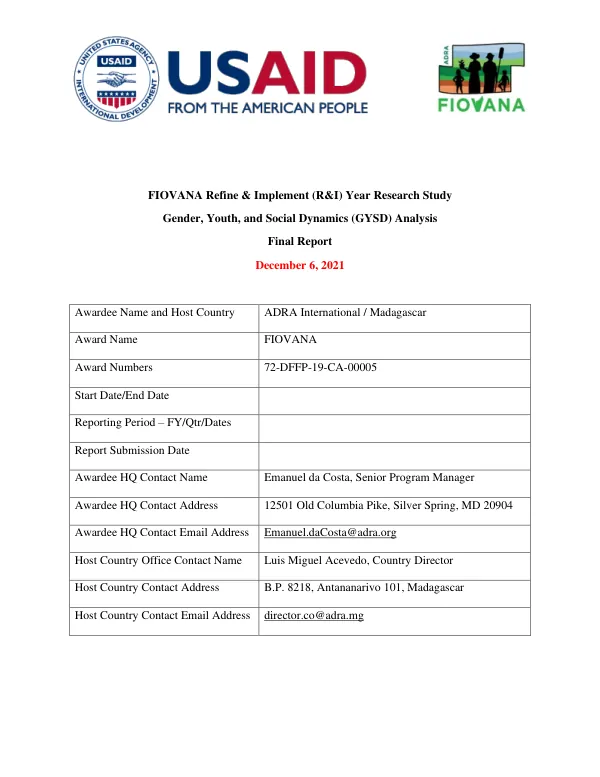
The FIOVANA Refine & Implement (R&I) Year Research Study, Gender, Youth, and Social Dynamics (GYSD) Analysis, was conducted by ADRA International in Madagascar to inform the development and implementation of the project's gender, youth, and social dynamics action plan.
2021 · 47 pages
Sign in to readA free account is required to download.
Abstract
The study aimed to determine the unique needs, interests, and constraints of women, youth, and marginalized individuals, including persons with physical and sensory disabilities, within the project implementation area. The FIOVANA project is a five-year food security intervention designed to achieve the sustainable improvement of food and nutrition security and resilience of vulnerable populations in the Atsimo Atsinanana and Vatovavy-Fitovinany regions of southeastern Madagascar. The project is implemented by a consortium of partners, led by ADRA International, with funding from the U.S. Agency for International Development's Office of Food for Peace (USAID/FFP). The GYSD analysis consisted of two components: a secondary desk review and a qualitative research component using in-depth interviews (IDI) with community members and key informant interviews (KIIs). The desk review built on existing publicly available quantitative and qualitative data, including DHS surveys, gender analyses from other projects and partners, reports, government policies and strategies, and peer-reviewed literature. The findings of the GYSD analysis highlighted several challenges and barriers to optimal project outcomes. Despite laws and policies aimed at improving gender equity and disability inclusion, enforcement is weak, particularly at the rural level. Cultural norms dictate and reinforce inequitable gender norms and beliefs, leading to exclusion from decision-making at the community level. Women and girls are responsible for most daily household tasks, while men have access and control over land and large property, leaving women more economically vulnerable. The analysis also found that community-level decision-making is left to adult men, leaving women and youth out of these processes. However, decision-making at the household level is more nuanced, with women typically having more power to contribute to decision-making, although men are still seen as having the final say. The study found differences between prior quantitative studies on GBV rates in the project areas and qualitative responses from the FIOVANA GYSD analysis, with respondents stating that physical and sexual GBV is unacceptable and uncommon in their communities. The GYSD team made several recommendations to address the gender, youth, and disability-related barriers to optimal project outcomes. These recommendations include conducting training for field staff and implementation partners on concepts and principles of implicit bias, disability inclusivity, gender and GBV, youth, and safeguarding of program participants. The team also recommended sensitizing traditional and local government leaders on Malagasy laws on equity in inheritance and access to property, land, and other resources, and engaging them to advocate for a change in customary practices around inequitable distribution of resources and male inheritance. Additionally, the team recommended conducting sensitization on the rights of women to inherit land equitably and the benefits of registering land and civil marriage to ensure inheritance and rights of women and children. The team also recommended addressing the knowledge and parenting-related contributors to early pregnancy through positive parenting sessions, and increasing targeting of adolescent girls and their families for income-generating activities.