USAID DEC
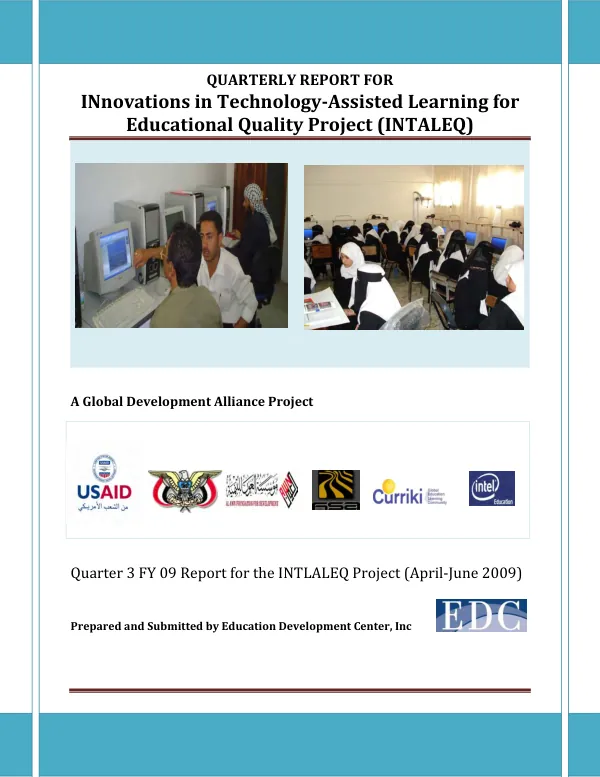
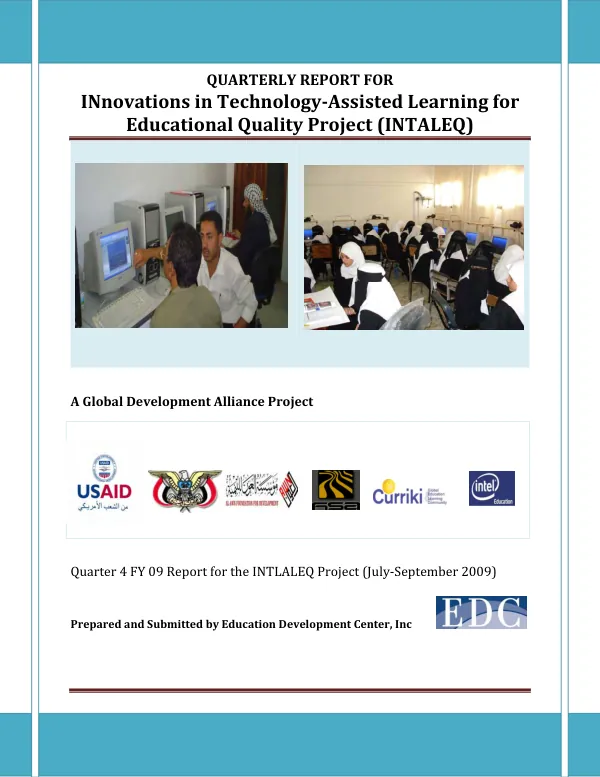
Quarterly Report for Innovations in Technology-Assisted Learning for Educational Quality Project (INTALEQ)
Sign inCENTER FOR EDUCATIONAL DEVELOPMENT
Quarterly Report for Innovations in Technology-Assisted Learning for Educational Quality Project (INTALEQ)
The INTALEQ project, a Global Development Alliance Project, aimed to improve educational quality through technology-assisted learning.
2009 · 103 pages
Sign in to readA free account is required to download.
Abstract
The project was implemented in Yemen, with a focus on the governorates of Sana'a, Ta'iz, Mukalla, and Aden. The project's main objective was to enhance teacher capacity and student learning outcomes through the use of digital learning objects and a portal for teacher collaboration. The project's implementation began in July 2009, with the launch of the INTALEQ "Curriki" portal, a platform for teachers to share information, lesson plans, and ideas. The portal was designed to facilitate teacher collaboration and provide access to digital learning objects. The project also conducted training activities for teachers in the four governorates, with a focus on using the digital learning objects and the portal. The project's monitoring and evaluation (M&E) findings revealed positive results, with students in INTALEQ project schools demonstrating learning gains of between 7 and 9 points higher than their counterparts in control schools. The results showed that over 60% of students in INTALEQ schools demonstrated learning gains of at least 7 points higher than their control school counterparts. Only about 10% of students in control schools could match those gains. The project also reported that 89% of teachers used the digital learning objects on a regular basis, as documented through the analysis of data collected from teacher interviews, journals, and lesson plans. The project's basic teacher training package was delivered to teachers and supervisors in the three project governorates, with a focus on using the digital learning objects and the portal. The project encountered difficulties over the issue of incentives for the Ministry of Education (MOE). Incentives were not being paid, and the MOE's role in the project was clarified during the quarter. The Memorandum of Understanding (MOU) signed by all partners laid out the commitments of each, including the MOE. However, the MOE had a copy of the MOU translated into Arabic that did not accurately translate the contents of the MOU. This was corrected, and a correct translation was distributed. The project's advisory meeting was held in Sana'a, with discussions centered around the issue of MOE incentives, the scope of the project, and the project budget. The MOE officials wanted to see the project expanded, with increased capacity to develop their own digital learning objects and more resources for the MOE, especially in the form of equipment. All parties agreed that they would like the project continued. The project's progress against the workplan was summarized, with activities completed in the past quarter highlighted in blue, activities completed in past quarters highlighted in green, and activities still to be completed marked with an X. Several additional appendices were attached to the report to provide further detail on the quarter's activities and results. The project's student assessment reports were finalized, with Dr. Fouad Abdelkhalick analyzing the data and producing the report tables and data interpretation sections. Helen Boyle, the project director, wrote the rest of the report and edited the two parts together into a complete report. The report was attached to the document in Appendix B. The project also analyzed the monthly student test data in the four target subject areas collected from teachers for the academic year 2008-2009. The data showed a statistically significant gain in average scores between the first and second semester among INTALEQ students.
Related documents