USAID DEC
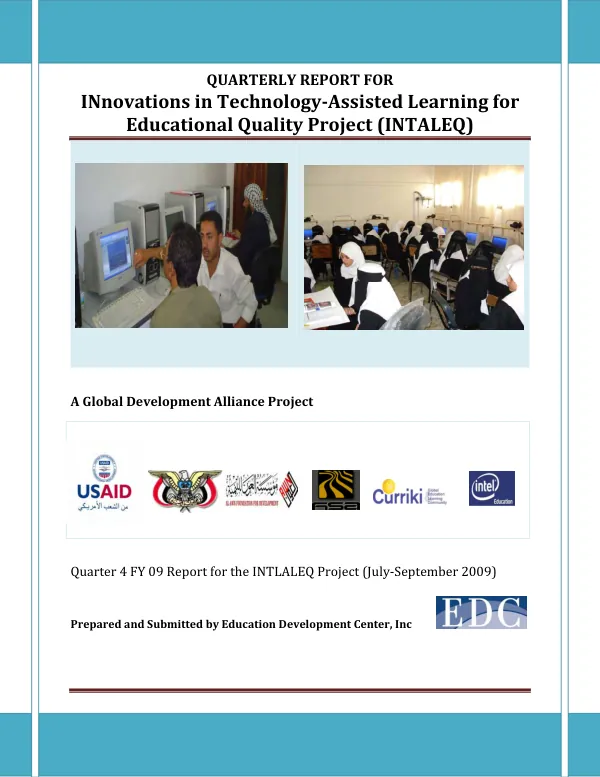
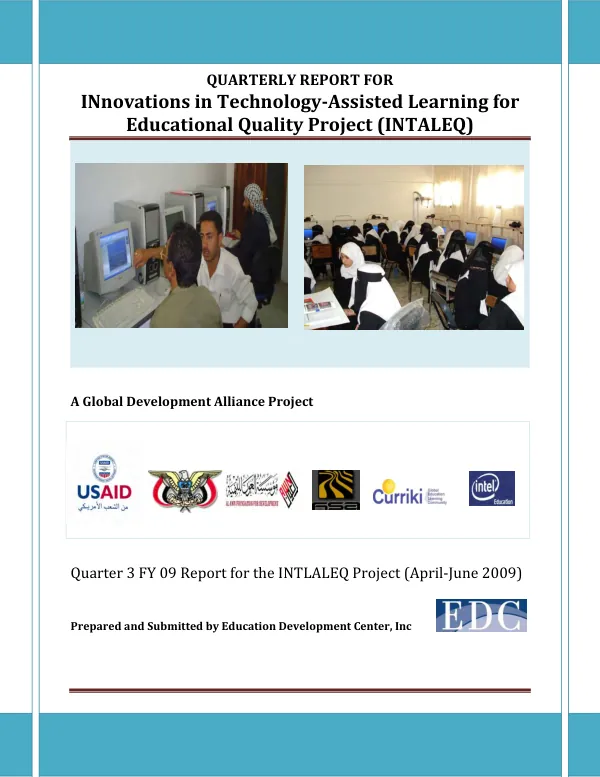
Quarterly Report for Innovations in Technology-Assisted Learning for Educational Quality Project (INTALEQ) Quarter 3 FY 09 Report for the INTALEQ Project (April-June 2009)
Sign inCENTER FOR EDUCATIONAL DEVELOPMENT
Quarterly Report for Innovations in Technology-Assisted Learning for Educational Quality Project (INTALEQ) Quarter 3 FY 09 Report for the INTALEQ Project (April-June 2009)
The INTALEQ project, a Global Development Alliance Project, focused on innovations in technology-assisted learning for educational quality.
2009 · 59 pages
Sign in to readA free account is required to download.
Abstract
The project's interventions were in full swing in the six pilot schools in Sana'a during the quarter of April to June 2009. INTALEQ staff and the Ministry of Education provided support to teachers using new teaching methods and digital learning objects, while also engaging in monitoring and evaluation activities. Monitoring and evaluation activities centered on student assessment, with students in INTALEQ and control schools given pre-tests in the previous quarter and post-tests in the current quarter. Results showed that INTALEQ schools had a positive impact on student learning, with students scoring 8 points higher on average in all subjects compared to control schools. This gap was statistically significant and had a 95% confidence level. The INTALEQ project summit in Ta'iz was a significant event, bringing together partners from the Ministry of Education, USAID, EDC, and the private sector. Teachers from the six INTALEQ schools in Sana'a presented their work using new teaching methods, audio and video clips, and sophisticated PowerPoint presentations. The event highlighted the project's progress and prepared for its expansion to Ta'iz, Mukalla, and Aden in the fall. The project also held its first advisory committee meeting on May 10th, which proved to be a useful meeting for the implementing partners. USAID and private sector partners shared feedback with the Ministry of Education and EDC, offering suggestions on generating further interest and involvement from other private sector and community partners. EDC and the Ministry of Education met several times to discuss modes of implementation going forward, signaling the Ministry's keen interest in and ownership of the project. Digital content development was a key area of focus during the quarter, with the development of digital learning objects for 10th-grade math and science subjects. The project also made progress in dissemination systems, with the establishment of a digital library of materials and a Ministry Education Portal. Capacity building activities included training for teachers using new teaching methods and digital learning objects. The project's results reporting section highlighted the positive impact of the project on student learning, with students in INTALEQ schools scoring higher on average in all subjects compared to control schools. The section also reported on output indicators, including the number of teachers trained and the number of digital learning objects developed. The project workplan, attached as an appendix, highlighted the activities completed in the past quarter, including monitoring and evaluation, digital content development, and dissemination systems. The workplan also identified activities still to be completed, including the expansion of the project to Ta'iz, Mukalla, and Aden. The INTALEQ project's quarterly report for April to June 2009 highlighted the project's progress and challenges in various technical domains, including digital content development, dissemination systems, capacity building, and project administration. The report also provided an overview of the project's results and highlighted the positive impact of the project on student learning.