USAID DEC
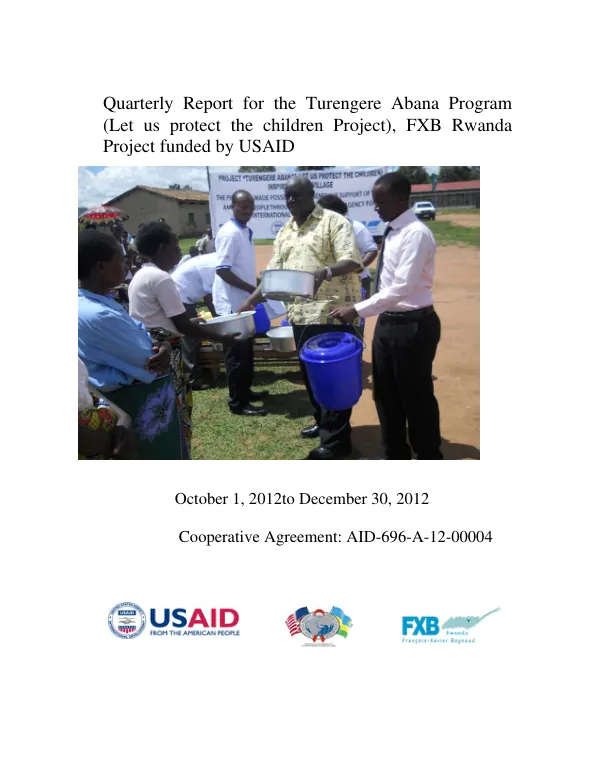
Quarterly Report for the Turengere Abana Program (Let us protect the children Project)
Sign inUSAID
Quarterly Report for the Turengere Abana Program (Let us protect the children Project)
The Turengere Abana Program, also known as the "Let us protect the children" project, is a comprehensive initiative aimed at supporting vulnerable households in Rwanda.
2012 · 14 pages
Sign in to readA free account is required to download.
Abstract
The program is funded by USAID and implemented by FXB Rwanda. The primary goal of the project is to support 1,120 households to escape poverty, educate and empower 85,000 individuals, generate access to and demand for local resources in 8 districts, and build or strengthen 250 sustainable community social support networks. The project is being implemented in seven districts countrywide, including Huye, Nyanza, Nyamagabe, Muhanga, Nyarugenge, Kicukiro, and Rubavu. The program has reached a total of 4,627 beneficiaries, consisting of 1,879 adults and 2,748 children, all living in 680 families countrywide. Among these households, 363 are completed families, 304 are headed by one parent, and 13 are headed by orphans. The project's specific objectives include supporting 1,120 households to launch and grow livelihood projects and earn sufficient income to meet their basic needs, fostering 120 group livelihood and SLAs among caregivers of OVC and transitioning 12 new and existing SLAs as official cooperatives, providing care, training, and referrals to 7,000 vulnerable children and adults, and ensuring that at least 3,700 vulnerable children attend and perform well in primary school, secondary school, and/or vocational training centers. During the first quarter of FY 2012, the project's implementation focused on establishing the program's foundations. USAID conducted a pre-award survey, and FXB Rwanda is addressing the findings and producing a related progress report. FXB Rwanda has also reinforced existing administrative, financial, and managerial procedures to better comply with USAID requirements. In addition, FXB prepared and submitted the work plan and Performance Monitoring Plan, which are awaiting USAID approval. In December 2012, FXB Rwanda officially launched the Turengere Abana Project in Nyanza and Huye in the Southern Province and in Nyarugenge, Kigali City. The project's activities during the first quarter included education support, which involved establishing a list of all school-aged OVC in enrolled households and providing insights on schools attended, levels of education, and former grades. This information will be used to inform the project's education support activities. The project's education support activities aim to ensure that at least 3,700 vulnerable children attend and perform well in primary school, secondary school, and/or vocational training centers. The project has also implemented income-generating activities and livelihood training for caregivers of OVC, which have been well received by beneficiaries. The project's HIV prevention training and testing activities have also been implemented, with a focus on providing access to health insurance, HIV prevention, and treatment, counseling, and psychosocial support to 70,000 individuals. Overall, the Turengere Abana Program is a comprehensive initiative aimed at supporting vulnerable households in Rwanda. The project's implementation has focused on establishing the program's foundations, and activities have been implemented to address the root causes of human insecurity among destitute families and the OVC in their care.