USAID
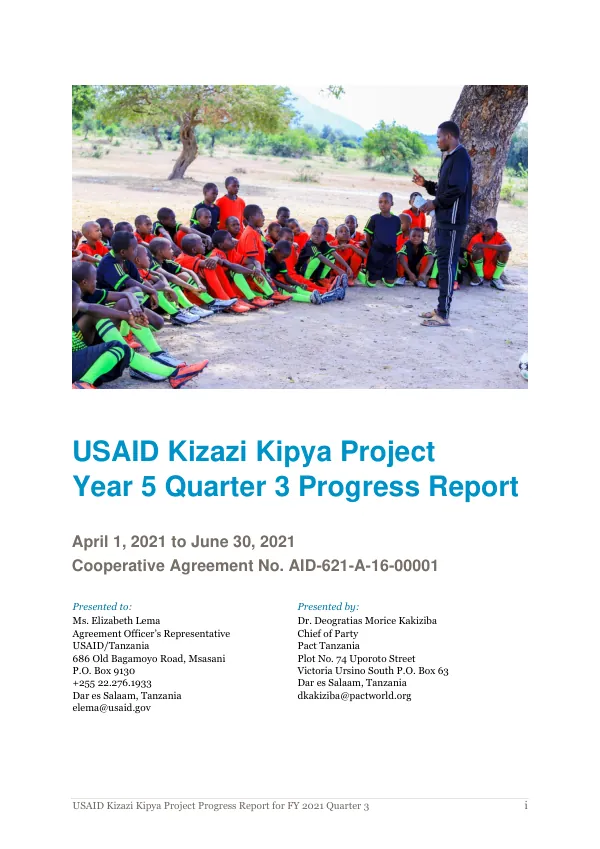
USAID Kizazi Kipya Project Progress Report for FY 2021 Quarter 3
The USAID Kizazi Kipya Project aims to enable Tanzanian orphans and vulnerable children (OVC) to access age-appropriate HIV and AIDS-related services for improved care, health, nutrition, education, protection, livelihoods, and psycho-social well-being.
2021 · 39 pages
Sign in to readA free account is required to download.
Abstract
The project is implemented by Pact in partnership with local organizations, businesses, and governments to create sustainable and resilient communities. The project's geographic coverage includes several districts in Tanzania, with a focus on Kilosa District Council, where community-based initiatives such as Coaching Boys into Men (CBIM) are being implemented. CBIM aims to prevent violence against children and promote healthy relationships among adolescents. The project also targets hard-to-reach populations, including children working in mines (CIM) and children living with HIV (CLHIV). The project's results framework is structured around four main results: parents and caregivers have the financial resources to meet the needs of vulnerable children and adolescents; parents and caregivers have the skills to meet the needs of HIV-infected and vulnerable children and adolescents; high-quality services are available to HIV-infected and vulnerable children and adolescents; and high-quality services are available to hard-to-reach HIV-infected and vulnerable children and adolescents. Progress toward achieving these results is being monitored through various indicators, including the categorization of OVC households according to the Family and Child Assets Assessment (IR 1.0), the increase in temporary consumption support and social protection (IR 1.1), and the improvement in case management services for OVC households (IR 3.0). The project has also made progress in expanding education services (IR 3.1) and interventions for health, HIV, and sexual and reproductive health services (IR 3.2). The project has also engaged with various stakeholders, including the Government of Tanzania, USAID/PEPFAR IPs, and private sector partners, to leverage resources and support the project's objectives. Challenges and lessons learned have been documented, and the project is working to address these issues and improve its implementation. Monitoring and evaluation activities are ongoing, with data quality assessments, data review meetings, and supportive supervision being conducted regularly. Research and learning activities are also being implemented to inform project decisions and improve outcomes. The project has made significant progress in the first quarter of FY 2021, and efforts are being made to sustain this momentum and achieve the project's goals.
Related documents