USAID DEC
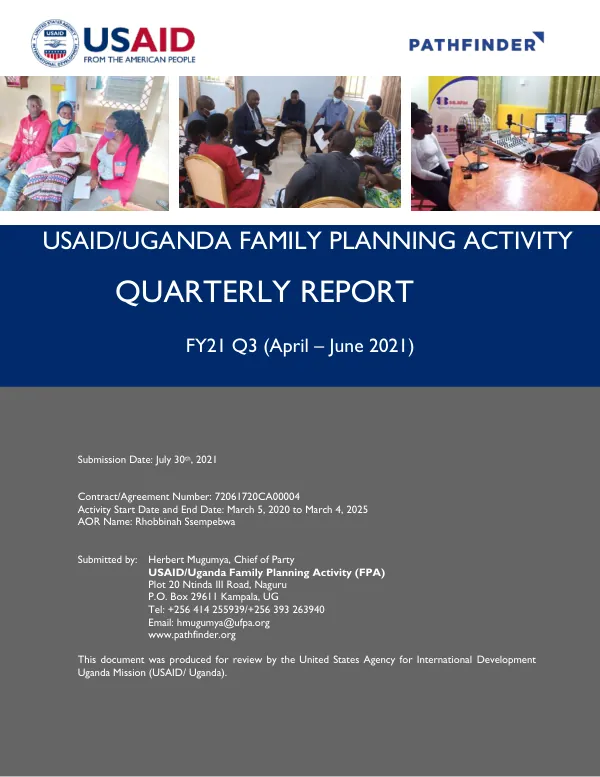
Quarterly Report FY21 Q3 (April – June 2021) for USAID/Uganda Family Planning Activity
Sign inPATH
Quarterly Report FY21 Q3 (April – June 2021) for USAID/Uganda Family Planning Activity
The USAID/Uganda Family Planning Activity (FPA) is a five-year initiative that began on March 5, 2020, and is set to conclude on March 4, 2025.
2021 · 41 pages
Sign in to readA free account is required to download.
Abstract
The activity is funded by the United States Agency for International Development (USAID) and aims to strengthen Ugandan leadership and coordination to support voluntary family planning, enhance positive social norms and behaviors to improve healthy timing and spacing of pregnancies, and increase access to quality, voluntary family planning. The FPA has made significant progress in achieving its objectives. In the first quarter of FY21, the activity implemented various interventions, including farmer training programs, infrastructure development, and market linkage facilitation. The activity has also made notable gains in increasing access to quality, voluntary family planning. The FPA has also strengthened Ugandan leadership and coordination to support voluntary family planning. The activity has worked closely with government officials, civil society organizations, and community-based organizations to enhance their capacity to provide family planning services. The activity has also supported the development of policies and guidelines that promote family planning and reproductive health. In terms of geographic focus, the FPA has targeted several districts in Uganda, including Kimuli, where the activity has implemented various interventions to improve access to family planning services. The activity has also worked with community health workers and other stakeholders to promote family planning and reproductive health. The FPA has also made significant progress in integrating cross-cutting issues and USAID Forward priorities. The activity has incorporated inclusive development, environmental compliance, and local capacity development into its implementation plan. The activity has also supported the development of policies and guidelines that promote environmental sustainability and community development. In terms of stakeholder participation and involvement, the FPA has worked closely with various stakeholders, including government officials, civil society organizations, and community-based organizations. The activity has also engaged with local communities to promote family planning and reproductive health. The FPA has also made significant progress in management and administrative issues. The activity has implemented a robust monitoring and evaluation system to track its progress and identify areas for improvement. The activity has also developed a comprehensive financial management plan to ensure the effective use of resources. In conclusion, the USAID/Uganda Family Planning Activity has made significant progress in achieving its objectives. The activity has strengthened Ugandan leadership and coordination to support voluntary family planning, enhanced positive social norms and behaviors to improve healthy timing and spacing of pregnancies, and increased access to quality, voluntary family planning. The activity has also integrated cross-cutting issues and USAID Forward priorities into its implementation plan and has made significant progress in management and administrative issues.
Related documents