USAID DEC
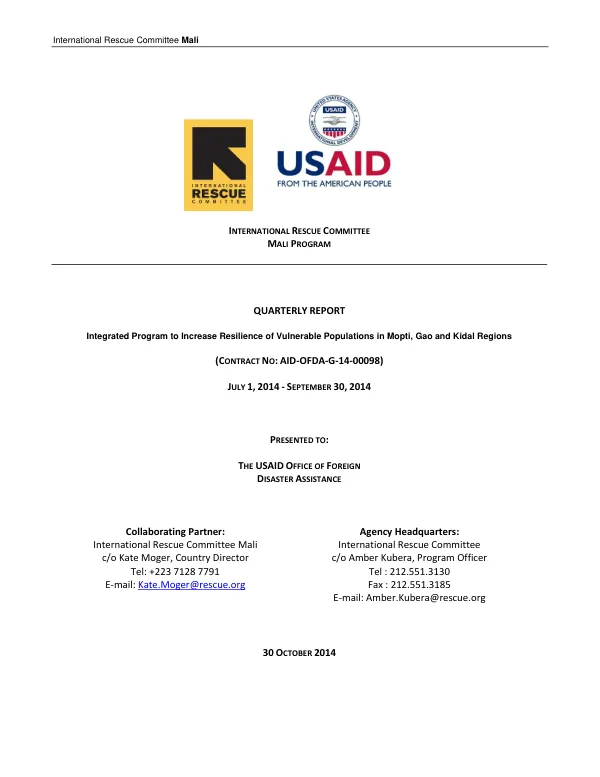
Quarterly Report: Integrated Program to Increase Resilience of Vulnerable Populations in Mopti, Gao and Kidal Regions
Sign inINTERNATIONAL RESCUE COMMITTEE
Quarterly Report: Integrated Program to Increase Resilience of Vulnerable Populations in Mopti, Gao and Kidal Regions
The Integrated Program to Increase Resilience of Vulnerable Populations in Mopti, Gao, and Kidal Regions in Mali began in July 2014 with funding from the USAID Office of Foreign Disaster Assistance.
2014 · 15 pages
Sign in to readA free account is required to download.
Abstract
The program aimed to increase the resilience of vulnerable individuals, households, and communities in the Gao, Mopti, and Kidal regions of Mali through enhanced capabilities and resources. The program had four main objectives: to increase knowledge and awareness on GBV and Child Protection, improve access to psycho-social services, support and advocate for protection and promotion of the rights of children and women; to increase access to basic water and sanitation facilities, promote awareness to control and prevent WASH-related diseases, and promote resilience for future shocks; to increase awareness, knowledge, create behavior change, and advocate on nutrition issues for communities and authorities; and to enhance women's livelihoods through a pilot program of direct support using VSLA methodology and business skills. The program targeted a total of 75,268 beneficiaries, including 9,658 for Protection, 22,916 for WASH, 7,555 for Nutrition, and 4,815 for Early Recovery and Market Systems. The program also targeted IDP beneficiaries, with an estimated 7,500 individuals affected in the target area. The program's location was in the Mopti, Gao, and Kidal regions of Mali, with a duration of 18 months from July 1, 2014, to December 31, 2015. The program's summary for the quarter ending September 30, 2014, focused on startup activities and the completion of the baseline survey. The baseline survey used a mixed method of quantitative and qualitative approaches to collect data on WASH, Child Protection, Economic Relief and Development, and Infant and Young Child Feeding. The Child Protection team was restructured during the first stage of the program to increase community acceptance and integration and mitigate evacuation risks. The team worked on reinforcing local staff in each field team to increase efficiency and create a more integrated approach. The Child Protection team also confirmed indicators and targets that were proposed, breaking down each indicator by intervention area and adapting the proposed intervention to the changed context. The program also focused on psychosocial interventions, with an evaluation of lessons learned being completed with field teams. Training modules were under review, which would be implemented by the Child Protection and WPE field teams starting in November 2014. Case management interventions were also a focus, with case workers and supervisors receiving a refresher training prior to project implementation. In Mopti, the Child Protection team focused on Douentza through the child center and local partner. Child Protection and WASH teams conducted joint visits to continue dialogue and involvement with local authorities for the implementation of start-up activities in October. In Boni, integrated WASH and Child Protection interventions were conducted for conflict-affected populations. In Gao, the Protection team focused on child protection and WPE interventions in the Gao community center through the local partner. In Ansongo, the protection team maintained a reduced intervention presence, focusing on awareness raising and case management in the most affected areas of the district. In Kidal, the newly recruited local Child Protection team identified the main protection needs and concentrated on awareness raising campaigns on Explosive Remnants of War risks and psychosocial interventions.
Related documents