FINTRAC
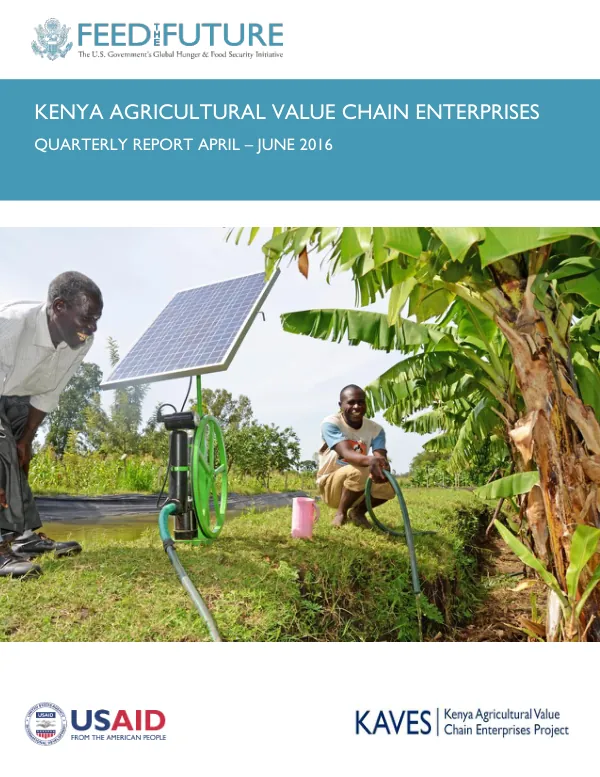
Quarterly Report: Kenya Agricultural Value Chain Enterprises QTR 16, FY 2016
The Kenya Agricultural Value Chain Enterprises (KAVES) program is a USAID-funded initiative aimed at improving agricultural productivity and value chain development in Kenya.
2016 · 72 pages
Sign in to readA free account is required to download.
Abstract
The program began in 2015 and is implemented by Fintrac Inc. in collaboration with the Kenyan government and other stakeholders. The dairy value chain is a key focus area for KAVES, with efforts aimed at improving productivity and production. Productivity and production improvement initiatives include training farmers on best practices, providing access to quality inputs, and promoting the use of hermetic storage bags to reduce postharvest losses. As a result, there has been an increase in volumes of milk marketed through collection centers, with a notable increase in volumes of milk consumption through the school milk program. In the maize and other staple crops value chain, KAVES has implemented extension and training programs to improve farmer knowledge and skills. The program has also focused on improving on-farm storage to reduce postharvest losses and increasing productivity to release more land for other high-value enterprises. Future efforts in this area will focus on scaling up successful interventions and expanding the program to reach more farmers. The horticulture value chain is another key area of focus for KAVES, with initiatives aimed at increasing production of high-volume crops, improving compliance with market requirements, and increasing value addition and product diversification through agro-processing. The program has established a National Horticulture Traceability System (HTS) to improve the tracking and tracing of horticultural products, and has implemented a Pesticides Residue Monitoring and Sampling Plan to ensure compliance with market standards. In the nutrition sector, KAVES has achieved significant progress in increasing community knowledge in child health and nutrition, with over 10,000 children reached with nutrition interventions during the quarter. The program has also made progress in improving dietary diversity among Women of Reproductive Age (WRA), with a notable increase in the consumption of nutrient-rich foods. The water, sanitation, and hygiene (WASH) sector has also seen significant progress, with efforts aimed at improving community environmental hygiene and sanitation. The program has implemented initiatives to improve community access to improved sanitation facilities, with a notable increase in the number of households with access to improved sanitation. In terms of organizational capacity building, KAVES has made significant progress in institutionalizing its strategic plan and policies, and has implemented an Institutional Strengthening Plan to build the capacity of its implementing partners. The program has also learned valuable lessons from its experiences, including the importance of engaging with local communities and building strong partnerships with other stakeholders. In terms of quantitative impact, KAVES has achieved significant results, including a 25% increase in milk production among participating farmers, a 30% increase in the volume of milk marketed through collection centers, and a 20% increase in the volume of milk consumption through the school milk program. The program has also reached over 10,000 children with nutrition interventions and has improved dietary diversity among WRA. The program's performance monitoring framework has been established to track progress and identify areas for improvement. The outlook for the next quarter is positive, with plans to scale up successful interventions and expand the program to reach more farmers. The program faces several constraints and opportunities, including the need to engage with local communities and build strong partnerships with other stakeholders. In terms of sustainability and exit strategy, KAVES has developed a plan to ensure the long-term sustainability of its interventions. The program has also established partnerships with other programs to leverage resources and expertise. The Global Development Alliance has been established to facilitate collaboration and knowledge sharing among stakeholders. The program's financial information is presented in the cash flow report and financial projections, which show a positive trend in program expenditures and income. The subcontract details are also presented, which show the program's commitment to transparency and accountability. The activity administration section presents information on personnel, including the program's staff and their roles and responsibilities.