USAID DEC
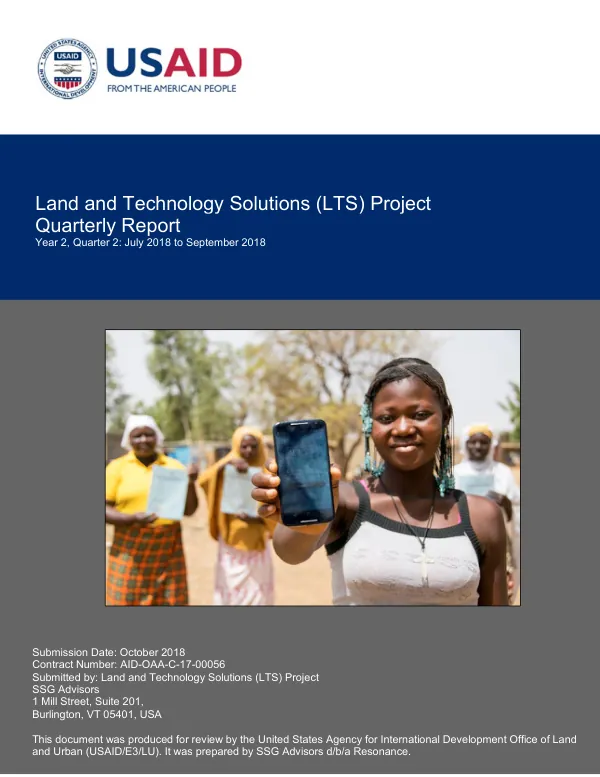
Quarterly Report: Land and Technology Solutions (LTS) Project Year 2, Quarter 2: July 2018 to September 2018
Sign inRESONANCE
Quarterly Report: Land and Technology Solutions (LTS) Project Year 2, Quarter 2: July 2018 to September 2018
The Land Technology Solutions (LTS) Project is a USAID-funded initiative aimed at improving land and resources governance and strengthening property rights for all members of society in developing countries through the use of mobile technology.
2018 · 24 pages
Sign in to readA free account is required to download.
Abstract
The project's primary objective is to promote the Mobile Applications to Secure Tenure (MAST) framework as a scalable, worldwide, "fit-for-purpose" land technology framework and delivery mechanism. This framework enables host-country stakeholders to document land rights cheaply, quickly, and efficiently. LTS is implemented by Resonance (SSG Advisors LLC) and its subcontractor Tetra Tech under USAID Contract No. AID-OAA-C-17-00056. The project's scope includes providing a cost-effective, customizable ("fit-for-purpose") community-based technology framework within sustainable local systems to map and document land rights, and to clarify and secure land-based resources under different tenure regimes. LTS also facilitates the uptake of "fit-for-purpose" mobile applications at the Mission and host country levels, empowers communities, especially women, with information and documentation needed to secure land rights, and provides evidence to inform USAID programming in food security, environment, democracy, and governance. During the second quarter of Year 2 (July 1, 2018 to September 30, 2018), LTS updated its Monitoring, Evaluation, and Learning (ME&L) Plan to reflect anticipated changes in the LTS activities. The project developed a survey instrument to review how users navigate and use the MAST Learning Platform, multiple communication products, and started to develop a ME&L Plan for its upcoming pilot in Liberia. LTS also worked on expanding and promoting MAST, developing new strategies for MAST promotion and sustainability, and identifying consultants and firms to provide technology support to USAID/LTS. The project consolidated code for MAST on GitHub as MAST is updated, and engaged a software development consultant to update MAST for Burkina Faso. These updates are expected to be completed early next quarter. The LTS project has made significant progress in promoting MAST as a scalable, worldwide, "fit-for-purpose" land technology framework and delivery mechanism. The project's activities have stayed consistent with its ME&L Plan, and it continues to maximize its learning in all tasks. LTS has developed a report that provides USAID with a thorough analysis of the stakeholder and technology landscapes, outlines the strengths and weaknesses of MAST, and outlines key recommendations for USAID's consideration based on lessons learned and best practices. The LTS project has also developed a best practice guide for stakeholders implementing land technologies in development, which has been informed by processes and practices conducted in previous MAST projects, lessons learned by LTS, and research from the wider land tenure and development literature. This guide is intended to be posted on the MAST Learning Platform. Overall, the LTS project has made significant progress in promoting MAST as a scalable, worldwide, "fit-for-purpose" land technology framework and delivery mechanism, and has developed a range of tools and resources to support its implementation.
Related documents