USAID DEC
Quarterly Report: October 1, 2022 – December 31, 2022, Mali Girl’s Leadership and Empowerment through Education (GLEE)
Sign inINTRAHEALTH
Quarterly Report: October 1, 2022 – December 31, 2022, Mali Girl’s Leadership and Empowerment through Education (GLEE)
The Girls Leadership and Empowerment through Education (GLEE) project in Mali aims to increase access to education for adolescent girls and enable them to obtain greater educational attainment.
2022 · 51 pages
Sign in to readA free account is required to download.
Abstract
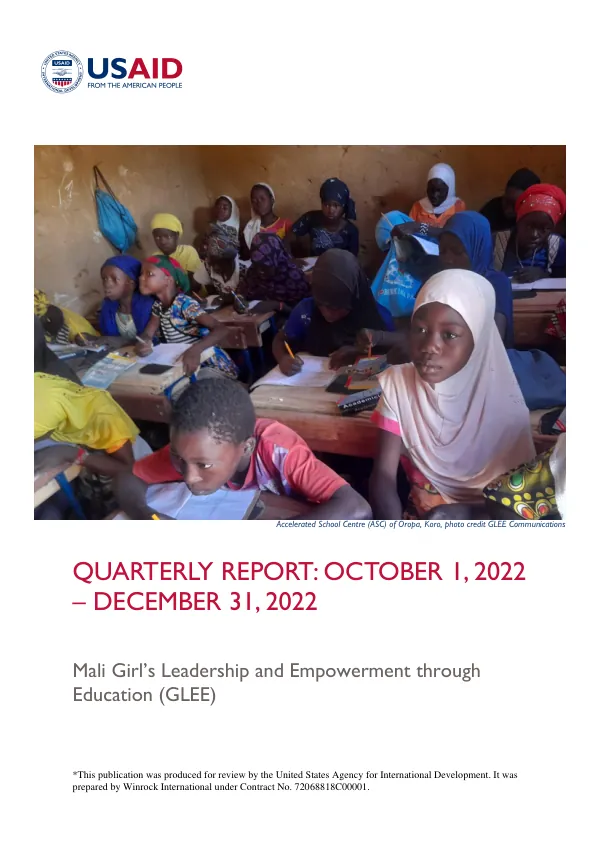
The project is led by Winrock International, in partnership with GAAS, IntraHealth, and OMAES. Community engagement and school support activities are implemented by GAAS Mali, while OMAES is responsible for accelerated schooling centers and teacher professional development activities. IntraHealth is responsible for reproductive health and WASH activities in the regions of Bandiagara and Douentza. During the reporting period, October 1, 2022, to December 31, 2022, GLEE established 60 Accelerated Learning Centers and identified 17 new host schools, bringing the total number of schools supported to 289. The project also continued to support the 37 community health centers through its network of community leaders, mentors, grandmothers/aunts, young ambassadors, and peer educators. The social-political context of Mali during the reporting period was marked by security threats and continuous dialogue between ECOWAS and the transitional government to allow the elections to be held in February 2024. A key event was the detention of 49 soldiers by Malian authorities who claimed these soldiers were mercenaries that illegally entered national territories. Several mediation visits were conducted by the ECOWAS Chief of States to negotiate the liberation of the 40 soldiers. The global economic and political context, marked by the Russian-Ukrainian conflict, still greatly affects Mali and many other countries. Despite these challenges, most schools in the implementation area resumed on October 3, 2022. GLEE's efforts to support education and health in Mali continue to be crucial in addressing the needs of adolescent girls and promoting their empowerment. The project's objectives include decreasing key barriers for adolescent girls to access quality education, improving safety of adolescent girls in their community, and increasing knowledge and adoption of positive health behavior among adolescent girls. GLEE's activities are focused on providing learning support opportunities for girls, making teaching more responsive and relevant for adolescent girls, and supporting communities and families in promoting girls' education. GLEE's quarterly report highlights the project's progress in achieving its objectives and provides an update on the implementation of its activities. The report also discusses the challenges faced by the project and the proposed solutions to address these challenges. The project's performance indicators and monitoring and evaluation plan are also presented in the report. The GLEE project has made significant progress in establishing Accelerated Learning Centers and supporting community health centers. The project's efforts to promote girls' education and health have been crucial in addressing the needs of adolescent girls in Mali. However, the project continues to face challenges, including security threats and the global economic and political context. Despite these challenges, GLEE remains committed to its objectives and continues to work towards promoting the education and empowerment of adolescent girls in Mali.
Related documents