USAID DEC
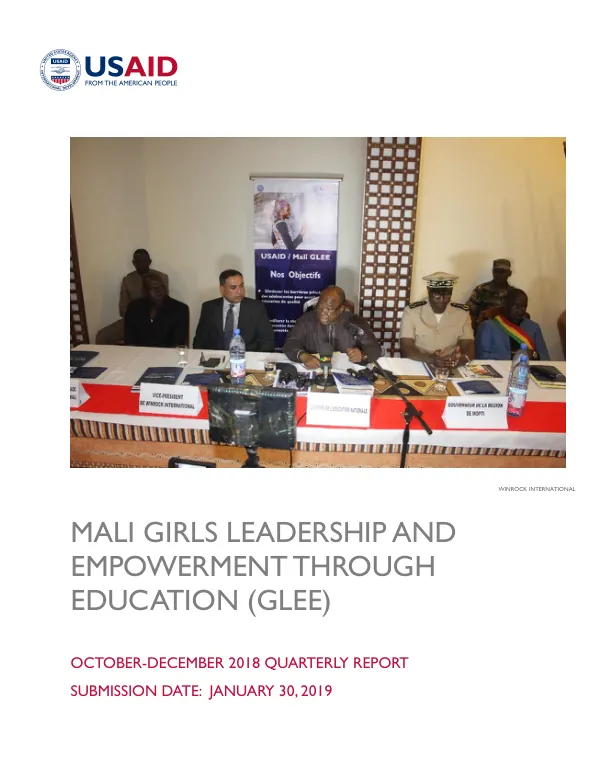
Mali Girls Leadership and Empowerment through Education (GLEE) Quarterly Report October-December 2018
Sign inGOVERNMENT OF MALAWI
Mali Girls Leadership and Empowerment through Education (GLEE) Quarterly Report October-December 2018
The Girls Leadership and Empowerment through Education (GLEE) program in Mali aims to improve the educational outcomes and overall well-being of adolescent girls.
2018 · 149 pages
Sign in to readA free account is required to download.
Abstract
The program is implemented by Winrock International and is funded by the United States Agency for International Development (USAID). The program focuses on three main objectives: decreasing key barriers to quality education for adolescent girls, improving the safety of adolescent girls in schools and their communities, and increasing knowledge and adoption of positive health behaviors among adolescent girls. To achieve these objectives, the program has established several sub-results, including increasing learning support opportunities for girls, making teaching more responsive and relevant for adolescent girls, and supporting communities and families in girls' education. The program also aims to establish effective reporting and referral mechanisms for school-related gender-based violence (SRGBV) and to increase adolescent girls' knowledge of and access to health services. The program has made significant progress in the first quarter of 2019, including finalizing target schools with USAID approval, signing memoranda of understanding with the Ministry of Education, the Ministry of Public Health, and the Ministry for the Advancement of Women, Children, and the Family, and continuing community asset appraisals in select communities. The program has also commenced a baseline study and submitted a revised Performance Monitoring Plan (PMP) with baseline data. In terms of community entry, the program has established a strong presence in the target communities, with a focus on building relationships with local stakeholders and identifying key barriers to girls' education. The program has also established a framework for partner consultations and has participated in the National Youth Forum. The program has also made progress in monitoring, evaluation, and learning, including updating the Accelerated Learning Program (ALP) and conducting training on the program's methodology. The program has also established a risk management and security plan and has identified key risks and mitigation strategies. In terms of sustainability, the program has established a plan for local capacity development and has identified key partners and stakeholders who will be involved in the program's implementation. The program has also established a framework for collaboration and partnerships, including with the Ministry of Education, the Ministry of Public Health, and local NGOs. Overall, the GLEE program in Mali has made significant progress in its first quarter of implementation, with a strong focus on community entry, monitoring, evaluation, and learning, and sustainability. The program is well-positioned to achieve its objectives and make a positive impact on the lives of adolescent girls in Mali. The program's geographic focus is on the Kayes and Mopti regions of Mali, where adolescent girls face significant barriers to education and health services. The program's implementation is led by Winrock International, with support from local partners and stakeholders. The program's timeframes are focused on the period from October 2018 to September 2019, with a focus on achieving key milestones and objectives during this period. The program's recommendations for future implementation include continuing to build relationships with local stakeholders, identifying key barriers to girls' education, and establishing effective reporting and referral mechanisms for SRGBV. The program's cross-cutting solutions include a focus on gender, youth, science, technology, innovation, and research (STIR), environmental compliance and climate risk management, and private sector engagement and public-private partnerships (PPPs). The program's sustainability plan includes a focus on local capacity development, policy and governance support, and collaboration and partnerships. The program's monitoring, evaluation, and learning plan includes a focus on tracking key performance indicators (KPIs), updating the ALP, and conducting training on the program's methodology. The program's risk management and security plan includes a focus on identifying key risks and mitigation strategies. The program's annexes include a detailed report on the program's environmental review, a report on the program's geographic information system (GIS) data, and a report on the program's success stories. The program's lessons learned include a focus on the importance of building relationships with local stakeholders, identifying key barriers to girls' education, and establishing effective reporting and referral mechanisms for SRGBV.
Related documents