CHEMONICS
Quarterly Report, July 1 – September 30, 2012
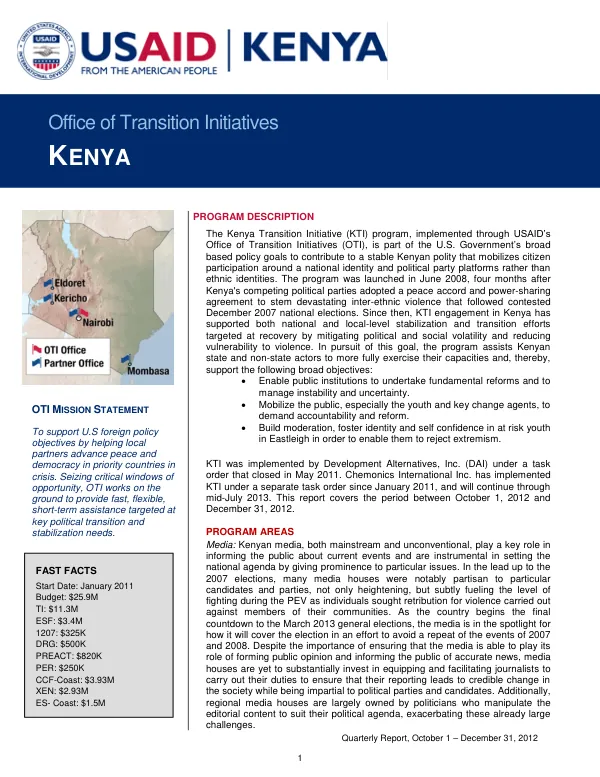
The Kenya Transition Initiative (KTI) program, implemented through USAID's Office of Transition Initiatives (OTI), aims to contribute to a stable Kenyan polity by mobilizing citizen participation around a national identity and political party platforms rather than ethnic identities.
2012 · 10 pages
Sign in to readA free account is required to download.
Abstract
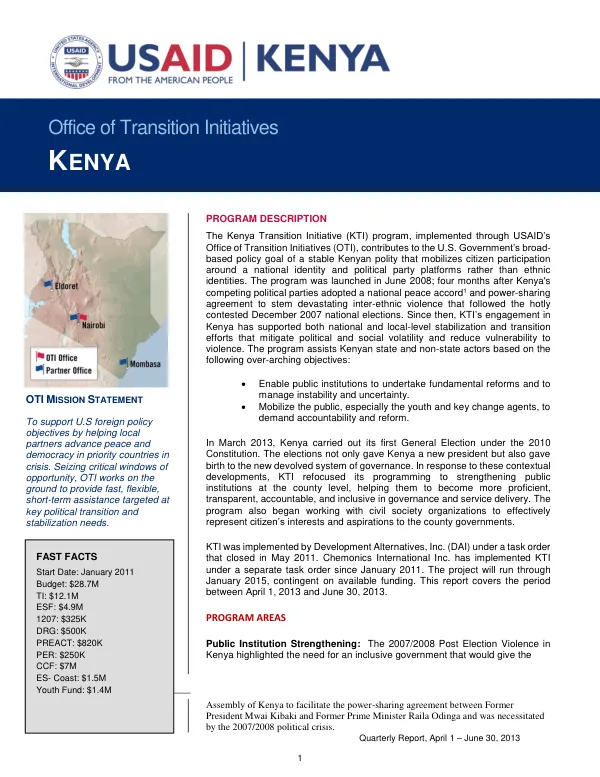
Launched in June 2008, the program supports national and local-level stabilization and transition efforts to mitigate political and social volatility and reduce vulnerability to violence. KTI's objectives include enabling public institutions to undertake fundamental reforms and manage instability and uncertainty, mobilizing the public to demand accountability and reform, and building moderation and fostering identity and self-confidence in at-risk youth. The program is implemented by Development Alternatives, Inc. (DAI) and Chemonics, with a budget of $11.33 million in Transition Initiative funds, $3.4 million in Economic Support Funds, and $325,000 in 1207 funds. During the reporting period, July 1 to September 30, 2012, KTI supported activities to mitigate ethnic tensions among multi-ethnic and border communities, known as hot spots, and among youth who have historically been vulnerable to manipulation by unscrupulous politicians. In the South Rift region, KTI facilitated dialogue among stakeholders in tea estates known for their diversity of worker populations, which have commonly experienced inter-ethnic violence at election times. Through a KTI grant, workers on multiple tea estates were engaged in open discussion and sharing of their experiences during the last elections as a way to encourage reflection on ways to avoid a repeat of violence. KTI also supported debates, radio programs, and town hall meetings where political candidates were invited to share their proposals and platforms as a way to better inform voters and encourage them to consider the qualities they wish to see in their leaders. In Naivasha, a well-known hot spot during election times, KTI engaged youth in creating video peace messages that will be aired at grassroots levels aimed at drawing youth away from participating in acts of violence. In the Coastal region, KTI provided support to the Supreme Council of Kenyan Muslims to create a task force to bring together key stakeholders in the region. The task force was able to secure radio shows where they addressed local youth and encouraged them to maintain peace as they waited for the police to investigate the circumstances in which a controversial Muslim cleric was killed. This resulted in youth not holding their planned demonstrations and helped ease religious tensions in the region as Mombasa regained calm. Public Institution Strengthening is another key area of focus for KTI. The program has provided support to a number of governmental institutions with a role in moving forward with key reforms that will contribute to peaceful elections in 2013. This has included support to a number of local-level land registry offices, in recognition that unresolved land grievances and skepticism of the government's commitment to addressing them remain a potent driver of conflict in many areas. During the quarter, KTI supported the Ministry of Lands in Kilifi District along the Coast, to enhance service delivery through improvements to its records storage facility and security upgrades of the physical land registry. The Kenyan judiciary has also begun to appear serious in its efforts to reform the country's judicial system. KTI is supporting the Mombasa High Court by purchasing and installing case management system software that will increase the rate of information that court users and the public have access to, incorporating lessons learned from prior work with the Eldoret and Kapsabet Courts. As Kenyans begin to perceive the Courts with greater trust due to increased efficiency and transparency, it is hoped that they will be less likely to turn to vigilantism and violence to address their grievances and will be more willing to use the established legal framework to resolve conflicts in a peaceful and legal fashion. The Coastal Region has experienced a significant increase in violence, with over 100 people killed in Tana River County during fighting between bordering ethnic communities over natural resources incited by political leaders in the region. The government's response to the Tana River attacks was criticized for being slow, and violence in the area continued even after a large police contingent was deployed to restore calm. KTI has decided to engage a consultant to conduct an overall assessment of the region that will be used to inform KTI programmatic responses to this still-volatile and evolving context. In Mombasa, the killing of Sheikh Aboud Rogo, suspected of links to known terrorist groups, sparked two days of riots in the city as mostly youth protesters demonstrated against his killing, implicating the police. The protestors targeted police, killing three officers in the process, and attacked Christian churches. The violence exposed underlying religious intolerance in the Coastal region. Kenya's President and Prime Minister shuffled the cabinet, with the Prime Minister being replaced by a new leader. This change has created uncertainty and has the potential to impact the country's stability and security.
Related documents