ABT ASSOCIATES
Quarterly Report – Q1/04
The Wajibika Project, a USAID-funded initiative, supports the Government of Tanzania's efforts to strengthen Local Government Authorities' (LGA) capacity for fiscal and programmatic accountability under the decentralization by devolution (D by D) program.
2011 · 14 pages
Sign in to readA free account is required to download.
Abstract
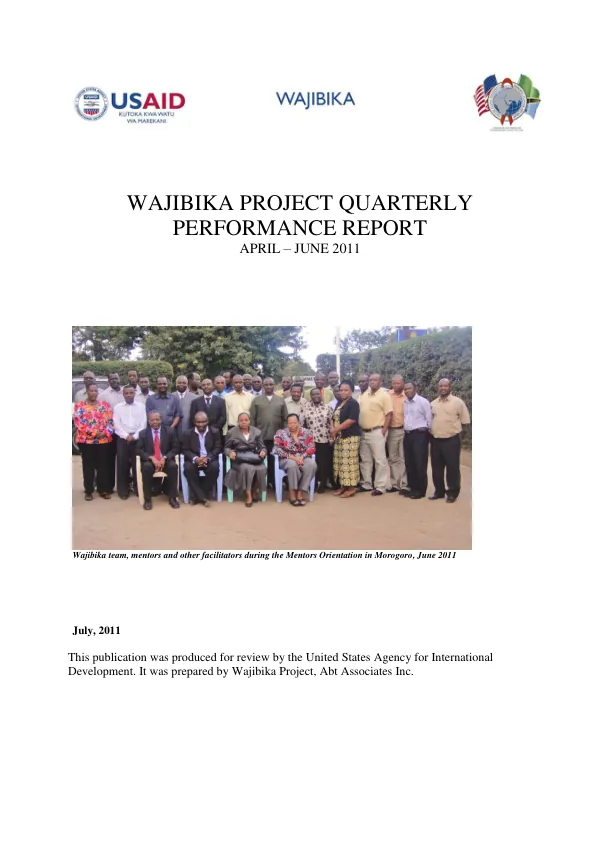
The project operates in partnership with the Prime Minister's Office Regional Administration and Local Government (PMO-RALG), the Ministry of Health and Social Welfare (MOHSW), and Family Health International (FHI). In the quarter April 1 to June 30, 2011, the project implemented several key activities. Mentor Orientation was conducted from June 1-3, 2011, with 21 mentors participating. The main objective of the orientation was to equip mentors with appropriate skills for mentoring in councils, focusing on planning, budgeting, reporting, and resource mobilization and allocation. The training included presentations on mentoring experiences from the Iringa Region, LGAs reforms, mentoring practices, procurement procedures, and the Comprehensive Council Health Plan (CCHP). International Public Sector Accounting Standards (IPSAS) Training was also conducted in June 2011, with 222 participants from 27 Local Government Authorities (LGAs) in Morogoro, Dodoma, Iringa, and Pwani Regions. The training aimed to build and enhance the capacity of Local Government Accountants and Auditors in the area of IPSAS, enabling them to improve their ability to be accountable and transparent. The project also subcontracted an outside organization to develop a Web-Based tool that would facilitate communication among the LGAs, Regional Secretariat, and PMO-RALG Headquarters. However, due to delays, the project decided to develop the tool in-house. A mock-up of the tool was completed during this quarter, and meetings were held with PMO-RALG to get their input on the tool. Supportive supervision and technical assistance were also conducted in the Iringa Region, with the Wajibika team visiting 4 councils to assess the project's impact on strengthening LGAs' capacity in planning and financial management. The supervision team found that the presence of mentors resulted in several improvements in the councils, including high scores in the Regional Secretariat's assessment of CCHPs. In addition, the Wajibika team, in collaboration with PMO-RALG, conducted a pilot test of Epicor 9.05 in Iringa DC and trained five accountants and two procurement specialists in the use of the software. The implementation activities included confirming readiness with pre-requisite data, confirming availability of trained staff, and connecting to the system. Overall, the Wajibika Project made significant progress in the quarter April 1 to June 30, 2011, in implementing key activities and achieving benchmarks. The project's efforts to strengthen LGAs' capacity for fiscal and programmatic accountability are expected to have a positive impact on the decentralization by devolution program in Tanzania.
![Tanzania Public Sector Systems Strengthening Plus (PS3+) Year 3 [Fiscal Year 4] Quarter 3 Report](https://covers.devme.ai/gen/149103.webp)