USAID DEC
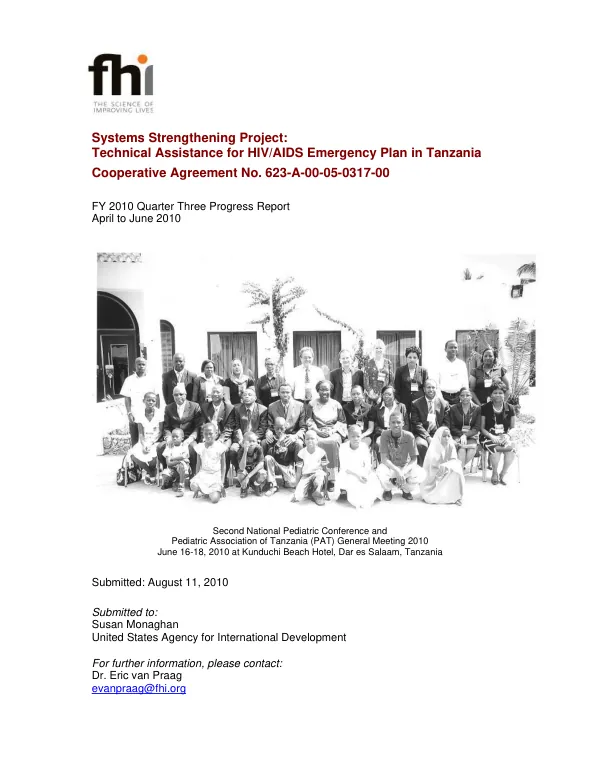
Systems Strengthening Project: Technical Assistance for HIV/AIDS Emergency Plan in Tanzania
Sign inFAMILY HEALTH INTERNATIONAL
Systems Strengthening Project: Technical Assistance for HIV/AIDS Emergency Plan in Tanzania
The Systems Strengthening Project in Tanzania, supported by the United States Agency for International Development (USAID), aims to enhance the multi-sectoral response to HIV/AIDS in the country.
2009 · 18 pages
Sign in to readA free account is required to download.
Abstract
The project is implemented by Family Health International (FHI) in collaboration with the Ministry of Health and Social Welfare (MOHSW), the National AIDS Control Program (NACP), and other stakeholders. The project's primary objective is to strengthen the capacity of the NACP to lead and coordinate the scale-up of national care and treatment services. To achieve this, FHI has been providing technical assistance to the NACP, including facilitating a management retreat to enhance leadership and management capacity. The retreat, scheduled for October, will focus on team-performance analysis, agenda design, and implementation. FHI has also been working to strengthen health systems through transitioning and program integration. The USG-GoT Partnership framework was presented in September as the umbrella for all systems strengthening activities. FHI initiated discussions with the Prime Minister's Office Regional Administration and Local Governments (PMORALG) to support a more strategic approach for planning and budgeting of HIV care and treatment activities by local councils and regional authorities. In addition, FHI has been working closely with the Reproductive Child Health Department of the MOHSW to study the feasibility of integrated family planning (FP) and treatment activities at care and treatment clinics (CTCs). A costed action plan is being drafted and supported by FHI for a revival of a national FP strategy. The relevance of FP integration was reflected in the revised national home-based care (HBC) guidelines and the finalization of the national SOPs in August. The project also aims to maximize the use of human resources in health. With support from the donor committee, the Permanent Secretary (PS) MOHSW decided to reactivate the Human Resource Working Group with broad and full membership of non-governmental bodies and clear deliverables from the various strategic objectives of the national HR Strategic Framework 08-12. FHI used the meeting as an opportunity to promote and revive the task shifting (TS) discussion, resulting in an invitation to present TS realities and opportunities in Tanzania to the senior management team of the MOHSW in November/December. Pre-service training was strengthened this quarter through FHI membership in the Advisory Committee on Nurse Education chaired by the Director, School of Nursing, MUHAS. With FHI support, the nurse tutor curriculum has been finalized and is in use now at all nurse tutor schools in the country. So far, 398 nurse tutors have been trained, and 15 nurse tutor schools have been supported to implement the new curriculum. The project has also made progress in other areas, including the launch of the national HIV/AIDS Stigma Reduction Guide and the finalization of the National Guidelines for Improving Quality of Care, Support and Protection of Most Vulnerable Children in Tanzania. The project has obtained valuable feedback through visits to HBC service providers/supervisors and PLHIV support groups on their experiences with implementing positive prevention interventions. Information obtained through these discussions is being evaluated and will shape future strategies. Overall, the Systems Strengthening Project in Tanzania has made significant progress in strengthening the capacity of the NACP, health systems, and human resources in health. The project continues to work towards enhancing the multi-sectoral response to HIV/AIDS in the country and contributing to the President's Emergency Plan for AIDS Relief (PEPFAR) targets.