USAID DEC
Quarterly Report: Reading for Ethiopia’s Achievement Developed Technical Assistance (READ TA) Project
Sign inMINISTRY OF EDUCATION
Quarterly Report: Reading for Ethiopia’s Achievement Developed Technical Assistance (READ TA) Project
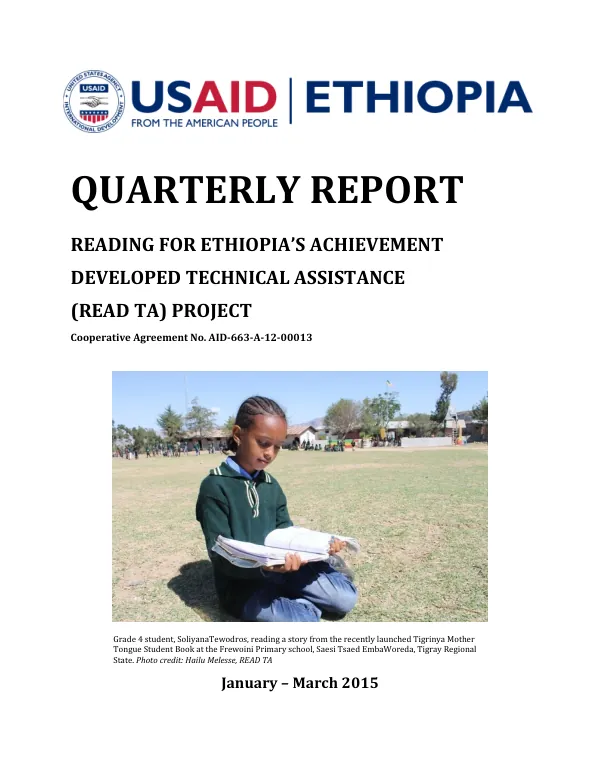
The Reading for Ethiopia's Achievement Developed Technical Assistance (READ TA) project is a cooperative agreement between the United States Agency for International Development (USAID) and the Government of Ethiopia.
2015 · 35 pages
Sign in to readA free account is required to download.
Abstract
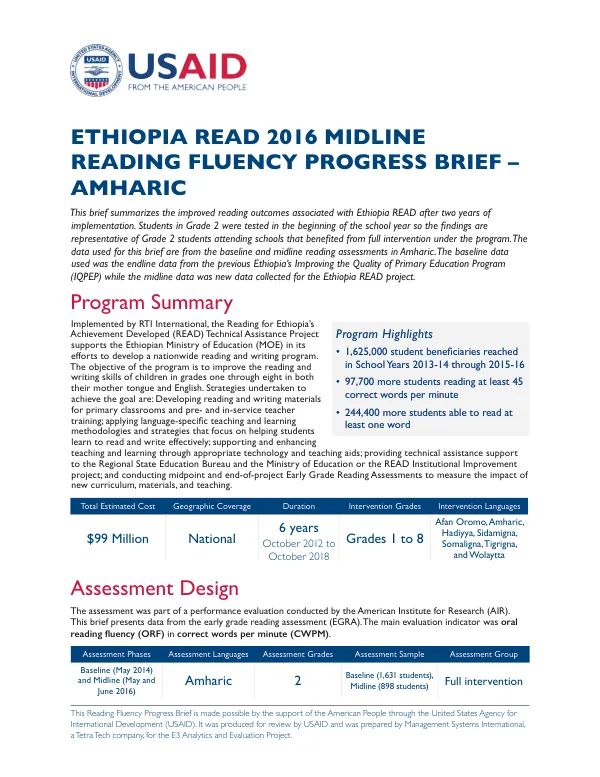
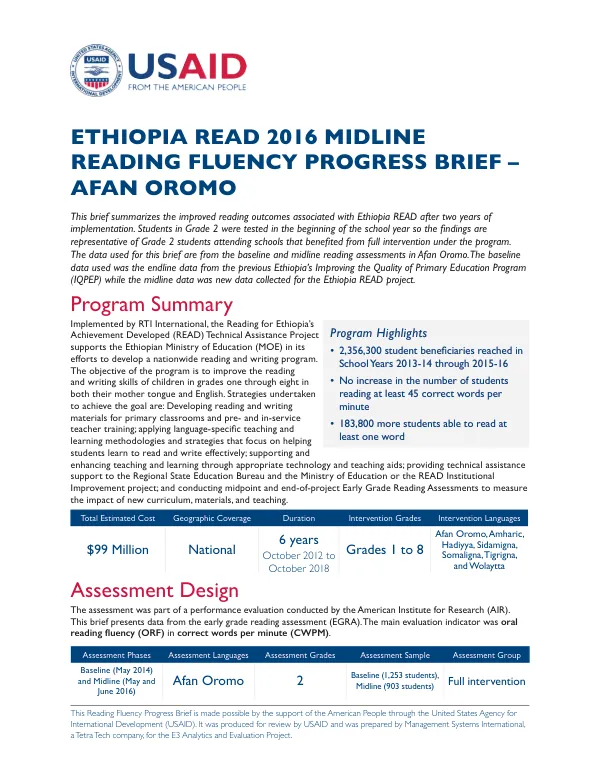
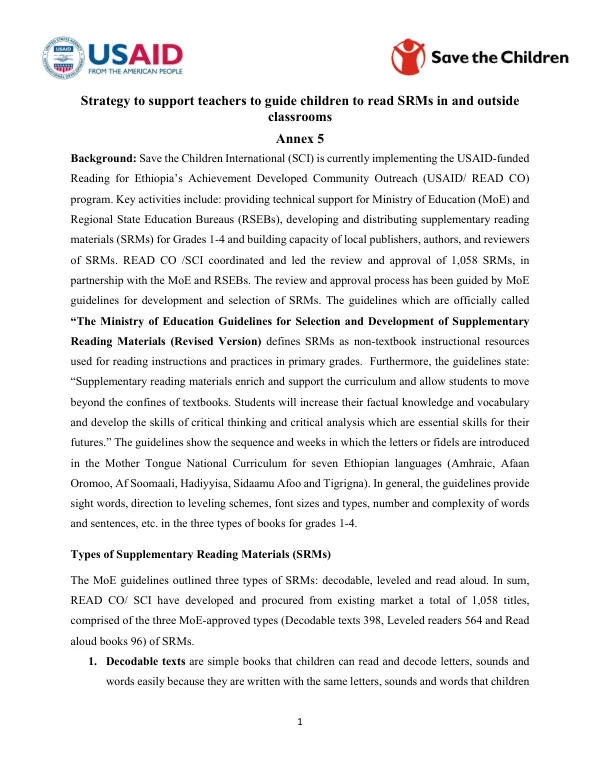
The project aims to improve reading and writing skills among primary school students in Ethiopia. The project is implemented in four regions: Amhara, Oromia, SNNPR, and Tigray. The project has made significant progress in developing reading and writing materials for primary classrooms and pre-service and in-service teacher training. The Mother Tongue Curriculum Development Team (MTCDT) has finalized the work on Grade 5-8 curriculum materials in the seven mother tongues and readied them for final validation. The project has also conducted final validation workshops for Grade 5-8 materials in the seven mother tongues and obtained Regional State Education Bureau (RSEB) approvals for camera-ready copies. The project has also made progress in adapting Grade 5-8 Amharic, Afaan Oromo, and Af-Somali student books and teachers' guides to 12 language communities in nine other regions. Additionally, the project has designed a methodology for the English Situation Analysis (ESA) in collaboration with the Ministry of Education (MoE). The ESA field study consultants have developed 10 instruments and trained 25 data collectors. The project has also deployed ESA data collectors, collected data, received data from 29 schools, and started data entry. The project has also made progress in developing language-specific teaching and learning methodologies and strategies that focus on helping students learn to read and write effectively. The project has prepared and scheduled the development of the Grade 5-8 Teacher Training Manual. The project has also developed terms of reference (TOR) to guide the development, adaptation, and validation of the mentoring manual and approach that received MoE approval. The project has also conducted regional-level consultative meetings on innovative practices to reading and writing with Task Force Members, Zone Education Department (ZED) representatives, exemplary schools, Regional Teachers' Association representatives, and non-governmental organizations (NGO) working on reading and writing. The project has also provided monitoring support for teacher training rollouts organized by Amhara, Oromia, and SNNPR RSEBs through deploying Master Trainers. The project has also made progress in language teaching and learning supported by appropriate technology. The project has developed a methodology for the use of information and communication technology (ICT) in reading and writing instruction. The project has also provided training to teachers on the use of ICT in reading and writing instruction. The project has also made progress in institutional improvement. The project has provided technical assistance support to RSEBs and MoE for READ institutional improvement. The project has also conducted monitoring and evaluation visits at College of Teacher Education (CTE) implementing Module 1. The project has also made progress in regional updates. The project has provided updates on the progress of the project in the four regions. The project has also provided information on the challenges faced by the project in the four regions. The project has also made progress in project management. The project has provided information on the project's financial expenditure. The project has also provided information on the key upcoming activities for the project. The project has also made progress in short-term technical assistance (STTA). The project has provided information on the planned international STTA for Year 3 Quarter 4. The project has also provided information on the READ TA staff as of March 31, 2015.