CHEMONICS
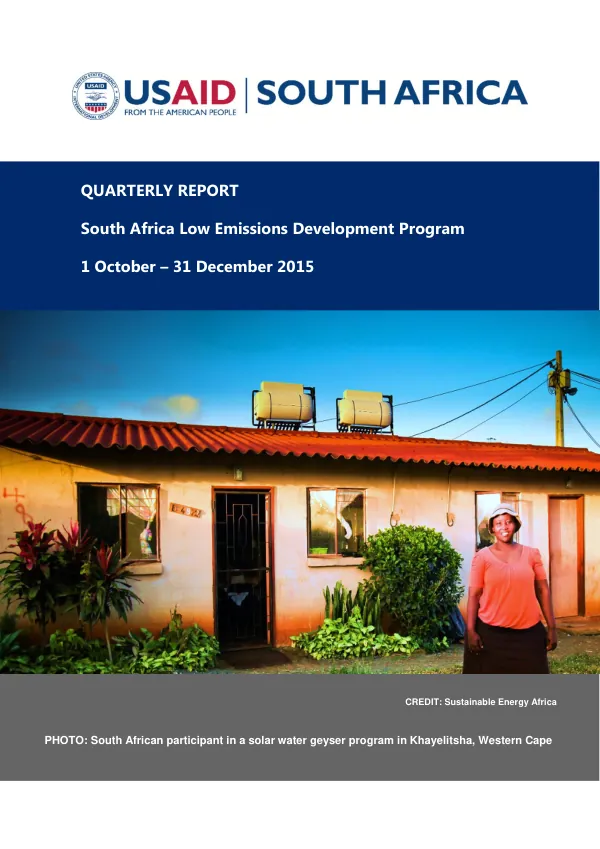
Quarterly Report: South Africa Low Emissions Development Program
The South Africa Low Emissions Development Program (SA-LED) began executing its year-ending 30 September 2016 annual plan, designed to identify capacity constraints, gaps in the market, and blockages to LED project development and implementation.
2015 · 30 pages
Sign in to readA free account is required to download.
Abstract
The results, informed by practical project technical assistance experience and a rigorous program of research in 2016, will be used to develop a data-driven, structured program of technical assistance for years 2017-2020 that will support a systemic adoption of low emissions technologies at a sub-national level. During the quarter, the project team identified 10 municipal LED initiatives in various stages of the project development cycle to support with technical assistance. The projects selected strategically represent at least one project per flagship sector (renewable energy, energy efficiency, waste management, and transport) and range from feasibility study engineering assistance, to financial advisory services support, legal/regulatory support, RFP development, and LED project planning and capacity building. The SA-LED team made excellent progress in meeting its milestones this quarter. Motivated by the need to better understand the South African LED landscape, the SA-LED team spent part of the quarter engaging stakeholders across national, provincial, and local government and meeting with private sector developers and financial institutions to better understand the blockages to developing, financing, and implementing LED projects. In this quarter, SA-LED held over 50 stakeholder meetings and hosted a Roundtable Workshop for thirty private-sector project developers, developed its research program, finalized its technical assistance framework, sourced ten LED initiatives, and formally launched its program with the US Ambassador and senior officials of the Governments of the United States and South Africa. The SA-LED Program has two key objectives: to strengthen public sector-related LED planning and project development capacity and to increase core competencies through technical assistance and learning activities. The program indicators include the number of LED projects assisted, the number of individuals with improved project development capacity, the value of funds mobilized to support LED project development, and the total projected quantity of GHG emissions reduced or avoided as a result of the implementation of projects supported by SA-LED. The SA-LED team developed its technical assistance framework and classified its interventions into five broad categories: research and analysis, LED project development, capacity development, enabling environment, and measurement, reporting, and verification of GHG emissions. The research and analysis component aims to understand the legal, financial, and regulatory barriers to LED project implementation, while the LED project development component supports 10 municipal LED initiatives across each of the four flagship sectors. The capacity development component embeds experts and conducts formal training with municipal partners, and the enabling environment component helps create an institutional support for LED efforts across local, provincial, and national government. The measurement, reporting, and verification of GHG emissions component supports municipalities to perform project-level greenhouse gas emission analyses.