CHEMONICS
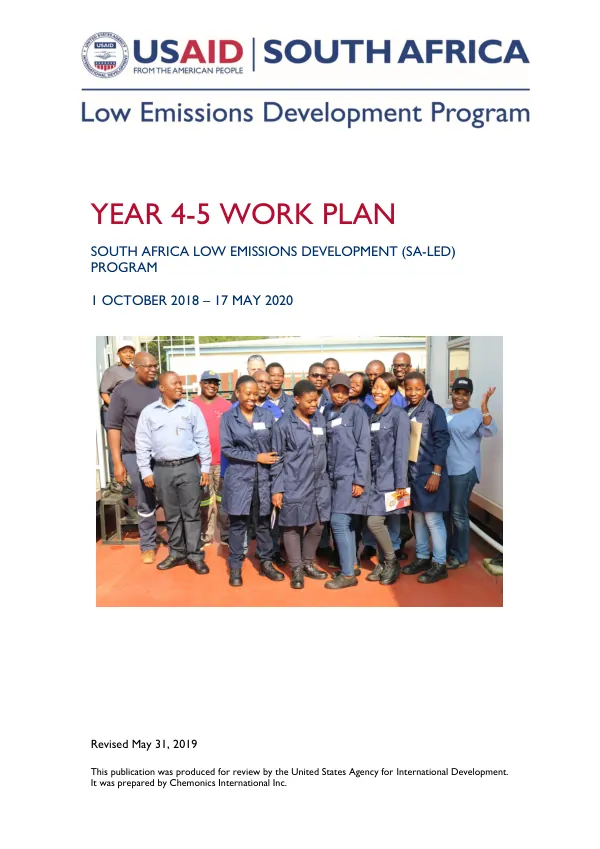
Quarterly Report: South Africa Low Emissions Development (SA-LED) Program
South Africa is embarking on an ambitious effort to use Low Emissions Development (LED) as a means to reduce its substantial greenhouse gas (GHG) levels in a sustainable and equitable way.
2018 · 47 pages
Sign in to readA free account is required to download.
Abstract
To do so will require transformational change at multiple levels and sectors, including mitigating key capacity bottlenecks and coordinating with a diverse set of actors who contribute to LED project development. The 2011 National Climate Change Response White Paper presents ambitious cross-sectoral mitigation goals, but significant obstacles remain in translating its vision into actual LED projects. Many South African municipalities lack the management skills to move projects through the pipeline, and a clear structure for coordinating between the municipal and national department level has not yet been articulated. Additionally, these institutions do not yet have an understanding of the operational and planning implications of provisions of the White Paper and have had issues translating national Department of Environmental Affairs (DEA) recommendations into actionable projects. South African investors also lack a sophisticated understanding of LED technology or the legal and regulatory framework surrounding green investment, perceiving such investments as risky. Addressing these challenges requires translating LED concepts into replicable projects, proving their success, and scaling up. The United States Agency for International Development (USAID) South Africa Low Emissions Development Program's (SA-LED) goal is to support the primary objectives of emissions reduction in South Africa. SA-LED aims to support the development of LED projects that are replicable, scalable, and sustainable, and that can be implemented by municipalities and other stakeholders. The program focuses on building the capacity of municipalities to develop and implement LED projects, as well as providing technical assistance to support the development of LED projects. SA-LED also works to create an enabling environment for LED project development, including providing support for the development of policies and regulations that support LED projects. The program's quarterly report highlights several key activities and achievements, including the development of LED projects in various municipalities, the provision of training and technical assistance to support LED project development, and the creation of an enabling environment for LED project development. The report also highlights several challenges and constraints that have been encountered, including the lack of management skills and capacity among municipalities, and the need for further support to develop policies and regulations that support LED projects.