CHEMONICS
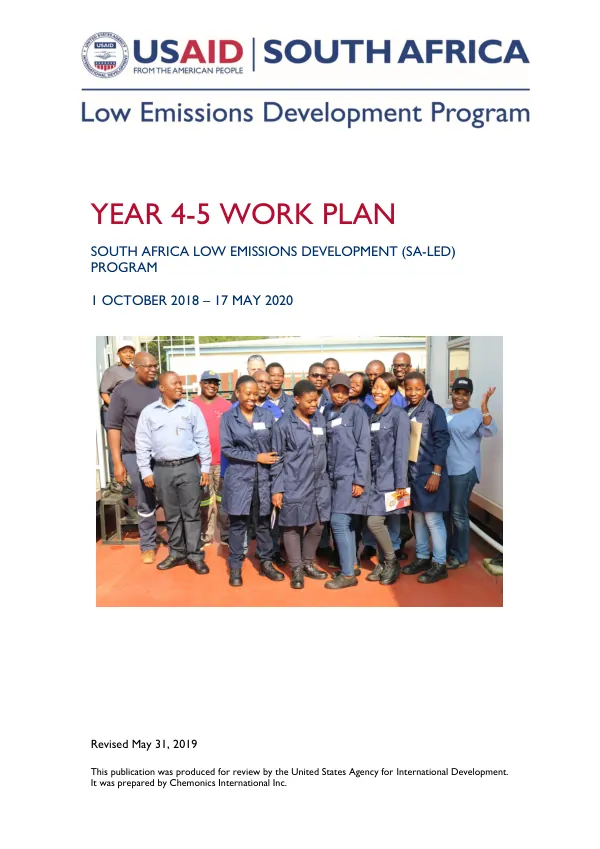
Annual Work Plan Years 4-5: South Africa Low Emissions Development (SA-LED) Program
The South Africa Low Emissions Development (SA-LED) Program is a USAID/South Africa funded program that supports the accomplishment of the U.S.
2019 · 56 pages
Sign in to readA free account is required to download.
Abstract
Government's Development Cooperation Strategy in South Africa. The program was awarded to Chemonics International on May 18, 2015, under Contract No. AID-674-C-15-00005. SA-LED's overarching objective is to support the Government of South Africa (GoSA) in its efforts to expand low emissions development (LED) through improving the capacity of South African LED actors to select, plan, implement, and expand LED projects. The program has two integrated strategic objectives: Objective 1, which aims to strengthen public sector-related development planning and project development capacity for low emissions projects, including the mobilization of development finance and private sector participation; and Objective 2, which seeks to increase public sector core competencies through technical assistance and learning activities in support of GoSA's Green Growth initiatives. The GoSA has been instrumental in co-creating the terms of reference for this program and will continue to be part of the program's Strategic Advisory Committee. South Africa has committed to implement an effective nationally determined climate change response, including mitigation and adaptation actions that represent the nation's fair contribution to the global climate change response. Central to the approach adopted by the government is an emphasis on LED to reduce its substantial greenhouse gas (GHG) emissions levels in a sustainable, equitable, and just manner. To achieve this, transformational change at multiple levels and sectors is required, including mitigating key capacity bottlenecks and coordinating with a diverse set of actors who contribute to LED project development. The Climate Change Bill (2018) acknowledges the important role of the sub-national government sphere (province and local) in achieving the country's national climate change response. While the bill recognizes the role of municipalities in climate change mitigation, it does not explicitly establish sectoral emissions targets for municipalities. However, the bill does require mayors of municipalities to undertake climate change needs and response assessments within a year of the promulgation of the Climate Change Bill, followed by the development of municipal climate change response implementation plans that include measures or programs (LED projects) relating to both adaptation and mitigation. The SA-LED program aims to address the challenges associated with LED project development in South Africa. The program's approach focuses on strengthening public sector capacity, increasing public sector core competencies, and promoting LED through technical assistance and learning activities. The program's success is critical to the implementation of the Climate Change Bill and the achievement of South Africa's national climate change response. The SA-LED program has identified several key areas of focus for the next two years, including increasing investment in LED, accelerating the rate of implementation of LED initiatives, and improving the quality of monitoring and reporting of GHG emissions at sub-national and project levels. The program will achieve these objectives through a range of activities, including technical assistance, training, and capacity building, as well as the development of tools and resources to support LED project development. The SA-LED program has a strong local ownership and strategic support from its partners at the national level, including the Departments of Environmental Affairs (DEA) and Science and Technology (DST). The program's success will depend on the effective implementation of its activities and the achievement of its objectives, which are critical to the implementation of the Climate Change Bill and the achievement of South Africa's national climate change response.