USAID DEC
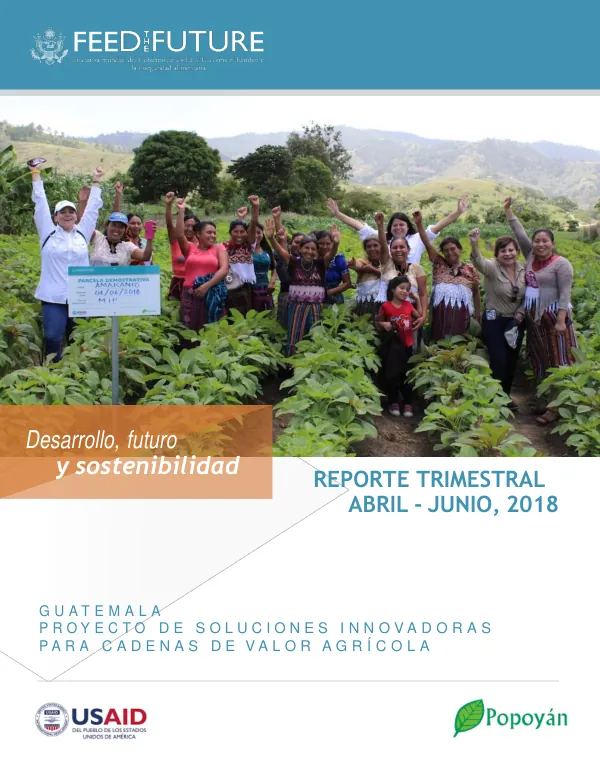
Quarterly Report: Third Quarter – April 01 to June 30, 2018, Feed the Future Guatemala-Innovative Solutions for Agricultural Value Chains Project
Sign inUSAID/GUATEMALA-CAP
Quarterly Report: Third Quarter – April 01 to June 30, 2018, Feed the Future Guatemala-Innovative Solutions for Agricultural Value Chains Project
The agricultural development initiative in Guatemala, known as the Feed the Future Guatemala-Innovative Solutions for Agricultural Value Chains Project, aims to improve the livelihoods of small farmers and their families in the western highlands of the country.
2018 · 43 pages
Sign in to readA free account is required to download.
Abstract
The project is funded by the United States Agency for International Development (USAID) and implemented by Agropecuaria Popoyán, S.A. The project's main objective is to enhance the nutritional status, increase agricultural income, and improve the resilience of the natural environment of small farmers and their families. The project focuses on five departments in the western highlands of Guatemala: Quiché, Huehuetenango, Quetzaltenango, San Marcos, and Totonicapán. The project's strategy is based on four pillars: the strength of alliances between the public and private sectors, the promotion of innovation based on applied science, territorial and thematic prioritization, and leadership by different institutions. The project's design is grounded in the learning from successes and lessons learned from previous initiatives and efforts of USAID in the framework of the Feed the Future programs. During the third quarter of 2018, the project trained 1,049 people, of which 21% were women, 79% were men, and 27% were young people (under 30 years old). These trainings represent the most important mechanism for improving the capacities of small farmers to increase the productivity of their crops. The project also implemented 143 demonstration plots, where 13% of the participants were women and 87% were men. Of the total number of leader farmers participating, 24% were young people. The project has also initiated the identification of the first lands for a reforestation campaign, in alliance with the Municipalities of San Juan Cotzal, Quiché, and San Lorenzo, San Marcos, with the objective of reforesting 50 hectares of those areas. Approximately 74,000 forest seedlings (between pine, alder, and cypress) will be acquired for this purpose. In terms of market access, the project has maintained interactions with other actors in the private sector to maintain an inclusive approach and expand the project's scope to communities and farmers outside the immediate network. To define the framework of participation of the private sector, the project published the first Pro Compite tender, achieving a total of 37 proposals from different organizations in the private sector for the components of productivity, nutrition, and market access. The project's progress during the third quarter of 2018 has been significant, with the implementation of demonstration plots, trainings, and the initiation of the reforestation campaign. The project's focus on innovation, territorial prioritization, and leadership by different institutions has been instrumental in achieving its objectives. The project's success will contribute to the reduction of poverty and chronic malnutrition in Guatemala, as well as the improvement of the resilience of the natural environment of small farmers and their families.