USAID DEC
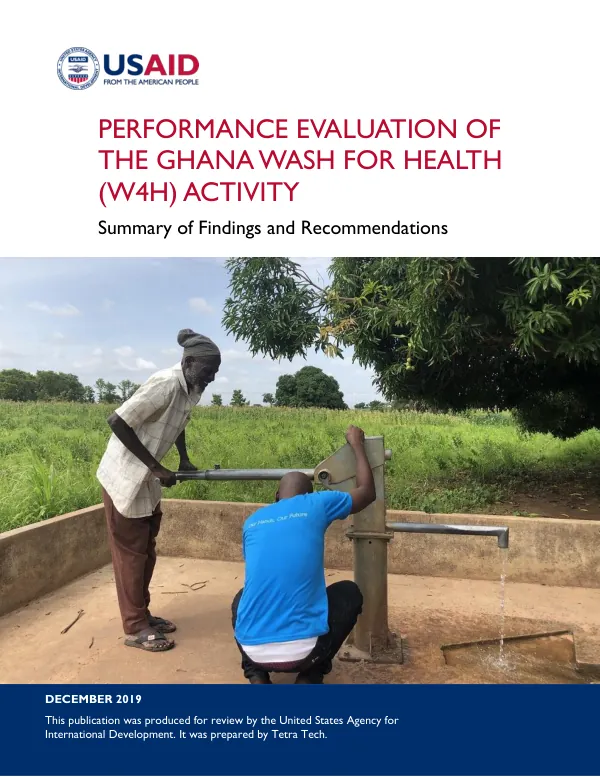
Quarterly Report: Water, Sanitation and Hygiene for Health Project January 2016 – March 2016
Sign inGLOBAL COMMUNITIES
Quarterly Report: Water, Sanitation and Hygiene for Health Project January 2016 – March 2016
The Water, Sanitation and Hygiene (WASH) for Health project was awarded to Global Communities on February 6, 2015, and is to be implemented until February 2020.
2016 · 33 pages
Sign in to readA free account is required to download.
Abstract
The goal of the project is to accelerate sustainable improvement in water and sanitation access and improve hygiene behaviors in target districts in Ghana. The project is funded by the United States Agency for International Development (USAID) with a total estimated federal funding of US$ 18,693,256. The project is being implemented in five regions of Ghana: Greater Accra, Central, Volta, Northern, and Western. The project has six components: Increased Use of Improved Household Sanitation, Improved Community Water Supply Services, Improved Sector Governance and Policies, Expanded Key Hygiene Behaviors, Leveraged PPP Investments to Magnify the Impact of USG Funding, and Improved Water Supply and Sanitation Infrastructure for Schools and Health Facilities. In the second quarter of Fiscal Year 2016 (FY16), activity implementation under each component continued according to the annual work plan. Sketches of various household toilets have been developed based on community water and sanitation agency (CWSA) standards, and catalogs showing the different toilet options are being produced to inform community decision making. A plastic toilet is also being developed in partnership with Duraplast Ghana Limited, and after producing prototypes, is now being piloted. Six prototype plastic toilets have been installed in Agortime, Adaklu, and Ho Municipalities in the Volta Region, with another four installed in Ada East and Ada West in the Greater Accra. A total of 164 Field Officers were trained in community-led total sanitation (CLTS) facilitation, and 348 Natural Leaders were chosen to help attain and sustain open defecation free (ODF) status in their communities. So far, 27 of these Natural leaders have been trained. In three districts (Bole, Sawla-Tuna-Kalba, and West Mamprusi) in the Northern Region, residents of triggered communities began building roughly 800 household toilets. WASH for Health is handling sanitation marketing in the Northern districts through a partnership with Jaksally Youth Group, which consists of 36,000 members who are encouraged to save money for household toilets. Further, the project is increasing the availability of toilet construction materials, like cement and vent pipes, within convenient traveling distances for community members to purchase. The project has also made progress in promoting hygiene behaviors, with a focus on social behavior change communication (SBCC) and community-led total sanitation (CLTS). The project has established a small grants scheme to support community-led initiatives and has provided training and support to community-based organizations (CBOs) and local non-governmental organizations (LNGOs). The project has also made progress in improving water supply and sanitation infrastructure, with a focus on improving access to safe drinking water and sanitation facilities in schools and health facilities. The project has installed water and sanitation facilities in several schools and health facilities, and has provided training and support to facility managers and users. Overall, the WASH for Health project has made significant progress in the second quarter of FY16, with a focus on accelerating sustainable improvement in water and sanitation access and improving hygiene behaviors in target districts in Ghana.