USAID DEC
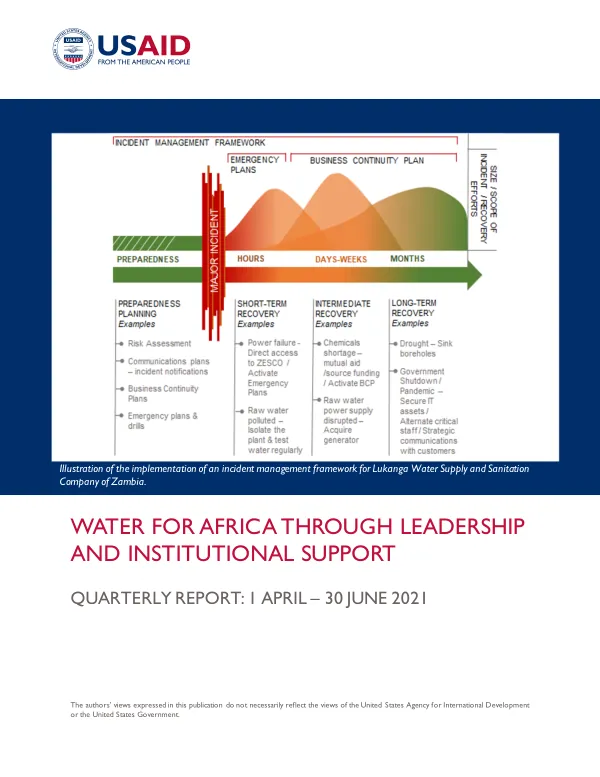
Water for Africa through Leadership and Institutional Support (WALIS) Quarterly Report: 1 April – 30 June 2021
Sign inDAI GLOBAL, LLC
Water for Africa through Leadership and Institutional Support (WALIS) Quarterly Report: 1 April – 30 June 2021
The Water for Africa through Leadership and Institutional Support (WALIS) program is a six-year initiative that aims to improve access to clean water and sanitation in Africa.
2021 · 38 pages
Sign in to readA free account is required to download.
Abstract
The program is implemented by DAI Global LLC and has an estimated maximum total funding amount of $13,883,704. WALIS is bolstered by the Water and Development Indefinite Delivery Indefinite Quantity (WADI) contract and is designed to support the Sustainable Development Goals (SDGs). The program has undergone several extensions, with the original period of performance running from September 25, 2015 to September 24, 2020. The current period of performance is from September 25, 2015 to November 23, 2021. WALIS is focused on bolstering the ability of African leaders, donors, and stakeholders to better use existing data and analyses to shape national water, sanitation, and hygiene (WASH) policy, planning, and budgets. The program is structured around four core task areas for Program Years 1-5: Task 1, Task 2, Task 3, and Task 4. Task 1 involves developing, monitoring, and analyzing sound sector data. Task 2 focuses on targeted research and pilot activities around identified sector constraints. Task 3 aims to strengthen country systems to develop informed policy and improve sector planning toward sustainable WASH services. Task 4 increases the capacity required to support improved collection and use of sector knowledge. In year six of the program, a scope of work was co-created with USAID to support USAID's Internal WASH Strategic Approach to COVID-19. This approach is referenced in USAID's April 22, 2020 Justification and Approval Memo and USAID's May 14, 2020 Proposed Revised Statement Work. WALIS will support USAID's Internal WASH Strategic Approach to COVID-19 through four COVID-19 and WASH Response task areas for Program Year 6: Task 1, Task 2, Task 3, and Task 4. Task 1 of the COVID-19 and WASH Response focuses on developing, monitoring, and analyzing sound sector data to inform COVID-19 response and/or resource allocation. Task 2 involves engaging in the gathering and dissemination of critical information and data to African governments. Task 3 aims to strengthen country systems and engage and inform sector policy that allows for the continuation and improvement of WASH service delivery. Task 4 increases the capacity of African regional institutions to improve the collection and use of sector knowledge to respond to COVID-19 coordination and monitoring needs. The program is implemented in several countries, including Zambia, Senegal, and Ghana. The WALIS team is led by Richard Rapier, Chief of Party, and includes a range of experts and stakeholders. The program has made significant progress in improving access to clean water and sanitation in Africa, with a focus on strengthening country systems and increasing the capacity of African leaders, donors, and stakeholders to better use existing data and analyses to shape national WASH policy, planning, and budgets. The program has also made significant progress in responding to the COVID-19 pandemic, with a focus on developing, monitoring, and analyzing sound sector data to inform COVID-19 response and/or resource allocation. The program has engaged in targeted research and pilot activities around identified sector constraints and has strengthened country systems to develop informed policy and improve sector planning toward sustainable WASH services. The WALIS program has a range of deliverables and reports, including the quarterly report, which provides an update on the program's progress and achievements. The program also has a range of annexes, including Annex A, which provides information on the WALIS MEL monitoring tables, and Annex B, which provides information on financing Africa's future with access to water, sanitation, and hygiene. Overall, the WALIS program is a significant initiative that aims to improve access to clean water and sanitation in Africa. The program has made significant progress in strengthening country systems and increasing the capacity of African leaders, donors, and stakeholders to better use existing data and analyses to shape national WASH policy, planning, and budgets.
Related documents