INTERNATIONAL BUSINESS AND TECHNICAL CONSULTANTS, INC.
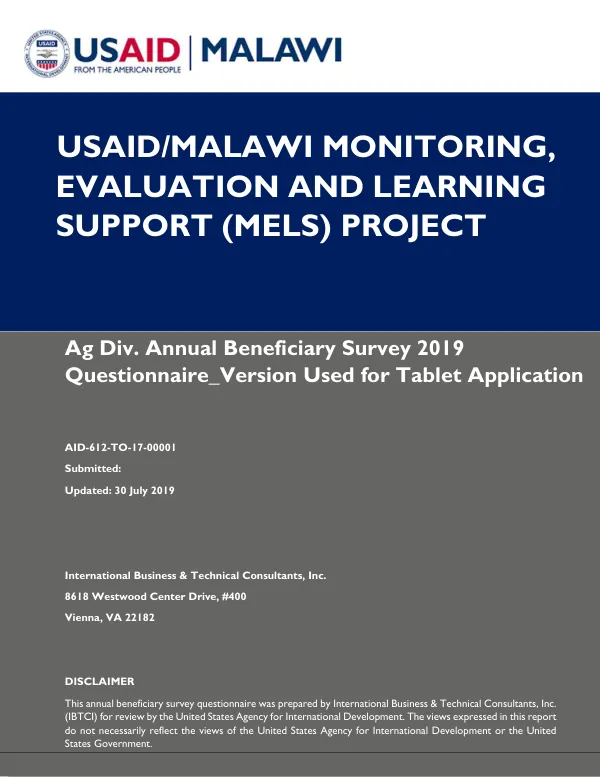
Questionnaire Annual Ext 2019
The agricultural development initiative in Malawi is focused on improving the livelihoods of smallholder farmers.
2021 · 58 pages
Sign in to readA free account is required to download.
Abstract
The initiative is being implemented by the United States Agency for International Development (USAID) through the Monitoring, Evaluation, and Learning Support (MELS) Project. The project aims to enhance the productivity and income of farmers through the adoption of improved agricultural practices and technologies. The baseline survey questionnaire was developed by International Business & Technical Consultants, Inc. (IBTCI) in June 2017. The questionnaire is designed to collect data on the agricultural practices and challenges faced by farmers in Malawi. The survey covers various topics, including involvement in agricultural activities, beneficiary identification, value chains, natural resources and ecosystem management, women's empowerment in agriculture, and female consumption of a diet of minimum diversity. The survey is conducted through a tablet application, and the questionnaire is divided into several modules. Module A focuses on involvement in agricultural activities, while Module B collects information on beneficiary identification. Module C covers value chains, including groundnuts, soybeans, and orange flesh sweet potatoes. Module D deals with natural resources and ecosystem management, while Module E focuses on women's empowerment in agriculture. Module F examines female consumption of a diet of minimum diversity, and Module G involves GPS area measurement of value chain fields. The informed consent statement is read to the beneficiary before the survey begins. The statement explains the purpose of the survey, the topics that will be covered, and the confidentiality of the data. The beneficiary is informed that participation is voluntary and that they can choose to stop at any time or skip any question they do not want to answer. The statement also provides contact information for the Centre for Development Management (CDM), the consulting firm conducting the survey. The survey is designed to collect data on the agricultural practices and challenges faced by farmers in Malawi. The data will be used to inform the development of agricultural policies and programs that can improve the livelihoods of smallholder farmers. The survey is an important tool for monitoring and evaluating the progress of the agricultural development initiative in Malawi. The survey questionnaire is comprehensive and covers a wide range of topics related to agricultural development. The questionnaire is designed to collect data on the adoption of improved agricultural practices and technologies, as well as the challenges faced by farmers in Malawi. The data collected through the survey will be used to inform the development of agricultural policies and programs that can improve the livelihoods of smallholder farmers. The survey is an important tool for monitoring and evaluating the progress of the agricultural development initiative in Malawi. The data collected through the survey will be used to identify areas where the initiative is making progress and areas where it needs to be improved. The data will also be used to inform the development of new agricultural policies and programs that can improve the livelihoods of smallholder farmers. The Centre for Development Management (CDM) is responsible for conducting the survey and collecting the data. The CDM is a consulting firm based in Lilongwe, Malawi, and has experience in conducting surveys and collecting data on agricultural development in Malawi. The CDM is working closely with the USAID MELS Project to ensure that the survey is conducted in a timely and efficient manner. The survey is an important step in the development of agricultural policies and programs in Malawi. The data collected through the survey will be used to inform the development of new policies and programs that can improve the livelihoods of smallholder farmers. The survey is an important tool for monitoring and evaluating the progress of the agricultural development initiative in Malawi, and it will play a critical role in shaping the future of agricultural development in the country.
Related documents