MINISTRY OF HEALTH AND POPULATION
Raedat Refiat (Community Health Worker) Program Strategy
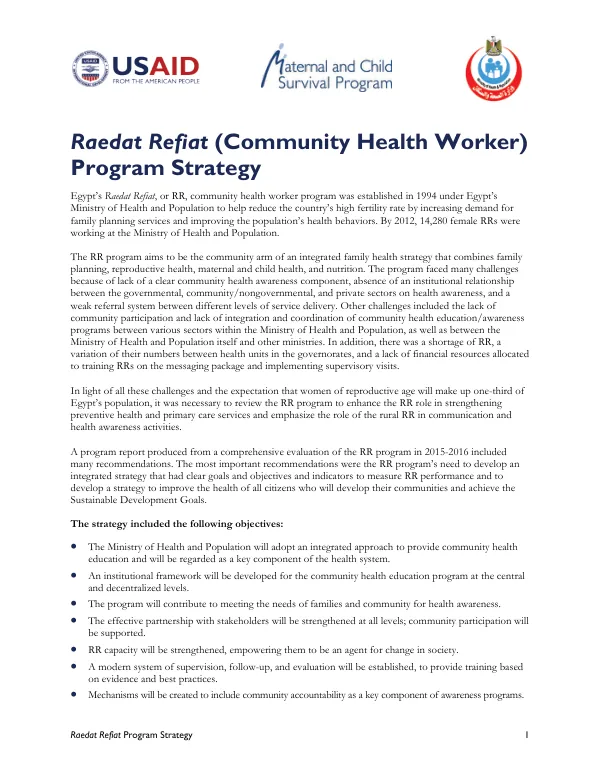
The Raedat Refiat (RR) community health worker program in Egypt was established in 1994 under the Ministry of Health and Population to address the country's high fertility rate by increasing demand for family planning services and improving health behaviors.
2019 · 2 pages
Sign in to readA free account is required to download.
Abstract
By 2012, 14,280 female RRs were working at the Ministry of Health and Population. The RR program aims to be the community arm of an integrated family health strategy combining family planning, reproductive health, maternal and child health, and nutrition. The program faced several challenges, including a lack of clear community health awareness component, absence of institutional relationships between governmental, community/nongovernmental, and private sectors on health awareness, and a weak referral system between different levels of service delivery. Other challenges included the lack of community participation, lack of integration and coordination of community health education/awareness programs between various sectors within the Ministry of Health and Population, and between the Ministry of Health and Population itself and other ministries. Additionally, there was a shortage of RRs, variation of their numbers between health units in the governorates, and a lack of financial resources allocated to training RRs on the messaging package and implementing supervisory visits. A comprehensive evaluation of the RR program in 2015-2016 led to several recommendations, including the need for the RR program to develop an integrated strategy with clear goals and objectives and indicators to measure RR performance. The strategy aimed to enhance the RR role in strengthening preventive health and primary care services and emphasize the role of the rural RR in communication and health awareness activities. The strategy included four main themes: institutionalized frameworks and governance, partnership, awareness and quality services, and capacity and resource development. The RR program needs to adopt new policies to improve and develop the work system, gain political support, activate coordination mechanisms, and support institutional and financial sustainability. Mechanisms for implementing and integrating these strategies include developing community health awareness plans, coordinating with community/nongovernmental organizations and the private sector, increasing the capabilities of service providers, engaging research institutions, and strengthening the supervision system. To codify the strategy and achieve the desired results, the strategy should be disseminated to high-level decision-makers, ministries, civil society organizations, and the private sector to raise public awareness about community health through the RR program. A ministerial decision will establish a national committee for monitoring and evaluation of the RR program strategy, which will follow up on the operational plans and continued evaluation through the indicators set out in the strategy and produce an annual report on what has been done.
Related documents