DAI
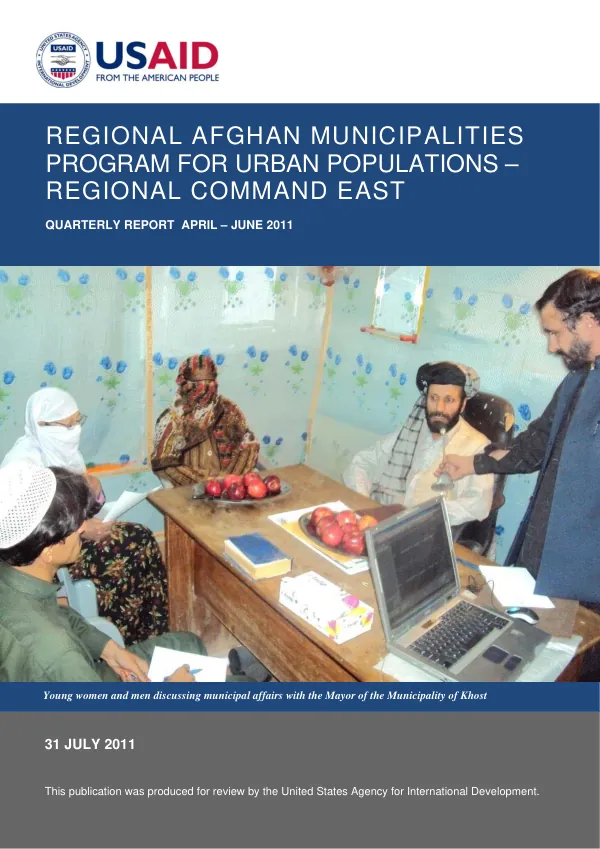
RAMP UP East Quarterly Report April-June 2011
Regional Afghan Municipalities Program for Urban Populations – Regional Command East (RAMP UP East) is a program aimed at creating effective, responsive, democratic, transparent, accountable, and gender-sensitive municipal governance.
2011 · 26 pages
Sign in to readA free account is required to download.
Abstract
The program's primary Assistance Objective is to increase the capacity of municipal officials, improve municipal service delivery to citizens, and assist municipalities in fostering economic growth. The program's three-pronged approach focuses on municipal governance and municipal officials' capacity building, service delivery, and revenue generation. In the second quarter of 2011, RAMP UP East undertook several activities to achieve these objectives. The April Municipal Planning Conference gathered Mayors, IDLG staff, USAID counterparts, and RAMP UP East staff in Kabul for two days of planning and program development. The conference resulted in the establishment of Technical Working Groups (TWGs) as a formal mechanism for discussion and program critique between GDMA and RAMP UP East. The TWGs identified important GDMA responsibilities vis-a-vis the RAMP UP East deliverables and helped build a strong rapport between GDMA and RAMP UP East counterparts. The 13 client municipalities undertook public consultations in May aimed at identifying community needs and priorities for municipal public services. Mayors asked community members to propose and prioritize small-scale municipal service delivery improvement projects, and RAMP UP East staff helped facilitate the consultation process. In June, stakeholders returned to Kabul for the second Municipal Action Planning Workshop, where Mayors presented the proposed Year 2 Municipal Investment Plans (MIPs) to IDLG/GDMA and explained how these public service delivery projects would impact on improving the city and daily living conditions of Afghan citizens. The workshop secured endorsement from IDLG and GDMA to move forward with approved Year 2 MIPs. RAMP UP East also focused on building Mayors' capacity with a ½ day forum on solid waste management practices. Reports from the prototype projects and RAMP UP technical research were presented, and the Mayors subsequently gathered in small groups to discuss sustainability of solid waste management services, community involvement in solid waste management, and solid waste landfills and project management. Feedback from the workshop indicated a very positive response to the opportunity to work collectively on this high-priority municipal challenge. Financial management is an essential building block for RAMP UP East's work, and accurate and transparent financial systems are critical for most of the program's activities. In the second quarter of 2011, RAMP UP East introduced performance-based budgeting in the classroom and made significant progress on the three milestones of setting performance goals, developing performance measures, and reporting on progress against the goals. Eight municipalities participated in a more extensive exercise to create an initial draft version of a performance-based budget, and ongoing discussions are being held with IDLG over the implementation of these budget processes. RAMP UP East has also been undertaking considerable research and pilot activity in the area of solid waste management, consistent with findings from the fall 2010 external survey, which prioritized solid waste as a top community concern. In April, RAMP UP East assisted Charikar in evaluating the solid waste collection pilot project led by the municipal Public Works Department, and a proposal for improved solid waste management was subsequently developed focusing on the efficient use of limited human and financial resources. In Ghazni, the Public Works Team of Mehterlam Municipality undertook a solid waste management analysis, and a proposal for improved solid waste management was developed focusing on the efficient use of limited human and financial resources. The program's activities in the second quarter of 2011 have contributed towards the primary Assistance Objective of creating effective, responsive, democratic, transparent, accountable, and gender-sensitive municipal governance.