AFGHAN MINISTRY OF RURAL REHABILITATION AND DEVELOPMENT
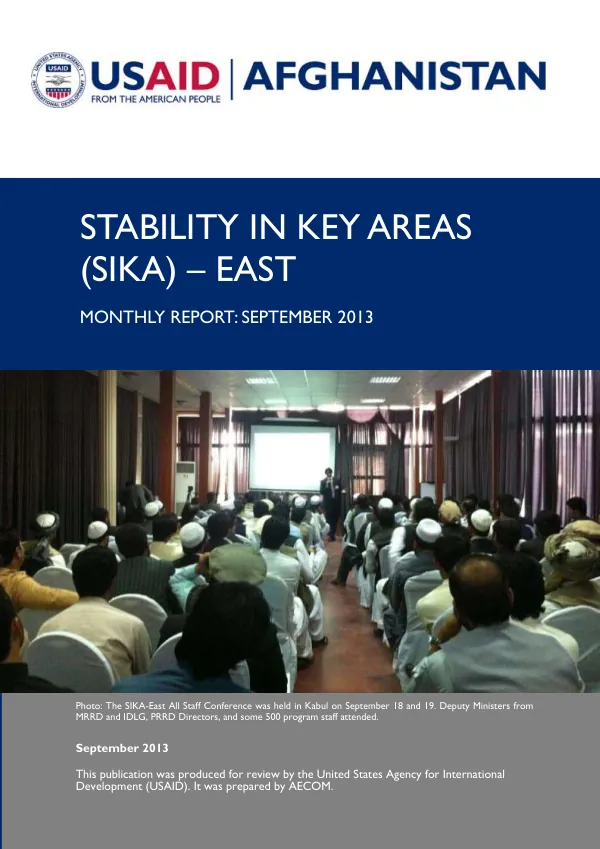
Stability in Key Areas (SIKA) - East Monthly Report: September 2013
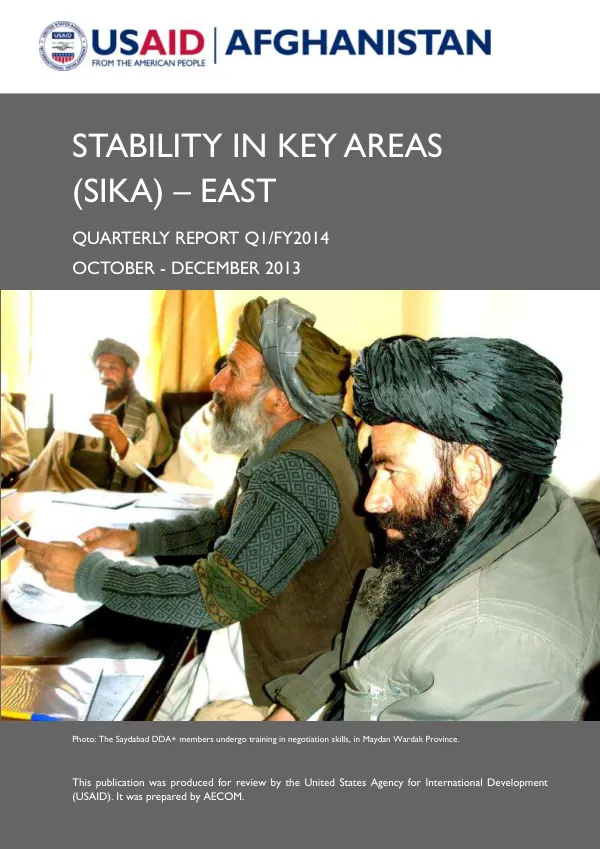
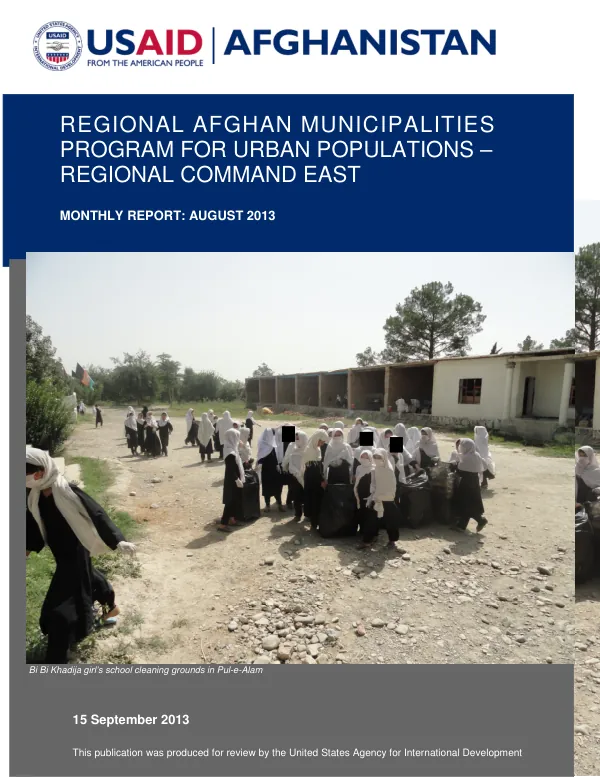
Stability in Key Areas (SIKA) - East is a program working to strengthen governance and service delivery in conflict-affected districts of southeastern Afghanistan.
2013 · 32 pages
Sign in to readA free account is required to download.
Abstract
The program, launched in December 2011, aims to promote good governance and service delivery in targeted districts, with the intended effects of promoting stability and reducing the impact of the insurgency. SIKA-East is implemented in collaboration with the Afghan Ministry of Rural Rehabilitation and Development (MRRD) and the Independent Directorate of Local Governance (IDLG). The program's primary objective is to promote good governance and service delivery in targeted districts through capacity building with MRRD and IDLG in the areas of intervention. To achieve this objective, SIKA-East conducts a wide-ranging stability-focused capacity building program for expanded District Development Assemblies (DDA), or so-called DDA Plus (DDA+). The DDA+ enables districts to identify, analyze, and monitor sources of instability and their root causes, develop and execute strategic plans to address the root causes of instability, and forge alliances and generate public activism to raise awareness about and advocate for district stability. Complementing capacity building, SIKA-East offers grants to district entities to enhance service delivery and assist implementation of stability-focused initiatives. These grants are predominantly small-scale infrastructure projects intended to mitigate the identified sources of instability. The result is a sound, local-level analysis of district instability dynamics, coupled with a ground-up plan of interventions to remedy it, local capacity to implement and manage it, and governmental ability to effectively communicate the challenges and the results to their constituents. As of September 30, the program was active in 20 districts in five provinces in southeastern Afghanistan: Ghazni, Khost, Logar, Maydan Wardak, and Paktya. The launch for the remaining 21st district, as per the SIKA-East Work Plan, was readied and set for early October. Over 70% of SIKA-East senior managers are Afghan nationals, serving as unit directors and department managers. Of SIKA-East's 564 staff members, 97% are Afghans, including 7% women. Field staff are embedded within Provincial Rural Rehabilitation and Development (PRRD) and District Government offices at provincial and district levels, respectively. In September, the program reached a major benchmark and significantly increased its stabilization reach by rolling out operations in four new districts: Jaghatu and Qarabagh in Ghazni Province, Jalrez in Maydan Wardak Province, and Ahmad Abad in Paktya Province. With the final district, Mando Zayi in Khost Province, set to launch at the beginning of October, SIKA-East will be operational in all 21 districts of five provinces in southeastern Afghanistan. SIKA-East attained several major benchmarks and results in the course of the reporting period. The program launched in four new districts, conducted 56 capacity building sessions across the districts, trained 1,246 men and 836 women in stability, resource mobilization, and outreach skills, and prepared eight District Project Portfolios (DPPs). Thirteen grants in line with the DPPs were awarded, totaling $783,222. The first six SIKA-East grants completed in Mohammad Agha and Saydabad districts. Cumulative results show that the program is active in 20 of the 21 planned districts of Southeast Afghanistan, with 20 DDAs+ formed, nine DPPs and seven District Communications Plans approved. Some 300 stability-focused trainings were conducted for 8,400 men and 2,600 women, 516 of whom are governmental officials. A total of 79 grants were awarded in value of $3,422,395, providing 126,279 individual work days to local communities.