USAID DEC
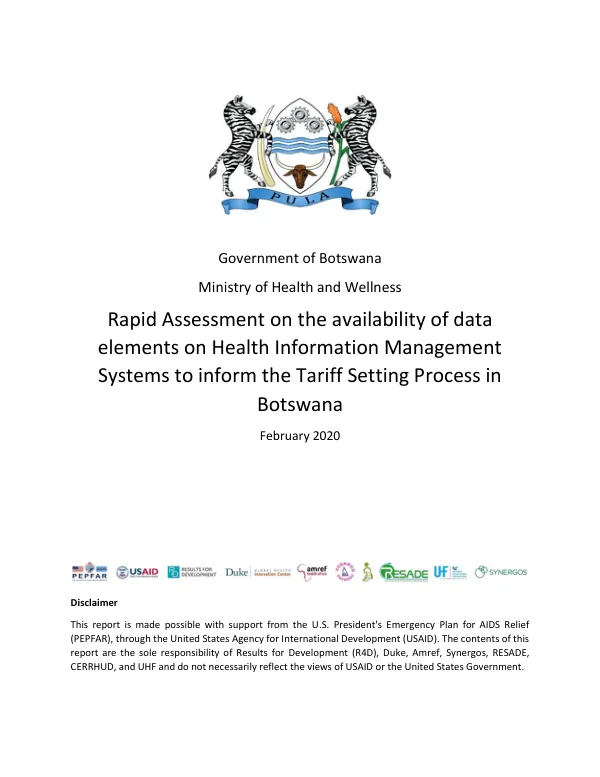
Rapid Assessment on the availability of data elements on Health Information Management Systems to inform the Tariff Setting Process in Botswana
Sign inRESULTS FOR DEVELOPMENT
Rapid Assessment on the availability of data elements on Health Information Management Systems to inform the Tariff Setting Process in Botswana
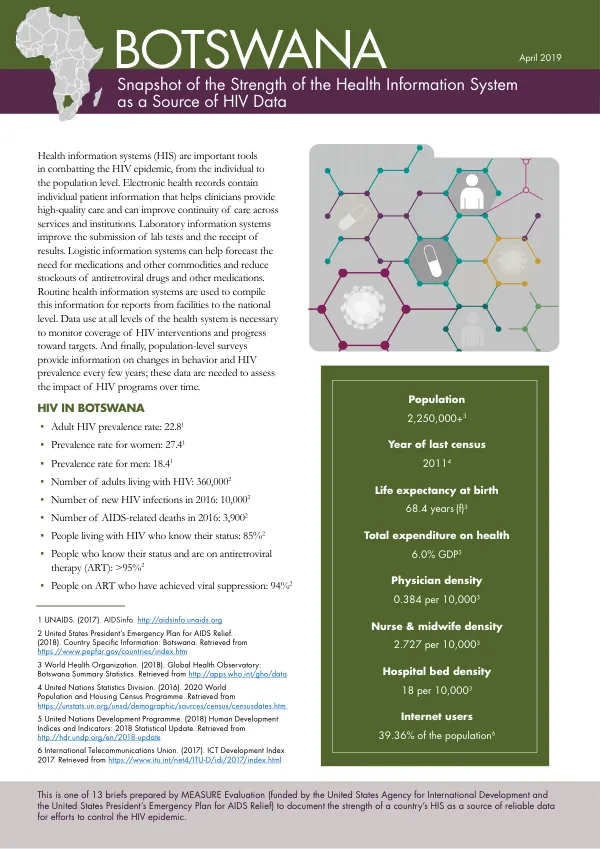
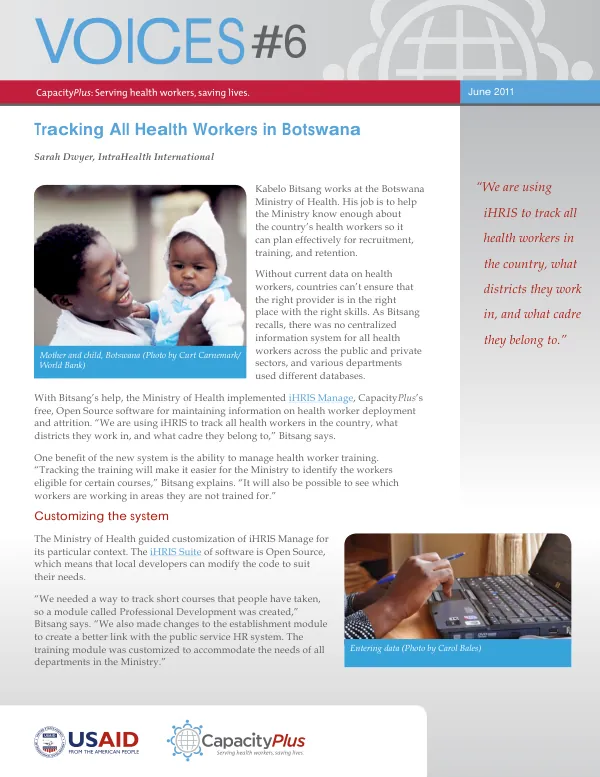
The Government of Botswana's Ministry of Health and Wellness undertook a rapid assessment of the availability of data elements on Health Information Management Systems to inform the Tariff Setting Process in Botswana.
2020 · 36 pages
Sign in to readA free account is required to download.
Abstract
The assessment aimed to identify the minimum data set elements necessary for the tariff system across the main Health Information Management Systems in the public and private sectors. The rapid assessment was conducted from August to September 2019 in both public and private facilities, with a total of 67 sites surveyed. The assessment focused on the main Health Information Management Systems, including the Integrated Patient Management System (IPMS) and Patient Information Management System (PIMS), in selected public facilities within selected health districts. In addition, an assessment of data elements in selected private hospitals and Medical Aid Schemes was undertaken. An additional assessment was conducted at MoHW units to determine their complementary efforts towards the management of the Health Information Management Systems. The data currently held in the Botswana healthcare system contains the minimum needed data elements and offers a usable foundation for commencing a tariff setting and payment simulation program. However, the data is of variable formats, precision, and completeness. To utilize this data effectively, a clear program of data standard setting and data quality improvement must be put in place as clear milestones and integral components of the implementation program. Demographic data was found to be available and mostly captured electronically in 93-100% of public facilities and private hospitals. However, only 40% of clinics and health posts capture data electronically in IPMS/PIMS, with the rest using manual methods. The assessment also identified areas of improvement, including the need for data standardization and quality improvement. The rapid assessment provides evidence on the availability of data to inform the tariff setting roadmap exercise and points to areas of improvement. The findings of the assessment will inform the development of a national reference tariff system and ensure a fair payment system for health services in Botswana. The assessment highlights the importance of data standardization and quality improvement in ensuring the effective use of data for tariff setting and payment simulation. The assessment also identified the need for a clear program of data standard setting and data quality improvement to be put in place as clear milestones and integral components of the implementation program. This will ensure that the data held in the Botswana healthcare system is of high quality and can be used effectively to inform the tariff setting process. The findings of the assessment will inform the development of a national reference tariff system and ensure a fair payment system for health services in Botswana. The Ministry of Health and Wellness units, including the Health Statistics Unit, IT unit, Monitoring and Evaluation Unit, and Data Warehouse, play a crucial role in the management of the Health Information Management Systems. The assessment found that these units have complementary efforts towards the management of the Health Information Management Systems, including data collection, analysis, and reporting. However, the assessment also identified areas of improvement, including the need for data standardization and quality improvement. Overall, the rapid assessment provides valuable insights into the availability of data elements on Health Information Management Systems in Botswana. The findings of the assessment will inform the development of a national reference tariff system and ensure a fair payment system for health services in Botswana. The assessment highlights the importance of data standardization and quality improvement in ensuring the effective use of data for tariff setting and payment simulation.