USAID
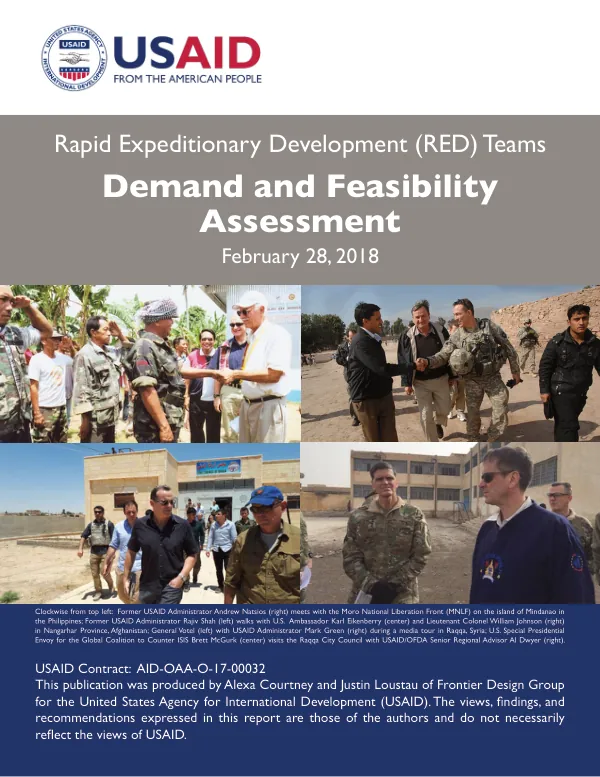
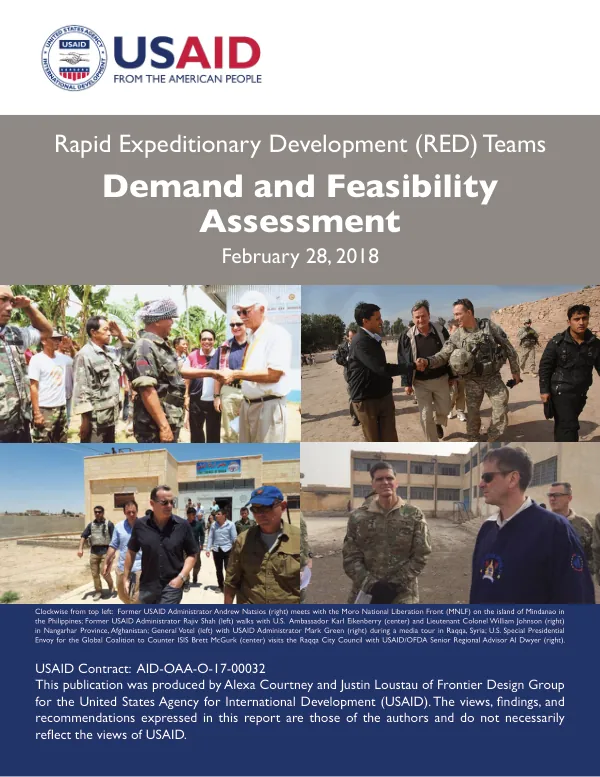
Rapid Expeditionary Development (RED) Teams Demand and Feasibility Assessment
The Rapid Expeditionary Development (RED) Team concept was proposed by the United States Agency for International Development (USAID) Global Development Lab to address the absence of civilian personnel with mission-critical skillsets in non-permissive environments (NPEs).
2018 · 75 pages
Sign in to readA free account is required to download.
Abstract
The concept involves deploying two-person RED Teams to work alongside local communities and interagency partners in extremis conditions. These teams would be composed of development officers with expertise in social movement theory, counter-network analysis, and community engagement. The RED Team concept aims to provide a new expeditionary development capability to counter violent extremist organizations (VEOs) in NPEs. The teams would be deployed farther forward than traditional USAID personnel and would operate under the authority of the host agency. RED Team members would be able to design, fund, and implement activities immediately in response to urgent and pressing requirements. Frontier Design Group was commissioned by the Lab to conduct research gauging the demand, desirability, and feasibility of the proposed RED Team concept. The report explores whether and to what extent a demand exists among non-traditional USG partners for a new expeditionary development capability to counter VEOs in NPEs. The report also examines the feasibility of the notional capability to include priority enablers and inhibitors for USAID's future consideration. The report documents critical opinions about the demand for and feasibility of the proposed capability from Special Operations Forces, Intelligence Community, and USAID perspectives. Virtually everyone consulted to gauge interagency demand for the proposed RED Team concept shared a widespread sentiment that the USG is woefully underperforming in non-permissive and denied environments. Senior leaders from across the USG expressed their dissatisfaction with the status quo of expeditionary civil-security/military platforms and their belief in the possibility of a better way. The report provides recommendations on key champions and influencers USAID might approach to advance the RED Team concept and field an initial pilot. The decision makers identified in this document have access to theaters/countries/commands, and discretionary funds that could support a pilot, and the power to operationalize RED Teams if they believe in the concept and in USAID's ability to deliver. Frontier also suggests several funding and prototype pathways for USAID to consider in specific geographies. The RED Team concept offers several potential benefits, including providing USAID with a direct, government-to-government reporting channel from denied environments to inform national security dialogue in Washington. RED Team members could also become "super enablers" by re-creating USAID's long-lost "doing capacity" and leveraging its talent and many assets after returning from deployment. This model offers another tool in USAID's toolkit and further diversifies the distinct yet complementary approaches that can be leveraged in NPEs by its officers.