USAID DEC
Rapport de Formation GEMS: Atelier USAID/Haïti sur la Conformité et les Régulations Environnementales
Sign inUSAID
Rapport de Formation GEMS: Atelier USAID/Haïti sur la Conformité et les Régulations Environnementales
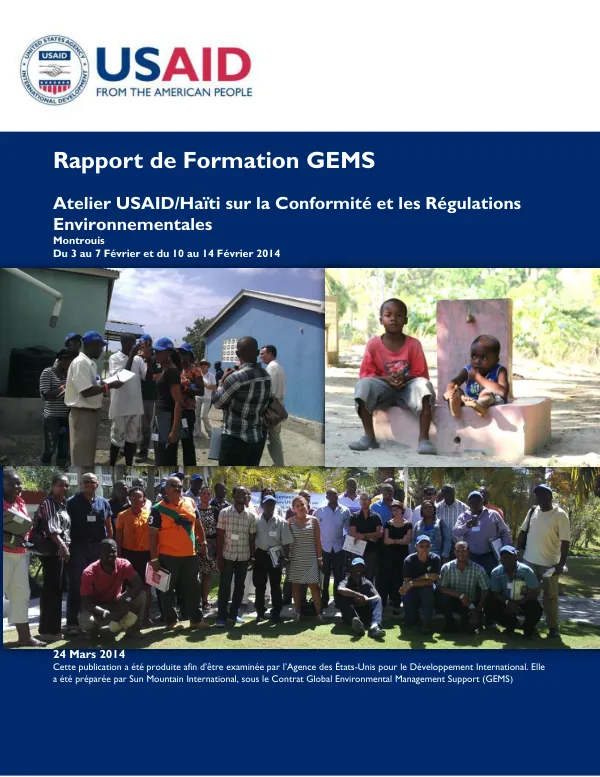
The USAID/Haïti Conformity and Environmental Regulations Workshop was held in Montrouis, Haïti, from February 3 to 7, 2014, and from February 10 to 14, 2014.
2014 · 67 pages
Sign in to readA free account is required to download.
Abstract
The workshop was designed to assist the USAID/Haïti team and their partner organizations in improving the quality and efficiency of their development programs. The workshop aimed to help participants identify, mitigate, and supervise environmental impacts of development projects under the authority of Title 22 of the Federal Regulations, Part 216, also known as 22 CFR 216 of USAID, as well as the internationally recognized environmental analysis framework. The workshop was a success, and the organizers would like to thank the presenters from USAID, the Ministry of Environment of the State University of Haïti, and Jeanne-Josette Acacha Akoha for their efforts and hard work in preparing the presentations. The planning and execution of the sessions would not have been possible without their professionalism, expertise, and commitment. The organizers would also like to thank the FLASSEF organization from the village of Ravine Sèche, the Moulin sur Mer hotel, the Saint Nicholas de Saint Marc reference hospital, the Victor Binkley hospital of Pierre Payen, and the WINNER and PSH projects for providing support and resources for the workshop. The workshop had several objectives, including: 1. To strengthen the capacity of participants to conduct high-quality environmental studies. 2. To help ensure the integration of environmental sound design and management (ESDM) elements into ongoing and future works. 3. To assist the USAID team, beneficiaries, contractors, and partner organizations in better understanding Regulation 216. 4. To promote collaboration, information exchange, and the creation of networks for key issues. To achieve these objectives, the workshop included group exercises and on-site case studies. The workshop was designed to provide participants with the knowledge and skills necessary to implement and monitor environmental best practices, evaluate development activities, and design more sustainable and effective programs. The workshop was attended by participants from various organizations, including USAID, the Ministry of Environment, and partner organizations. The workshop was facilitated by a team of experts, including presenters from USAID, the Ministry of Environment, and Jeanne-Josette Acacha Akoha. The workshop covered a range of topics, including environmental impact assessments, environmental monitoring plans, and environmental assessments. The workshop also included sessions on environmental sound design and management, environmental regulations, and the internationally recognized environmental analysis framework. The workshop was a success, and the organizers would like to thank all the participants, presenters, and supporters for their contributions to the workshop. The workshop provided a valuable opportunity for participants to learn about environmental best practices, share experiences, and develop skills necessary to implement and monitor environmental projects. The workshop was designed to promote collaboration, information exchange, and the creation of networks for key issues. The workshop provided a platform for participants to discuss environmental challenges, share experiences, and develop solutions to environmental problems.