USAID DEC
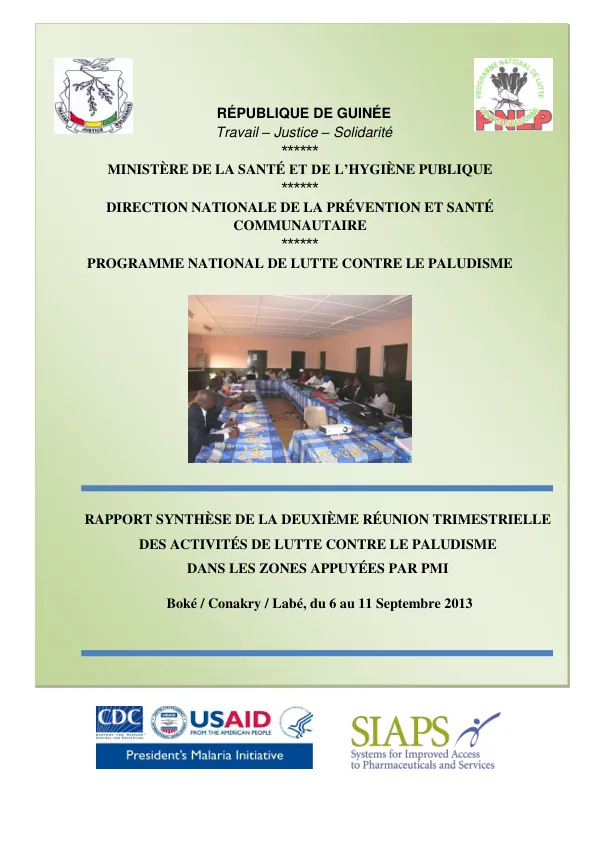
Rapport Synthèse de la Deuxième Réunion Trimestrielle des Activités de Lutte Contre le Paludisme dans les Zones Appuyées par PMI
Sign inSYSTEMS FOR IMPROVED ACCESS TO USAID-FUNDED PHARMACEUTICALS AND SERVICES
Rapport Synthèse de la Deuxième Réunion Trimestrielle des Activités de Lutte Contre le Paludisme dans les Zones Appuyées par PMI
The Programme National de Lutte contre le Paludisme (PNLP) in Guinea is a national initiative aimed at combating malaria.
2013 · 131 pages
Sign in to readA free account is required to download.
Abstract
The PNLP is supported by the Initiative Présidentielle Américaine de Lutte contre le Paludisme (PMI) and the United States Agency for International Development (USAID). The initiative focuses on improving access to malaria prevention and treatment services, particularly in areas with high malaria transmission. The PNLP operates in three regions: Boké, Conakry, and Labé. Each region has a regional director of health, who is responsible for coordinating the malaria control activities in their respective region. The regional directors are supported by a team of health professionals, including pharmacists, statisticians, and health officers. The PNLP has implemented several interventions to control malaria, including the distribution of insecticide-treated bed nets, the use of artemisinin-based combination therapies (ACTs), and the implementation of indoor residual spraying (IRS). The initiative also focuses on improving the capacity of health facilities to provide malaria diagnosis and treatment services. The PNLP has established a system for monitoring and evaluating the effectiveness of its interventions. The system includes regular reporting of malaria cases, treatment outcomes, and stock levels of malaria prevention and treatment commodities. The PNLP also conducts regular assessments of the quality of malaria services provided by health facilities. The PNLP has made significant progress in reducing malaria cases and deaths in Guinea. According to the PNLP's reports, the number of malaria cases has decreased by 30% since the initiation of the program. The program has also improved the availability of malaria prevention and treatment commodities, particularly in areas with high malaria transmission. The PNLP has also established a system for quality control and assurance, which includes regular monitoring of health facilities and the provision of technical support to improve the quality of malaria services. The program has also established a system for reporting and responding to malaria outbreaks, which has helped to reduce the impact of outbreaks on the population. The PNLP has received support from various partners, including the World Health Organization (WHO), the United Nations Children's Fund (UNICEF), and the Global Fund to Fight AIDS, Tuberculosis and Malaria. The program has also received technical assistance from the Centers for Disease Control and Prevention (CDC) and the World Bank. The PNLP has made significant contributions to the reduction of malaria cases and deaths in Guinea. The program's interventions have improved access to malaria prevention and treatment services, particularly in areas with high malaria transmission. The PNLP's system for monitoring and evaluating the effectiveness of its interventions has also helped to identify areas for improvement and to inform policy decisions. The PNLP's success has been recognized by the government of Guinea, which has committed to continuing the program beyond the current funding period. The program's impact has also been recognized by the international community, which has provided additional funding and technical assistance to support the program's continued success. The PNLP's experience has also been shared with other countries in the region, which have expressed interest in adopting similar approaches to controlling malaria. The program's success has also been recognized by the WHO, which has recognized Guinea as a model for malaria control in the region. The PNLP's continued success will depend on the availability of funding and technical assistance. The program will also need to continue to adapt to changing circumstances, including the emergence of new malaria strains and the availability of new malaria prevention and treatment technologies.
Related documents