USAID DEC
Re-analysis and interpretation of 2011 Liberia malaria indicator survey data to provide project-specific estimates for select malaria indicators
Sign inJHPIEGO
Re-analysis and interpretation of 2011 Liberia malaria indicator survey data to provide project-specific estimates for select malaria indicators
The Rebuilding Basic Health Services (RBHS) project, a partnership led by JSI Research and Training, aimed to support Liberia's Ministry of Health and Social Welfare.
2012 · 1 pages
Sign in to readA free account is required to download.
Abstract
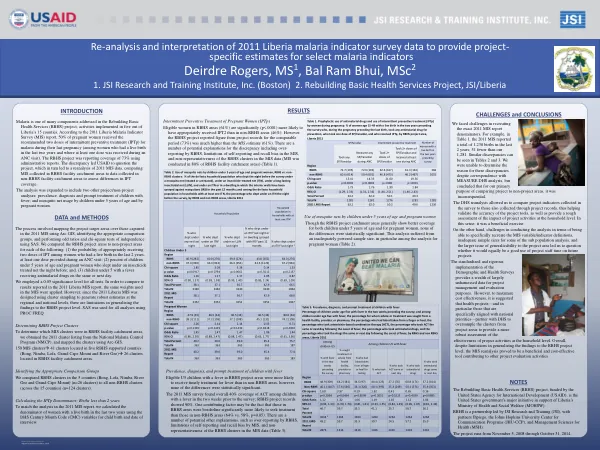
Funded by the United States Agency for International Development (USAID), the project ran from November 5, 2008, through October 31, 2014. The project's primary focus was on improving malaria control and prevention services in five out of Liberia's 15 counties. According to the 2011 Liberia Malaria Indicator Survey (MIS) report, 50% of pregnant women received the recommended two doses of intermittent preventive treatment (IPTp) for malaria during their last pregnancy. However, the RBHS project reported a higher coverage of 73% using administrative reports. This discrepancy led to a reanalysis of the 2011 MIS data to assess differences in IPT coverage between RBHS facility catchment areas and non-RBHS areas. The analysis compared RBHS project areas to non-project areas for three key indicators: IPT coverage among pregnant women, mosquito net usage by children under 5 years of age and pregnant women, and prevalence, diagnosis, and prompt treatment of children with fever. The results showed that eligible women in RBHS areas were significantly more likely to have appropriately received IPT2 than in non-RBHS areas. However, the RBHS project reported figure from project records for the comparable period was much higher than the MIS estimate. The analysis also found that children under 5 years of age with fever in RBHS project areas were more likely to receive timely treatment for fever than in non-RBHS areas. However, none of the differences were statistically significant. The 2011 MIS survey found overall 40% coverage of ACT among children with a fever in the two weeks prior to the survey, while RBHS project records showed 90%. One contributing factor may be the fact that those in RBHS areas were borderline significantly more likely to seek treatment than those in non-RBHS areas. The study faced challenges in recreating the exact 2011 MIS report denominators, resulting in discrepancies between the reported totals and the calculated values. Despite correspondence with MEASURE DHS analysts, the reason for these discrepancies could not be determined. The study concluded that for the primary analysis, the discrepancies did not significantly impact the results.
Related documents